Get Full Government Meeting Transcripts, Videos, & Alerts Forever!
Get email alerts on the Comprehensive Plan topic
No spam. Unsubscribe anytime.
Plantation staff previews draft comprehensive plan, emphasizing TOD, housing affordability and resilience
Summary
Planning staff presented an initial draft of a 20‑year comprehensive plan (labeled '02/1945'), outlining updates to future land use, transportation and housing elements with a focus on transit‑oriented development, sustainability, equity and incentives for affordable housing. Board members scheduled additional review sessions.
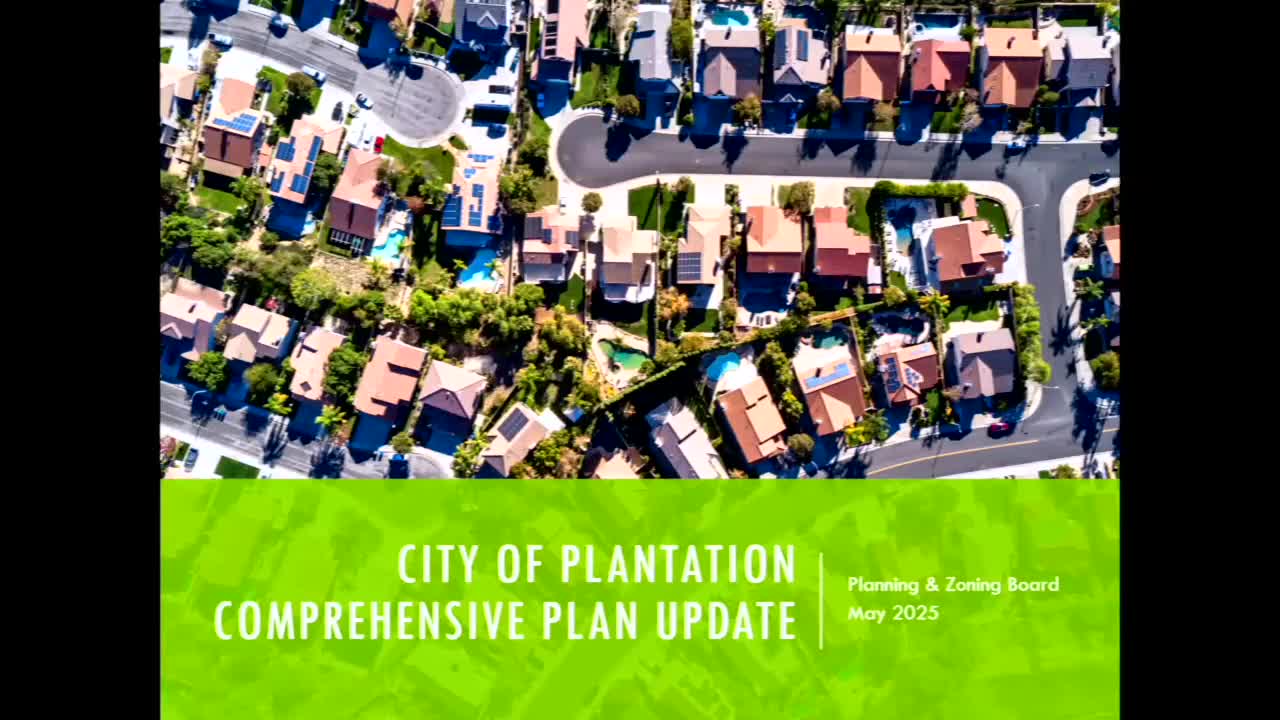
Dan Holmes, the city’s Planning, Zoning and Economic Development Director, presented a preliminary draft of Plantation’s updated comprehensive plan on Wednesday, describing a 20‑year policy framework that would guide land use, transportation and housing decisions through 2045.
Holmes told the Planning & Zoning Board the draft — described as a “first preliminary draft” — reorganizes the plan for usability, aligns city policies with recent state and Broward County requirements and adds new emphases on transit‑oriented development (TOD), sustainability and housing affordability. "A comprehensive plan is basically a state‑required long‑range policy document guiding the physical, the economic and the social development for the city," Holmes said, framing the document as a vision for growth and a tool for infrastructure and budget planning.
What’s new Staff highlighted multiple shifts from the city’s existing plan: - Structure and clarity: each element has its own numbering to make policies easier to find; objectives are grouped by theme to speed review. - Smart growth and TOD: stronger support for mixed‑use, infill and transit‑oriented development along corridors such as Sunrise Boulevard and Broward Boulevard; the plan encourages shared parking, reduced parking minimums and activity centers for areas such as Midtown. - Housing affordability: incentives such as density bonuses, a unified flex‑unit approach, accessory dwelling units (ADUs) and an allowance to count studio/efficiency units of 500 sq. ft. or less as 0.5 dwelling units for density calculations. - Transportation and mobility: an emphasis on complete streets, micro transit and multimodal design; staff said the city plans to launch a micro‑transit pilot and to coordinate with Broward County on safety and transit expansions. - Resilience and equity: the draft adds climate resilience policies (flood mitigation, green infrastructure and elevation standards), equitable access to services and attention to special‑needs and recovery‑community housing.
Staff cautioned that the draft is intentionality preliminary. Holmes said the plan will move through additional board reviews — sustainability, affordable housing and development review committees — and that staff will refine policies before formal adoption. The director also noted the plan must reflect recent statutory changes, such as the state’s Live Local Act, and align with county future‑land‑use policies.
Public feedback and board questions Board members and attendees asked about details and implementation: whether city infrastructure (water and sewer) can support higher Midtown densities, how the city will manage upgrades to older utility systems, and how to avoid ad‑hoc infrastructure replacements by private developers. Holmes said the comprehensive plan is intended to guide capital improvement planning and that an updated impact‑fee study and CIP would be used to sequence infrastructure upgrades and share costs.
Members asked how activity centers and rezoning would be handled. Holmes said an activity‑center approach for Midtown is under consideration and that building form (height, floor‑area ratio and setbacks) would remain governed by zoning regulations. The board scheduled follow‑up review sessions; the board and staff agreed on a special Planning & Zoning meeting for June 17 to continue the review.
Next steps Holmes said staff will gather feedback from board meetings and from other city advisory boards, revise the draft and return for formal recommendation to the City Council. He described the current draft as a working document and encouraged continued public comment and technical review by city departments before the city advances formal adoption.