Get Full Government Meeting Transcripts, Videos, & Alerts Forever!
Get email alerts on the Cemetery Policies topic
No spam. Unsubscribe anytime.
Saratoga Springs council reviews cemetery rules: hours, decorations, burial rights and pricing
Summary
Saratoga Springs city officials spent a multi-hour work session reviewing a draft cemetery policy that would set public hours, limit certain decorations, establish rules for buying and reselling burial rights, and define how the city will price plots and manage future capacity.
Saratoga Springs city officials spent a multi-hour work session reviewing a draft cemetery policy that would set public hours, limit certain decorations, establish rules for buying and reselling burial rights, and define how the city will price plots and manage future capacity.
The council and staff agreed to start with public access from 6 a.m. to 10 p.m., continue to evaluate enforcement needs with police patrols and possible camera options, and to prohibit burials on major holidays while permitting Saturday burials under an overtime/fee arrangement and with advance notice. Councilmembers Michael and Jim agreed to work with staff on a recommended fee schedule to return to the council for adoption.
Why it matters: the policies will shape how the new municipal cemetery operates, how residents may visit and decorate graves, and how the city manages long-term maintenance funding through a perpetual care/endowment approach. The rules also affect capacity planning — whether the city encourages or discourages double-depth graves will change how many interments the site can hold.
Most immediately, staff asked the council for direction on hours and fee/operational policies so a draft fee schedule can be ready for a June decision and for booking appointments at an upcoming public event. Councilmembers gave several targeted directions but no final ordinance or fee schedule was adopted at the session.
What council discussed and directed
Public hours and enforcement: Staff presented a draft matching park hours (6 a.m.–10 p.m.). Council members debated alternatives (dusk-to-dawn or sunrise-to-sunset) citing cultural practices, safety and enforcement limits. The group settled on starting with 6 a.m.–10 p.m. with an instruction for police to include drive-through checks and for staff to report back on enforcement and whether cameras or license-plate readers should be considered.
Weekend and holiday burials: The council discussed whether to offer Saturday burials (common in some jurisdictions for an extra fee) and unanimously agreed to allow Saturday burials as the exception rather than the rule, with fees intended to cover overtime and staffing costs and with at least 48 hours’ notice required under current policy language. Members were clear that burials should not take place on major holidays (for example, Memorial Day) because of the logistical conflict with holiday decorations and high visitation.
Decorations and maintenance: Council supported a policy that restricts loose vases and most objects on flat markers because they interfere with mowing and damage equipment; upright markers with in-slab vases would be treated more leniently. Staff will clarify that decorative items left in the grass or on flats may be removed during routine maintenance (the draft policy proposes clearance "within a week" or at the crew's discretion after holidays) and that volunteers (for example, veterans’ groups) will be expected to assist with seasonal cleanup.
Limits and transfers of burial rights: Council discussed resale and speculation risks. Staff proposed restricting transfers (so burial rights are not freely traded as investments) and selling rights first to residents, with a nonresident fee. Council directed staff to draft rules that (a) limit how many burial rights an individual household may purchase (council discussion landed on a starting limit in the single digits — council suggested six as a baseline with exceptions if proof of need is shown), (b) make burial rights nontransferable for a short initial hold period (example raised: two years), and (c) require the city to buy back unused burial rights at current market rate with a transaction fee to cover administrative costs.
Double-depth (companion) burials and capacity: Staff reported that test borings in the new site show clay soils favorable to double-depth burials, but council heard warnings about collapse risk, vault shoring constraints and monument size limits. The council directed staff to open phase 1 as single-depth with the option to require or encourage double-depth in future phases depending on inventory and soil conditions; staff and the Sexton will return with pricing and operational guidelines for any double-depth program. Technical details mentioned during discussion: the draft notes typical double-depth openings are significantly deeper (speakers cited roughly 12–14 feet for some double openings) and that shoring equipment dimensions can be a constraint (one contractor’s shoring units measured about 45 inches versus a typical grave width of 42 inches).
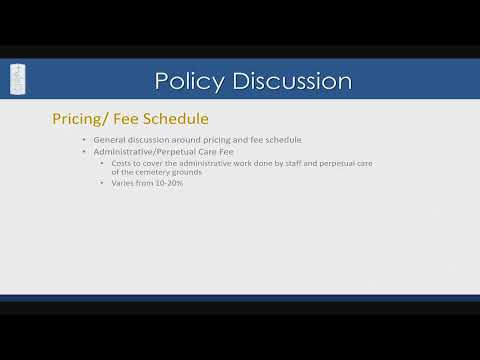
Pricing and perpetual care: Staff said pricing must balance affordability and long-term sustainability of the cemetery’s perpetual care (endowment) fund so maintenance is not subsidized by the city general fund for future generations. The council asked staff to develop a pricing schedule that: differentiates resident/nonresident rates, sets higher prices for plots that allow upright monuments, prices cremation/columbarium options to encourage appropriate use of urn spaces, and offers a modest early-adopter incentive for residents to seed the perpetual care fund. Councilmembers Michael and Jim agreed to work with staff and a consultant on the fee structure.
Other operational points and next steps: the council asked staff to (a) make the draft policy document available to council members for review, (b) return with a refined fee schedule in time for adoption before a planned public appointment event, and (c) prepare clearer language about decorations, liability waivers and disinterment procedures (staff said disinterments would follow existing chain-of-custody and funeral-director requirements and, where applicable, court orders). Staff will circulate the full draft policy and follow up on enforcement options and the proposed limits on purchase and resale of burial rights.
Attribution and speakers: the session included the mayor and multiple council members, staff members identified as Roland and a Sexton identified as Colton; Dan Cable (cemetery designer/consultant) and other city staff and councilmembers also contributed. Roland told the council the draft already contains significant liability-limitation language and staff would examine contractual language further; Sexton Colton described the soil test findings and said, "the soil up there is perfect for double deep," supporting staff study of double-depth feasibility.
What the council did not do: no final ordinance, fee schedule or formal vote occurred in the work session. The meeting produced direction to staff and two council liaisons to refine fees and return with a full package for formal action.
Ending note: Staff will circulate the full draft policy and a proposed fee schedule; councilmembers Michael and Jim will work with staff and the consultant on pricing and return the recommendation to the council for adoption in June or the next available council meeting.