Get Full Government Meeting Transcripts, Videos, & Alerts Forever!
Get email alerts on the Flood Control Budgets topic
No spam. Unsubscribe anytime.
Marin County adopts flood control and stormwater budgets; supervisors press for clarity on Zone 9 funding and operations
Summary
The Marin County Board of Supervisors on May 20 adopted baseline budgets for the Flood Control and Water Conservation District, approving countywide stormwater (Mixtop/MixedStop) and flood zone budgets while supervisors raised detailed questions about Zone 9 (Ross Valley) cash flow, Santa Venetia funding shortfall and ongoing maintenance costs.
The Marin County Board of Supervisors on May 20 conducted a public hearing and adopted baseline budgets for the Marin County Flood Control and Water Conservation District, encompassing the countywide stormwater program and eight flood zones.
Assistant Director Vanessa Davidson introduced staff and said the district was created in 1953 under Appendix 68 of the Water Code to plan, fund, construct and maintain flood control projects. Rob Carson, stormwater program administrator, presented the countywide stormwater program (MixedStop), and Tracy Clay, Water Resources Division manager, presented the flood zone budgets and capital improvement projects.
Why it matters: The district operates and maintains pump stations, levees and creeks, funds capital projects to reduce flood risk and must balance rising operation and environmental compliance costs with limited local revenues. Supervisors focused questions on transparency of inflows and outflows, the future after expiring fee measures and how the county will pay for large capital projects while sustaining operation and maintenance.
Stormwater (MixedStop)
Rob Carson said the countywide stormwater program supports permit compliance, trash‑control planning and green infrastructure design. Key points:
- Budget: MixedStop proposed about $4.1 million in expenditures and roughly $4.0 million in revenue for FY2025–26, with a modest draw on reserves. - Grants and construction: The draft budget includes roughly $2.5 million in current EPA grant funding for trash‑capture projects; staff said larger device projects are moving through design in multiple municipalities. - Regulatory change: Draft statewide Phase II stormwater permit language and new mandates (asset management, cost reporting, enhanced monitoring, TMDL implementation) are increasing program costs; staff said member agency contributions will rise and the budget reflects a roughly 30% increase in non‑grant expenditures and a 37% increase in member contributions compared with prior years.
"Mixed stop also manages most aspects of the band aided pollution pollutant specific control programs known as total maximum daily loads or TMDLs," Carson said, describing the programrole coordinating countywide work.
Flood zones and capital projects
Tracy Clay said the district includes eight flood zones, collectively responsible for more than $100 million in flood control infrastructure, with 13 active CIP projects totaling about $121 million and five projects exceeding $10 million each. Clay highlighted O&M demands including 18 pump stations housing 52 pumps and roughly 37 miles of creeks and channels that receive annual vegetation and sediment management.
Notable CIP projects cited by staff:
- Deer Island tidal marsh restoration (Flood Zone 1, Novato Baylands): estimated project total $11.4 million; mostly grant funded; construction planned next year. - Cardinal Road levee (Zone 3, Richardson Bay/Tam Valley): preliminary estimate $4.6 million; construction targeted for 2027. - Santa Venetia flood wall (Zone 7): preliminary cost estimate around $30 million; only about $37,000 in current fund balance for the zone; project would affect 112 parcels and require about three years for right‑of‑way acquisition after funding is secured. Staff said the zone faces a significant funding shortfall and staff are exploring a potential special assessment to supplement grants and local funds. - Lower Corte Madera Creek habitat restoration (Zone 9, Ross Valley): estimated $3.5 million; staff said the project is out to bid with construction expected this fall.
Operations and emerging issues
Clay and other staff emphasized that aging infrastructure, increasing regulatory mitigation and monitoring requirements, and rising emergency maintenance needs have driven higher ongoing costs. Clay said certain post‑construction mitigation monitoring obligations are substantial: "Post construction management of mitigation plantings, required for the FDS is estimated to cost more than a half a million dollars."
Cash flow and Ross Valley fee measure
Staff presented a two‑year cash flow analysis for Flood Zone 9 (Ross Valley) that reflects near‑term capital work tied to the Ross Valley fee measure, which staff noted has a 20‑year life and will end after calendar year 2027. The zone showed a projected use of fund balance to meet CIP needs; after accounting for anticipated grant revenues and planned CIP expenditures, staff estimated a post‑project ending fund balance of about $1.4 million, leaving only modest reserves once major projects complete.
Supervisor concerns and requests for clarity
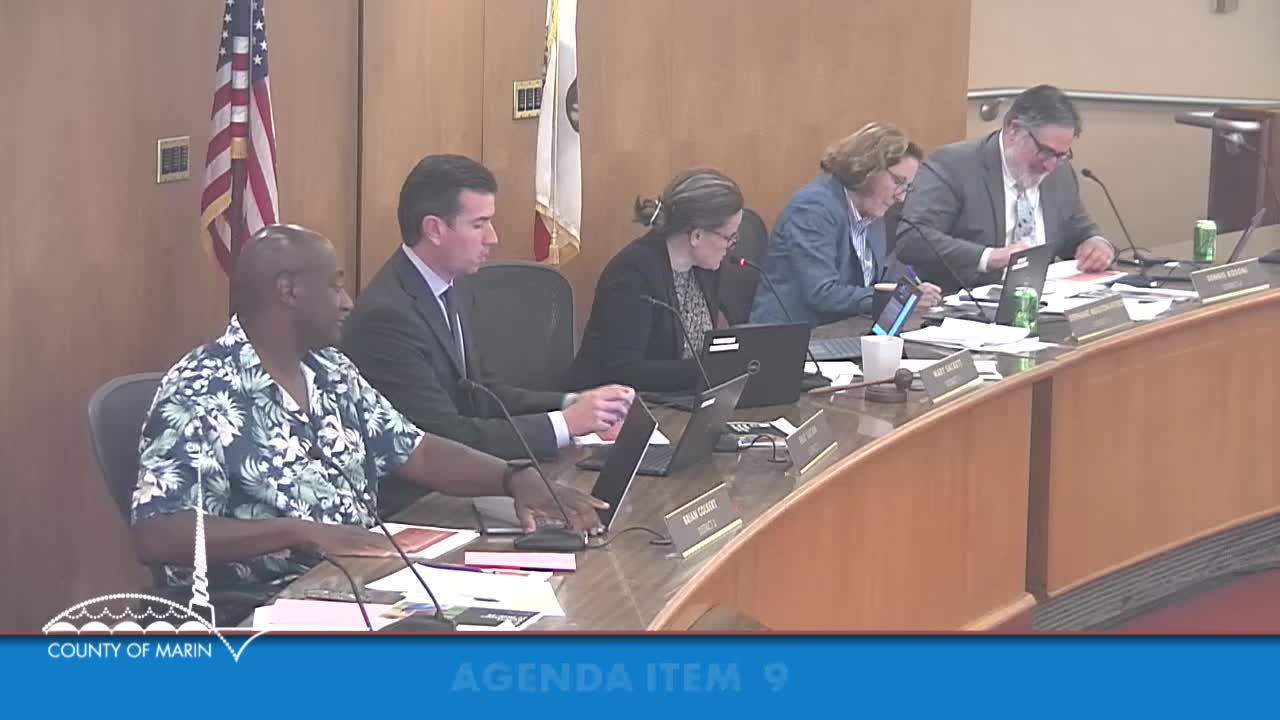
Several supervisors used the hearing to press staff for clearer, zone‑level transparency. Supervisor Colbert said the district must better explain inflows and outflows and asked for a clearer account of how fee revenues have been spent historically. Supervisor Culver asked for clearer breakdowns showing what is being spent on routine O&M versus capital projects and for zone‑by‑zone rollups in future materials. Supervisor Milton Peters, Supervisor Rodoni and others urged staff to present a strategy for easement acquisition and for delivering projects before fee expirations.
"We will have another opportunity in mid‑July to talk about the Ross Valley fee measure," Davidson said; staff agreed to return with more detailed zone‑by‑zone cash flows and options.
Board action
Following the presentations, a motion to adopt the Flood Control and Water Conservation District baseline budgets was made and seconded and the board voted to approve the budgets.
What to watch
- Santa Venetia: staff said the project faces a large funding gap and a long right‑of‑way timeline; temporary measures and maintenance costs continue while a financing strategy is developed. - Ross Valley (Zone 9): the fee measure expires in 2027; staff committed to returning with detailed scenarios for operating and maintaining newly constructed facilities after project completion. - MixedStop and state permits: evolving statewide permit language and court decisions could affect timing and scope of new mandates and member contributions.