Get Full Government Meeting Transcripts, Videos, & Alerts Forever!
Get email alerts on the Governance Organization topic
No spam. Unsubscribe anytime.
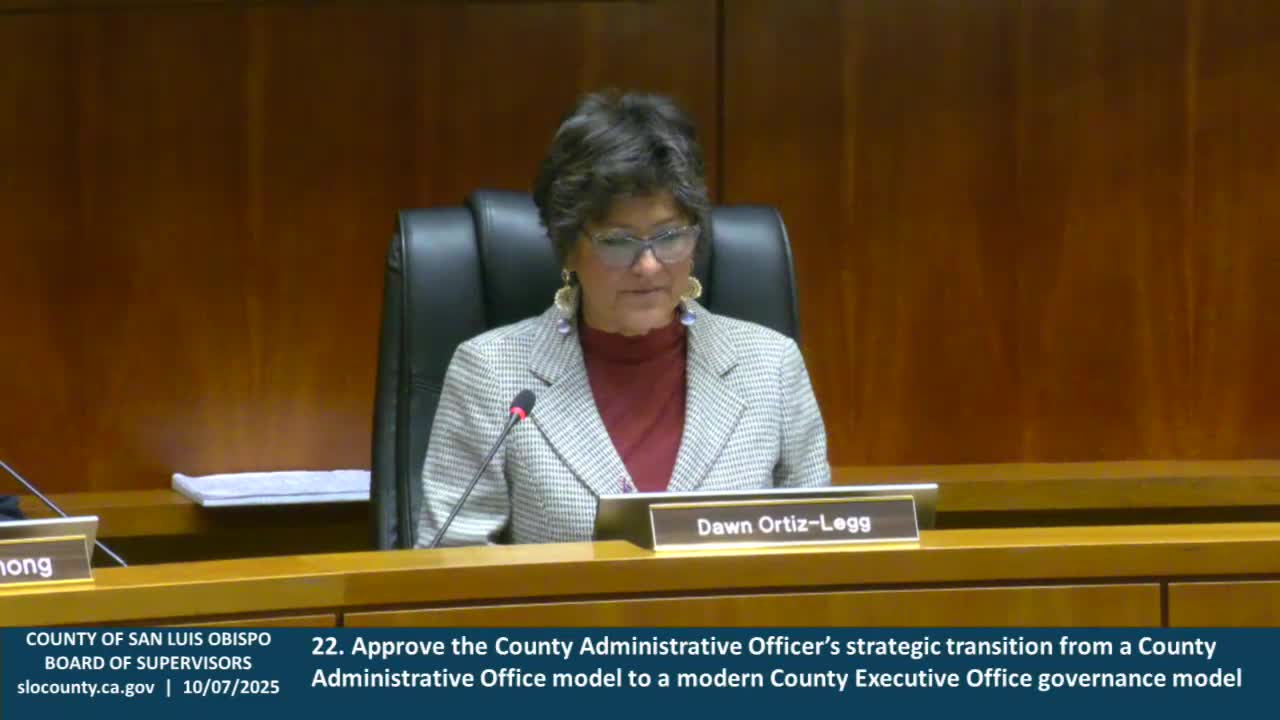
Board approves reorganization: county moves toward CEO-style model, folds Central Services into Administrative Office
Summary
Supervisors voted unanimously to reorganize the county administrative structure, adding an assistant county administrative officer and moving Central Services into the Administrative Office. The change is intended to improve coordination, strategic planning and communications across departments.
The San Luis Obispo County Board of Supervisors voted Oct. 8 to reorganize the county’s executive functions and fold the Central Services department into the County Administrative Office, a shift staff said will improve coordination, strategic planning and communications.
The board approved a resolution that (1) transitions the county from its current County Administrative Officer (CAO) model toward a CEO-style organizational approach, (2) reorganizes Central Services into the Administrative Office, and (3) amends the county’s position allocation lists to add 1 full-time equivalent assistant county administrative officer while graying out one division manager slot and deleting the Central Services director position.
Administrative Officer Matt Pontes told the board the reorganization groups related divisions under three assistant county administrative officers — municipal services, health and human services, and internal support — to increase alignment between board priorities and department operations. Pontes said the change is intended to help the county track board direction, improve cross-department communications and provide additional capacity for strategic initiatives.
“Transitioning to the CEO model fully increases alignment and accountability with the board, my office, and the departments,” Pontes said during the presentation. The plan also asks HR to standardize communications-related classifications and launch improved internal processes for circulating information across departments.
Discussion among supervisors ranged from support for added capacity to requests for an early study session to set clear board expectations and responsibilities. Supervisor Gibson said the success of any model depends on the board and county leadership agreeing on roles and expectations: “For any of these models to work ... it’s gonna require a clear understanding of our roles, responsibilities, and our expectations,” he said.
The board voted 5–0 to approve the measures. Supervisor Prashon moved the staff recommendation and Supervisor Paulding seconded. Staff said some ordinance and classification changes will follow in the coming months to align titles and duties with the new structure.
What happens next: The county will implement the position changes and create the ACO roles; HR will review communications classifications and a staff-led group will pursue a phased effort to standardize public information practices across departments. Staff indicated they will return with the ordinance and classification edits needed to formalize the structure.