Get Full Government Meeting Transcripts, Videos, & Alerts Forever!
Get email alerts on the Renewable Energy topic
No spam. Unsubscribe anytime.
Samsung outlines Pine Branch solar plan for Carroll County; supervisors raise airport, permitting concerns
Summary
Samsung C&T representatives presented a preliminary plan for the Pine Branch solar project to the Carroll County Board of Supervisors, describing a roughly 40-megawatt facility, permitting and interconnection timelines, economic estimates and decommissioning plans. Supervisors asked about FAA coordination and cultural and environmental reviews.
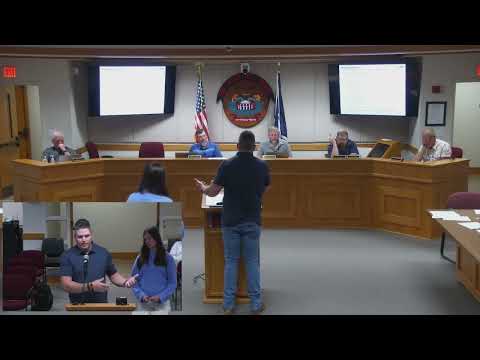
Madison Brandt, a project manager for Samsung C&T, and Chris Simmons, Samsung C&T America's development manager, presented the Pine Branch solar project to the Carroll County Board of Supervisors during the board's June meeting.
The developers described the site as roughly 8 miles from Hillsville in the northwest corner of the North Carrollton area with a target capacity of about 40 megawatts and a possible additional base adder above 20 megawatts. Brandt said the team has options or leases across three landowners totaling roughly 362 acres, with an estimated in‑fence footprint of about 259 acres that would include PV panels, racking, inverter stations, collector cabling, a project substation and a utility switchyard.
Samsung said it submitted an interconnection request to PJM Interconnection in December 2024. The company presented an estimated interconnection schedule that anticipates a phase 1 system study in fourth quarter 2025, phase 2 in second quarter 2026, phase 3 in fourth quarter 2026, and execution of an interconnection agreement in first quarter 2027. Samsung estimated notice to proceed in February 2028 and commercial operation in 2029. Brandt said the county siting review is estimated for late 2025 and the Virginia DEQ permit‑by‑rule process in fourth quarter 2026.
Chris Simmons described the anticipated environmental and cultural review steps: "We will conduct a natural resources review. The Virginia DEQ permit by rule process will include wetland delineations, habitat analysis, and coordination with the U.S. Fish and Wildlife Service." He also said the project team plans field surveys for wetlands, threatened and endangered species, archaeological assessments and a Phase I environmental site assessment before any formal permit decisions.
Samsung presented an economic analysis prepared by a third party that the company described as baseline modeling. The presentation listed about 23 direct and 8 indirect/induced local job‑years during construction, roughly $1,400,000 in associated local wages and benefits, about $5,100,000 in local economic output during construction, and roughly $192,000 in state and local tax revenue during the construction period. For a 40‑megawatt, panel‑only facility, Samsung estimated approximately $3,800,000 in cumulative county revenue over a 40‑year operational life under the company’s assumptions; it said a 20‑megawatt battery energy storage system (BESS) would be relatively small (the presenter compared one 20‑MW BESS to about four or five shipping containers) and could add roughly $700,000 over 20 years under their scenario.
Board members pressed the developers on proximity to the local airport. One supervisor said the site appeared to be "less than a mile" from the airport and roughly "4,200 feet from the end of the runway." Simmons replied that Samsung would "have to coordinate with the airport and the FAA" and that the company performs FAA concurrence for sites near airfields. He also said the company has developed projects adjacent to some airport properties in the past but would take the county's concerns back to engineers and the FAA.
On decommissioning, Samsung said lease options are typically for 40 years and that full decommissioning (removal of panels, racking and inverters) would take about 12 to 18 months; the project substation and switchyard would remain and be transferred to the utility. The presenters said they expect to negotiate decommissioning financial assurances, such as a bond or other surety, during siting agreement talks with the county.
Why it matters: the project would use county land, connect to a 138 kV transmission line, and could affect airport expansion planning, local land use and long‑term tax revenues. The company’s timeline leaves multiple permitting and study steps before any construction decision.
Next steps the presenters identified include completion of PJM study phases, county siting review later in 2025, permitting under the Virginia DEQ permit‑by‑rule process in 2026, and continued coordination with the county and FAA on siting and any potential effects on airport operations.