Get Full Government Meeting Transcripts, Videos, & Alerts Forever!
Get email alerts on the State Legislation And Budget topic
No spam. Unsubscribe anytime.
Portland committee presses state for more general assistance funding, backs local control of weapons in municipal buildings
Summary
The City of Portland Legislative and Nominating Committee met May 6 and focused its attention on statewide budget and policy items that members said could affect shelter capacity and housing availability in Portland.
The City of Portland Legislative and Nominating Committee met May 6 and focused its attention on statewide budget and policy items that members said could affect shelter capacity and housing availability in Portland. Committee members pressed for more state funding for general assistance, discussed a bill to reverse a DHHS reimbursement rule for emergency shelters, and reviewed several housing bond proposals. The committee also voted to support LD 1743, a bill that would allow municipalities to restrict firearms and other dangerous weapons in municipal buildings and voting places.
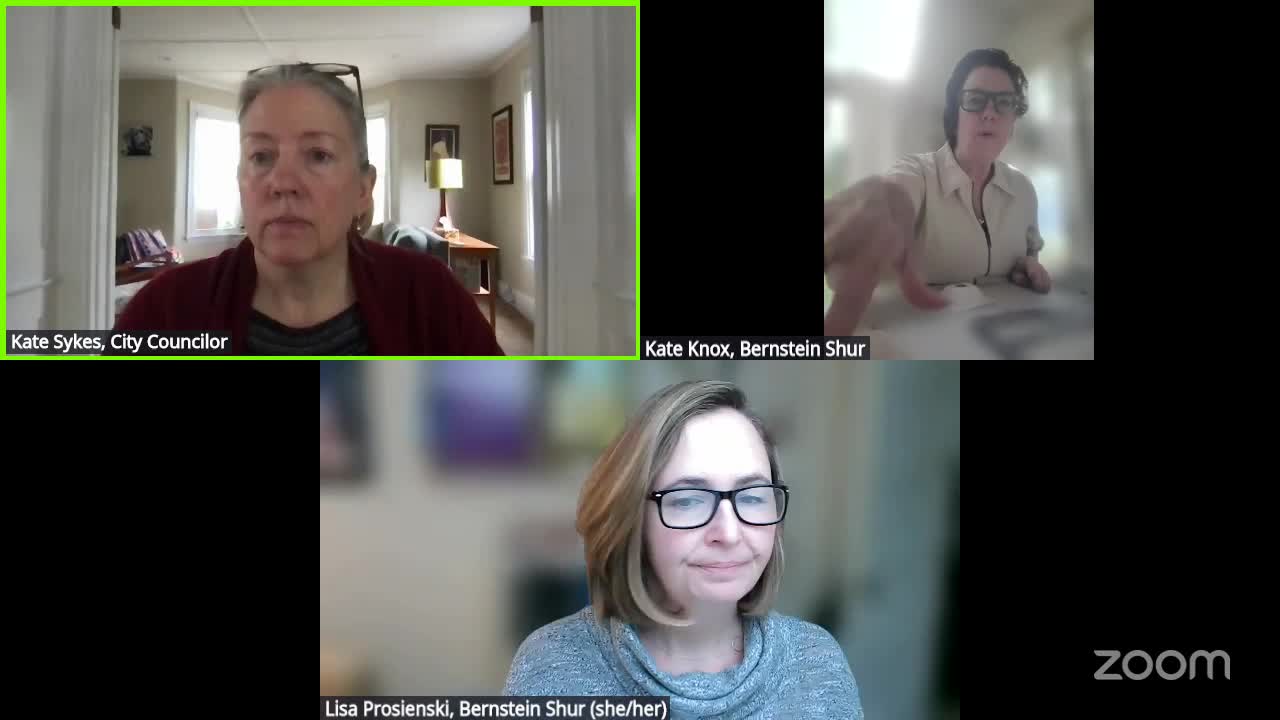
The committee’s priority is state-level funding affecting shelters and general assistance (GA), committee members said. "Things are moving at a hot clip at the State House right now," said Kate Knox, who gave the committee’s update on bills and budget work. Knox said recent committee action included HHS votes that would raise general assistance reimbursement to 75% in the next biennium and 80% in the following biennium, and would add a limitation of 12 months of assistance in a three‑year period.
Why it matters: Portland city leaders said the GA changes, emergency shelter reimbursements and the overall state budget will determine how much the city can respond to homelessness and shelter demand. Committee members also discussed multiple housing bond proposals that could increase long‑term housing supply — a point they tied to addiction of shelter capacity.
Key details from the meeting: - General assistance and MaineCare: Committee members said they were working closely with the city delegation and state appropriations to reconcile differing fiscal notes and secure funding. Knox said the governor’s budget would cut GA by $10 million relative to current funding and that, even to remain level, appropriators would need to replace that amount in the budget. Committee members described ongoing discussions with Representatives Brennan and Zager.
- Emergency shelter reimbursement (DHHS Rule 26): The committee discussed a bill added to the city’s priority list that would reverse DHHS’s reduction in emergency shelter reimbursement (identified in the meeting as a change under DHHS’s Rule 26) and restore the prior rate. That bill had a public hearing and was scheduled for a work session.
- Emergency food reimbursement: Knox told the committee an emergency food bill passed HHS on a bipartisan basis and would provide a little over $1 million to the city for food reimbursement.
- Housing bonds under consideration: Committee members reviewed multiple bond proposals. Knox summarized LD 1912 as a $60 million housing bond aimed at an "innovative housing incentive program" focused on manufactured or other innovative housing, grants for affordability and factory development, state housing authority programs and rehabilitation grants. Committee discussion also noted a larger speaker‑sponsored package described in committee documents as approximately $300 million (referred to in the meeting as a Speaker Factos proposal) with line items including roughly $80 million for a state affordable‑housing tax credit, $25 million for rural affordable rental housing and $20 million for first‑time homebuyer programs. Committee staff said it was not yet clear whether the Legislature would move a bond package this year or carry proposals into 2026.
- City-submitted bills and staff actions: The committee received updates on four city bills: a measure to allow off‑site training for law enforcement officers; an affordable‑housing bill requiring notice to parties when the city places affordability restrictions on property (reported as having a unanimous "ought to pass" committee vote after amendment and negotiation with Maine State Housing); a set of general assistance bills mostly advanced from HHS; and the bill to overturn DHHS Rule 26 discussed above. The committee also noted testimony was submitted on LD 1259 (a pilot bill) and that staff had testified on the committee’s behalf in committee.
- LD 1743 (firearms in municipal buildings and voting places): The committee discussed LD 1743, described in the staff update as another recurring attempt to permit municipalities to control the presence of firearms and other dangerous weapons in municipal facilities and at polling places. The committee voted to support the bill; a member offered to submit written testimony on behalf of the committee.
Votes at a glance: - Approval of minutes (April 29): Motion to approve minutes was made and adopted by voice vote. outcome: approved. - LD 1743 (permit municipal restrictions on firearms in municipal buildings and voting places): Committee voted to support the bill; motion carried by voice vote (recorded as unanimous in the meeting). outcome: supported by committee; staff will submit testimony as offered. - Adjournment: Motion carried. outcome: approved.
Committee members and staff emphasized that general assistance funding was occupying the bulk of their advocacy time because of its immediate effect on shelter and emergency services. Staff said they are monitoring appropriations closely and are seeking clearer fiscal notes from DHHS so the delegation and appropriations can reconcile differing projections. Committee members asked staff to prepare summaries of housing bonds so the committee could decide whether to support specific bond proposals before the Legislature makes a package decision.
The meeting concluded with committee staff offering to circulate summaries of bond proposals and to reconvene or correspond by email before the committee’s next scheduled meeting so members could provide direction to the delegation and to staff testimony.