Get Full Government Meeting Transcripts, Videos, & Alerts Forever!
Get email alerts on the Utilities And Water topic
No spam. Unsubscribe anytime.
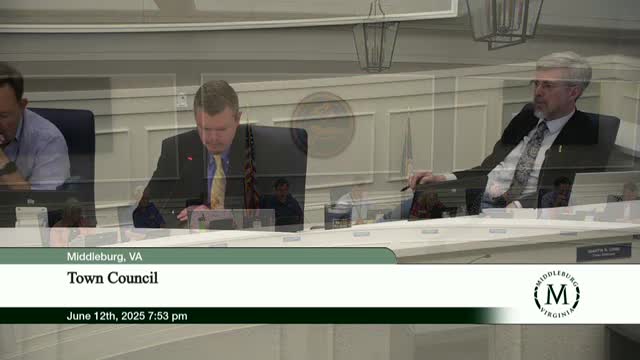
Middleburg Council debates water-conservation ordinance: caps, commercial carve-outs and next steps
Summary
Council reviewed a revised draft water-conservation ordinance, discussed flexible residential caps, commercial reductions, and data-driven metrics; staff will refine thresholds and reporting and return with revisions.
The Middleburg Town Council reviewed a revised proposal for a water-conservation ordinance that would establish staged restrictions during drought conditions and give staff and the council flexibility to set residential caps in extreme rationing.
Town Manager Danny Davis described the primary change in the draft: rather than fixing a single per-unit cap for the most severe rationing stage, the council or the town manager could set a cap that reflects local conditions and household size. Davis said a 300-gallon-per-day cap was a possible starting point but that the town should keep flexibility to tighten restrictions if the system does not improve.
Davis also presented measured results from the town's prior conservation actions: when the council imposed stricter water-conservation measures previously, the system’s production dropped from roughly 150,000 gallons per day to about 110,000, a savings on the order of 35,000–40,000 gallons per day. He said that additional per-unit rationing after those measures would yield more modest savings — in the draft numbers a residential cap could save an additional 1,300–4,500 gallons per day depending on the cap level chosen.
Council members pressed for clarity on how the ordinance would treat commercial users, seasonal businesses and multifamily properties. The draft would treat nonresidential users that have a 12‑month average at or below the residential cap as subject to residential caps; higher nonresidential users could face a percentage reduction (for example, a 10% reduction) during rationing. Town attorney Martin Crim confirmed the town may impose fair, reasonable reductions on commercial rates during declared water emergencies so long as they are supported by the record and applied consistently.
Several council members asked staff to consider seasonality in commercial averages (for example, businesses that are closed part of the year but busy in summer) and to consider alternative averaging methods — three-year seasonal averages, or seasonal-month averages — to avoid penalizing businesses with uneven demand. Staff said historical data (meter reads back to 2017) are available and that they can tailor averaging approaches for new or seasonal accounts.
Council members emphasized transparency and public reporting. Staff said the new cloud-based meter reads allow weekly export of usage data and will enable faster public reporting and customer outreach when reads show anomalous consumption.
No ordinance was adopted. Council asked staff to return with a revision that: 1) clarifies how commercial users and seasonal accounts are calculated and treated; 2) considers multi-year or seasonal-average options for commercial baselines; 3) preserves carve-outs for small nonresidential users whose daily use is below the residential cap; and 4) provides clear public reporting procedures on meter reads and conservation-stage triggers.
Staff said they will present well-specific data and additional edits at an upcoming meeting.