Get Full Government Meeting Transcripts, Videos, & Alerts Forever!
Get email alerts on the Parking topic
No spam. Unsubscribe anytime.
Oxnard staff advance private-parking ordinance allowing shopping centers to issue tickets
Summary
City staff presented a proposed citywide private parking ordinance that would let qualifying private parking operators issue written parking charges and establish a third‑party dispute process; a city committee recommended the ordinance be sent to the City Council for first reading.
Jamie Peltier, planning supervisor in the Planning Division of the Community Development Department, presented a proposed citywide private parking ordinance that would allow qualifying private property owners and parking operators in the City of Oxnard to register with the city and issue written parking charges for unauthorized parking instead of relying solely on towing.
The proposal, described by staff as implementing state law changes that followed 2015 lobbying and an action labeled AB 451, would create a new Division 3 in Article 4 of Chapter 8 of the Oxnard City Code to authorize enforcement on private, off‑street parking facilities that choose to register with the city. "The item being presented to the city council is the citywide private parking ordinance, which authorizes private property owners to initiate and enforce parking regulations on private property," Peltier said during the staff presentation.
The ordinance would apply to private off‑street parking facilities meeting the ordinance criteria; staff repeatedly cited qualifying retail shopping centers with 200 or more parking spaces as examples, naming The Collection, The Rose and The Esplanade as local facilities that could elect to register. Registration would require contact information for the property owner and operator, a parking plan showing regulated areas and signage language and locations, and a dispute resolution policy.
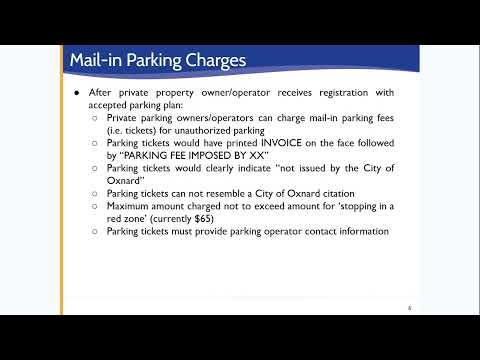
Under the framework described by staff, a registered private parking operator may begin issuing written parking charges after the city issues the registration and the operator obtains a business tax certificate. The operator must place temporary on‑site signage seven days before ticketing begins to notify customers and employees. The ordinance as presented would require minimum entry signage of 11 by 22 inches and would label the notices as issued by the property operator rather than by the City of Oxnard.
Parking charges would be limited to no more than the city’s red‑zone fine, which staff said is $65; the operator would set the precise amount up to that cap. The proposed process would prohibit private operators from transmitting charges to the Department of Motor Vehicles for collection, mirroring a limitation staff said exists in state law. The ordinance would also allow the Community Development Department to revoke a facility’s registration for noncompliance after warnings or unresolved complaints.
Peltier described a two‑tier dispute process: an initial review by the parking operator (who may dismiss or uphold a charge) and, if the customer is dissatisfied, an administrative hearing conducted by a third‑party qualified parking examiner. Staff said the administrative hearing would be handled entirely by the third‑party provider and would be final once those remedies were exhausted; city employees would not participate in the dispute adjudication.
The item was reviewed by the Community Services, Public Safety, Housing and Development Committee, which asked staff about application fees and whether registration would be ongoing or a one‑time application, about planner hourly rates for review, and about current towing regulations. Staff clarified that current towing rights under the California Vehicle Code remain available to private property owners and that the ordinance would incorporate the relevant state vehicle code provisions into the Oxnard City Code.
The committee moved the item forward with a 3‑0 vote and recommended that the City Council approve the ordinance’s first reading by title only and waive further reading. The staff presentation concluded with that recommendation being transmitted to the council.