Lifetime Citizen Portal Access — AI Briefings, Alerts & Unlimited Follows
Voters, advocacy groups press council to fund Initiative 83; campaign finance office warns Fair Elections program needs more money
Loading...
Summary
Residents and civic groups urged the Council’s budget committee to include funding to implement Initiative 83 — ranked‑choice voting and an open primary option for independent voters — as advocates said the implementation cost is modest and primarily for voter education; separately the Office of Campaign Finance told the committee it needs a substantial enhancement to cover projected Fair Elections payments in the 2026 cycle.
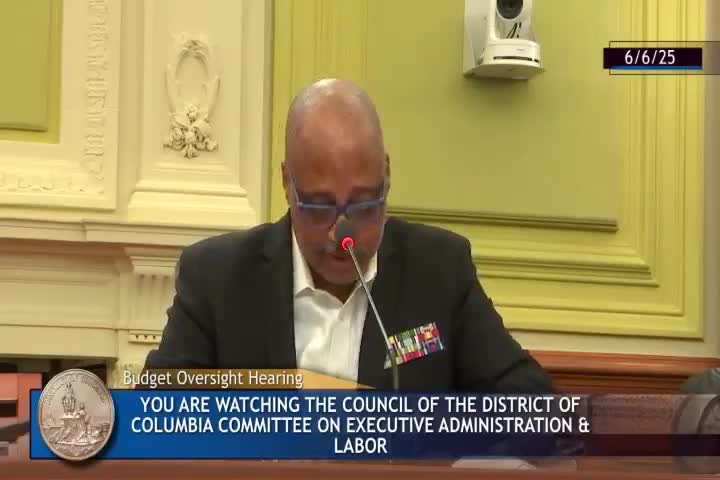
Scores of residents, civic groups and political activists testified June 6 that the District should fund implementation of Initiative 83 — a voter‑approved measure establishing ranked‑choice voting and allowing registered independents to vote in a single party primary — and they urged the Council to include the modest implementation funding in the FY26 budget.
Advocates and a broad coalition of witnesses told the Committee on Executive Administration and Labor that Initiative 83 passed with unusually high margins — 73 percent citywide and supermajorities in all eight wards — and that implementing the initiative will require primarily voter education, updated ballot formats and modest systems work. Witnesses and citizen proponents repeatedly cited a Board of Elections estimate that implementation would require about $1.5 million spread over four years; supporters asked the council to provide that funding so the Board can begin voter education early and have systems, printed materials and training in place for the 2026 elections.
The committee also heard a separate but related briefing from the Office of Campaign Finance (OCF) about the Fair Elections (public financing) program. OCF Deputy and staff testified the mayor’s proposed FY26 budget for OCF totals about $16.84 million with 38 FTEs — a 114.8 percent increase over FY25 — driven largely by non‑personal services increases for the Fair Elections program. But OCF told the committee that the amount in the proposed budget may still fall short of the payouts the agency must make during the 2026 election cycle. Citing program mechanics and participation patterns, OCF officials said the agency preliminarily projects $5,502,059 will be required during FY25 for activity tied to the 2026 cycle, and warned that the full cost of matching and base payments could total about $32,365,053 if candidate participation reaches 75 percent of the 2022 participation levels used for modeling. To avoid shortfalls, OCF asked the committee for an additional enhancement of $15,000,000 for the Fair Elections fund.
OCF director’s counsel William Sanford and managers walked the committee through prior-cycle experience: in the 2022 cycle the agency authorized roughly $12.36 million for base and matching payments to candidates certified under the Fair Elections program. The agency explained that payments must be made on statutorily defined timelines and that the fund is non‑lapsing but cannot be assumed to carry forward an adequate surplus in the near term to guarantee FY26 obligations. OCF said it will propose regulatory and legislative options for the future, including alternative match ratios and base amounts, if the Council prefers structural changes rather than one‑time enhancements.
Why it matters: Initiative 83’s changes affect how D.C. residents vote in the primary and could alter campaign behavior and turnout; the Fair Elections program is already changing the financing landscape for local candidates. The committee must weigh a small one‑time implementation cost to the Board of Elections against the potential difficulties OCF described in meeting public financing obligations without additional funds.
What the committee asked for and what’s next: Committee members asked the Board of Elections and OCF for more granular cost estimates and for options that could reduce program costs (for example, adjusted match ratios or base amounts). OCF said such changes would require legislative amendments. Several council members flagged the need to see spreadsheets and line‑by‑line explanations of why cost projections rose — a request OCF staff and citizen advocates both urged the mayor’s budget team and DGS to supply in more detail.
Votes at a glance: no formal council votes on these items were recorded during the hearing; the hearing focused on testimony and requests to the Administration and agencies.