Get Full Government Meeting Transcripts, Videos, & Alerts Forever!
Get email alerts on the Public Financing Reform topic
No spam. Unsubscribe anytime.
Ethics staff propose one‑time lifting of public financing ceilings and CPI‑adjusted contribution limits
Summary
Staff recommended replacing frequent incremental adjustments to individual expenditure ceilings with a single, race‑level threshold; proposed raising the city’s contribution limit from $500 to $900 with future CPI adjustments; commissioners took the presentation under advisement
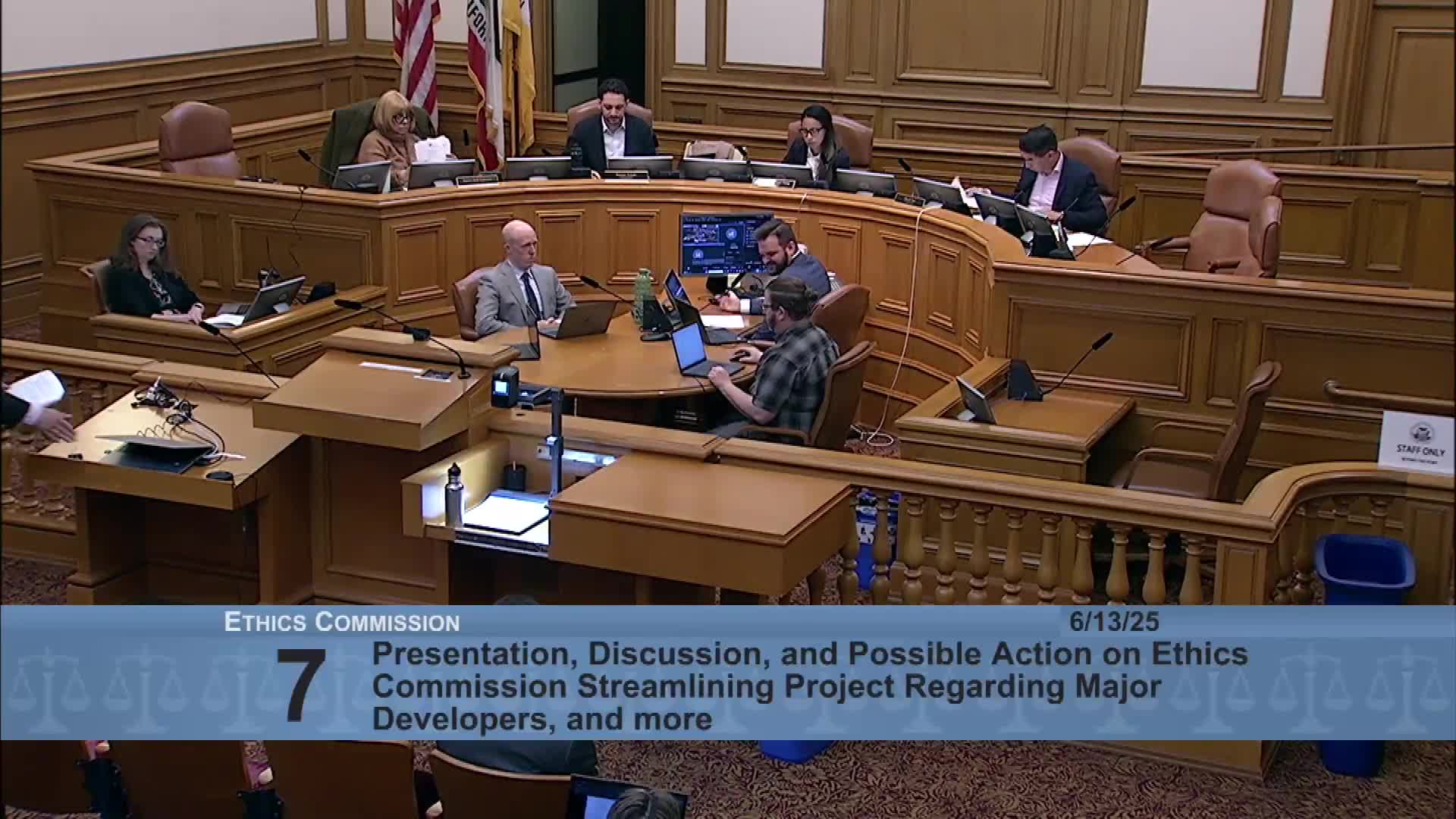
San Francisco — Commission staff proposed significant changes to how San Francisco administers its public financing program at the Ethics Commission’s June 13 meeting, recommending a streamlined, single‑event approach to raising expenditure ceilings and an inflation adjustment to contribution limits.
Michael Canning and Ryan Abusa presented the staff memo and said the current individual expenditure ceiling (IEC) process — used for candidates who accept public funds — requires auditors and campaigns to file and review many threshold statements during an election cycle. Staff noted the IEC mechanism can be adjusted repeatedly during a race (in $50,000 increments for supervisorial races and $250,000 for mayoral contests) and that in 2024 there were 295 IEC increases but only 12 of those adjustments meaningfully restricted spending.
To reduce administrative burden and the disproportionate compliance cost on under‑resourced campaigns, staff proposed replacing the current incremental, candidate‑by‑candidate IEC adjustments with a single race‑level mechanism: lift the expenditure ceiling for the entire race once objective criteria are met. The proposal’s suggested trigger is when a nonparticipating candidate’s expenditures or receipts exceed 75% of the applicable ceiling or when independent expenditures in the race exceed 75% of the ceiling. Staff said doing so would eliminate the need for ongoing supplemental threshold statements and simplify auditor monitoring.
Staff also recommended adjustments related to voluntary expenditure ceilings and two additional measures: an inflation‑adjusted increase in San Francisco’s general contribution limit (staff proposed moving the local limit from $500 to $900 and establishing a CPI‑linked automatic adjustment schedule every odd year) and updates to campaign disclaimer language ahead of a planned migration to .gov email addresses under Assembly Bill 1637.
Commissioners discussed equity implications of ongoing threshold reports, enforcement burden for auditors, and how comparable jurisdictions handle expenditure limits. No formal action was taken on the recommendations during the meeting; staff said it will work with the City Attorney’s Office to draft ordinance language and return a proposal for the commission to vote on and potentially refer to the Board of Supervisors.
The presentation included a reminder that the proposed reforms would not change eligibility for public funds nor the maximum public funding amounts (e.g., the memo recited current program maximums such as up to $255,000 for some supervisor candidates and up to $1.2 million for mayoral candidates in the public financing program), but would change how ceilings and reporting are handled.