Get Full Government Meeting Transcripts, Videos, & Alerts Forever!
Get email alerts on the Ethics Streamlining topic
No spam. Unsubscribe anytime.
San Francisco Ethics Commission proposes cutting or rewriting four low-performing programs; asks supervisors to drop trustee-election filings
Summary
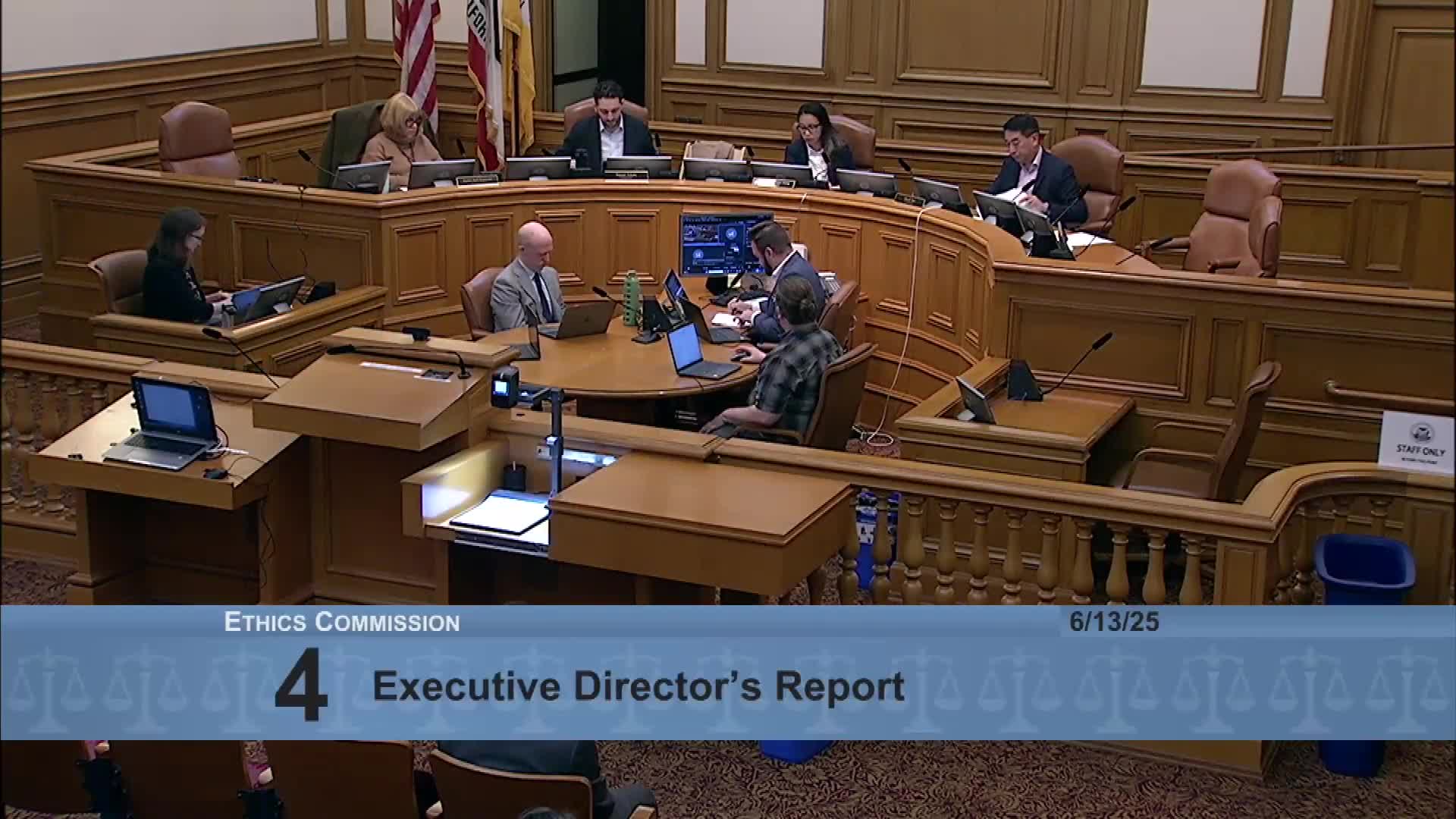
At its June 13 meeting the San Francisco Ethics Commission reviewed staff recommendations to scale back or eliminate four programs it says provide limited public benefit while consuming staff time.
San Francisco — At its June 13 meeting the San Francisco Ethics Commission reviewed staff recommendations to scale back or eliminate four programs it says provide limited public benefit while consuming staff time: the Major Developers registration and reporting program, the Campaign Consultant registration program, the supplemental recusal notification requirement for local boards and commissions, and the trustee-election disclosure regime for certain retirement and benefit boards.
The commission’s policy and legislative affairs manager, Michael Canning, and senior policy research specialist Ryan Abusa presented findings from an internal review and two interested‑persons meetings. Staff said the Major Developers program collects retroactive reports that often arrive after city officers have already met with nonprofits that received developer donations, that the $1,000,000 project threshold is likely low given local market conditions, and that 47% of filings disclose no donations. Staff recommended eliminating the program’s registration and reporting components and instead relying on established lobbyist rules to address paid advocacy.
Canning said the Campaign Consultant program — created after Proposition G (1997) to increase transparency around consultant relationships — duplicates information available through candidate campaign statements and other public datasets, creates administrative burden and confusion, and uses a $1,000 threshold that casts too wide a net. Staff recommended removing the registration and reporting requirements while keeping the prohibition against consultants lobbying their former or current clients.
On the supplemental recusal notification — a separate filing required after a board or commission member recuses — staff found the information is already disclosed at public meetings and in minutes, creating unnecessary work for volunteer commissioners and staff. The recommendation is to eliminate the separate supplemental recusal filing while leaving in place the statutory recusal rules that require a commissioner to announce the reason at the meeting and leave the room during discussion.
Ryan Abusa outlined trustee‑election disclosure rules that apply to three benefit boards whose trustees are elected by current and former city employees. Staff found very little activity under the trustee disclosure program: since 2018 only seven candidates ever registered and only one reported raising funds (about $78.60). Staff said requiring candidates — often career city employees or retirees who raise little or no money — to open campaign bank accounts and maintain ongoing filings imposes disproportionate burdens and yields minimal public benefit. Staff recommended eliminating the trustee‑candidate filing requirement and said a formal communication to the Board of Supervisors would be the appropriate next step because the trustee rules are codified in the Administrative Code.
Commissioners asked detailed questions about the interested‑persons feedback and whether programs could be fixed rather than eliminated. Canning and Abusa said they had heard little support for maintaining the current programs in their present form during outreach to treasurers, consultants, trustee boards and other stakeholders.
After discussion the commission voted unanimously to authorize Chair Flores Fang to sign a letter, with the executive director, requesting that the Board of Supervisors pursue discontinuing the trustee election reporting requirements in the Administrative Code. The vote was recorded as four yes votes from the commissioners present.
The staff presentation and discussion will inform draft legislation the commission and city attorney’s office will prepare; any code changes would still require Board of Supervisors action.
Sources and next steps: staff said it will work with the city attorney to draft ordinance language to repeal or amend the affected code sections and bring that draft back to the commission for additional review and a possible referral to the Board of Supervisors.