Get Full Government Meeting Transcripts, Videos, & Alerts Forever!
Get email alerts on the State Legislation topic
No spam. Unsubscribe anytime.
Commission hears review of Texas’ 89th legislative session; advocates celebrate kills and watch bills on governor’s desk
Summary
An environmental-policy briefing summarized bills that died in the 89th Texas Legislature, called out one bill the commission and partners helped defeat and flagged several measures that remain on the governor’s desk or have been signed into law.
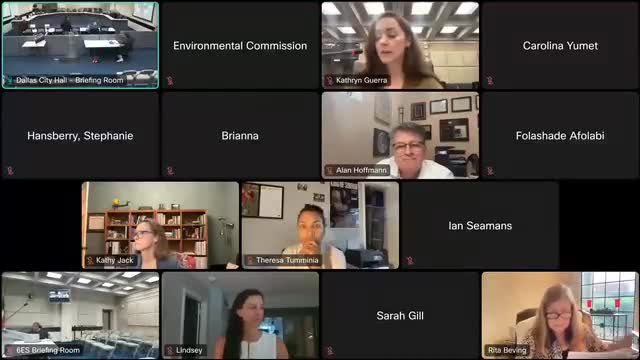
Rita Bevin, who briefed the Dallas Environmental Commission on the recent Texas legislative session, told the panel that a range of bills affecting renewables, water and permitting were still moving through the post-session approval process and that local advocacy influenced several outcomes.
Bevin said the commission’s advocacy and partner efforts helped kill HB 4313, which she described as a bill that “would kill any public funding for any environmental project that reduces climate emissions, reduce greenhouse gases, or pollution.” She said HB 4313 would have barred the use of public funds, private donations or city money for projects explicitly tied to greenhouse‑gas reduction and that its defeat preserves a range of municipal and grant programs the city uses for fleet and air‑pollution projects.
Bevin highlighted additional bills that did not advance or were defeated, including legislation that would have required a large share of dispatchable generation, increased permitting burdens for large renewable projects and restricted offshore wind interconnection. She also noted bills that she described as positive, including SB 1202 (a streamlined permitting measure for rooftop solar and batteries) and HB 29 (which requires large utilities or cities with more than 150,000 connections and excessive water loss to develop annual mitigation plans). Bevin said she was continuing to monitor several other measures that remained on the governor’s desk as of the briefing.
Bevin also identified HB 2890 (described in the presentation as HB 28 90), which she characterized as a measure that would create an LNG compact to promote liquefied natural gas; she said that bill had been signed and that the development of LNG infrastructure in Texas is an ongoing concern for environmental advocates.
Commissioners and staff discussed next steps for local advocacy; Bevin urged continued vigilance at state and local levels and offered to share updates after the governor’s signing deadline had passed. The briefing made clear which bills had been killed, which had passed and which still required the governor’s action, and commissioners thanked Bevin for organizing rapid alerts and mobilizing stakeholders during the session.
Ending: Commissioners asked staff and outside advocates to track bills that could affect the city’s CCAP work and to provide updates after the governor’s deadline; no regulatory or legislative action was taken by the commission during this meeting.