Get Full Government Meeting Transcripts, Videos, & Alerts Forever!
Get email alerts on the County Budget topic
No spam. Unsubscribe anytime.
Gadsden County officials review preliminary FY2025–26 budget; focus on staffing, new buildings and fleet costs
Summary
At a budget workshop, county staff presented tentative revenue of about $69.8 million and flagged rising insurance, new buildings, EMS staffing gaps, fleet lease costs and software needs as key drivers for next year’s budget.
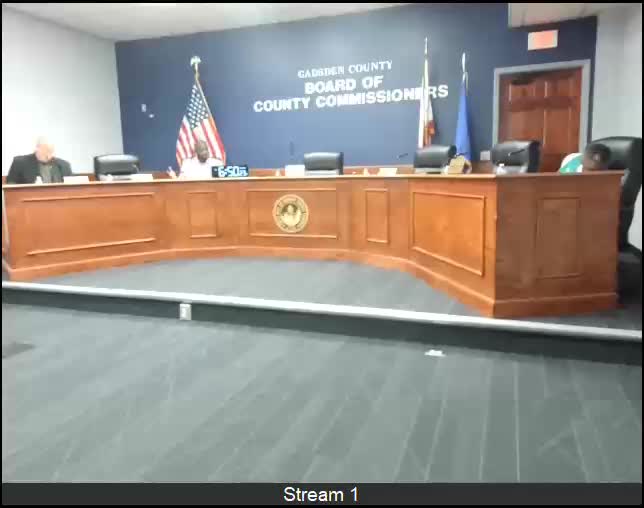
Gadsden County officials met in a budget workshop to review a preliminary Fiscal Year 2025–26 spending plan that staff said will be driven by rising insurance and facility costs, several new county buildings coming online and continuing recruitment challenges for emergency services.
Missus Raynak, the county staff member presenting the budget overview, told the Board of County Commissioners the county is preparing a tentative budget that “is planning to move forward into the October 2025 to September 2026 fiscal year” and that staff had met with department heads to assemble projections and identify decision points for the board.
The presentation laid out tentative totals and major revenue sources. Staff said tentative countywide revenue for 2025–26 is $69,750,000 and that the general fund is expected to generate about $33,000,000 in revenue while tentative general fund expenditures were shown at roughly $34,000,000. Raynak said ad valorem (property) tax revenue is projected at about $21,000,000 based on a current millage of 9 mills; moving the millage to 9.25 would add roughly $600,000 in revenue and lowering it to 8.75 would reduce revenues by about $600,000.
Raynak and other staff noted a number of grant and capital funding sources that will affect next year’s budget, including opioid settlement receipts, community development block grants, a courthouse historic preservation grant (second half), library grants (about $400,000 for internet access and device loan programs), SHIP housing grant applications and Big Bend Transit funding. She said the county expects “over $29,000,000” in incoming project and grant revenues identified in the packet but emphasized those are project-specific rather than ongoing operating revenues.
Commissioners and staff discussed a package of capital projects and new facilities that will raise operating costs when completed: a new public safety complex and EOC, a Quincy EMS station, the Boys & Girls Club, library/telehealth centers in Chattahoochee and Havana, and a public works equipment capital request. Raynak said the county currently is evaluating bids for several construction contracts and expects staffing, utilities and maintenance costs to rise as those buildings come online.
Several commissioners pressed for more detail on staffing and operating impacts. Commissioner Simpkins urged the board to be precise in public messaging about discretionary expenditures and where funds originated, saying, “I just don't need us putting out, like, we're spending a million dollars on parties,” and asking staff to break out what was funded by tourist-development or other restricted sources. Commissioners also discussed whether some custodial, grounds and other tasks should be contracted out or retained in-house to control long-term costs.
EMS staffing and recruitment was a persistent concern. Commissioners and staff agreed EMS, sheriff and fire services are fundamentally hard to make revenue-neutral and will require continued investment. One commissioner described long response and turnaround times for county EMS units when transports go to Tallahassee, stressing that coverage and workload, not just pay, affect retention and availability.
Fleet and vehicle leasing drew specific scrutiny. Staff said the county pays about $340,000 per year on a public works fleet lease that will come due this year with a buyout option near $1.3 million; staff are comparing buyout vs. continuing lease. The county is also auditing vehicle inventories and insurance to ensure it is not insuring vehicles no longer in service and plans a meeting with the leasing vendor Enterprise to review contract terms. The county will limit board attendance at that meeting to avoid Sunshine Law issues.
Staff and commissioners discussed county health insurance costs and employee benefits. Raynak gave the board monthly averages: about $873 per month for single coverage, about $1,250 per month for employee + dependent, and about $2,100 per month for family coverage. Commissioners noted those benefits are a substantial component of total compensation and will affect hiring and retention, and they cautioned that changes to benefits would shift costs to employees.
The county also discussed enterprise software and records integration. Staff said a single, countywide platform (rather than many disconnected departmental systems) would likely be more efficient and that discussions with the clerk’s office and potential vendors are needed to scope modules for HR, payroll and permitting. Commissioners directed staff to pursue a coordinated workshop with constitutional officers and the clerk to determine a recommended path and budget for software.
Staff confirmed the county audit report for FY2022–23 is expected to be presented to the board in a special meeting around June 30; commissioners said they want the audit before making final budget decisions. Raynak said some constitutional officers’ budget inputs are still pending (the tax collector’s submission is due by statute on Aug. 1) and that the sheriff’s and other reports should be provided as soon as available.
Board members agreed to schedule the next public budget workshop for Aug. 4, 2025, and also discussed an additional meeting in late June or early July to receive updated figures and constitutional officers’ submissions. Staff were asked to provide more detailed line-item impacts for staffing, custodial and facility maintenance (including estimates for additional custodial positions tied to new buildings), the implications of buying versus continuing the fleet lease, and a concise breakdown of prior-year nonbudgeted expenditures and their funding sources.
The workshop closed with the board directing staff to continue refining department budgets, to provide requested comparisons between contracting out and in-house provision for specific services, and to report back with updated revenue estimates, audit results when available and detailed cost projections for the identified capital and staffing items.