
Justice Resource Center work group advances outreach, court appearance resources and reentry data review
Get AI-powered insights, summaries, and transcripts
Subscribe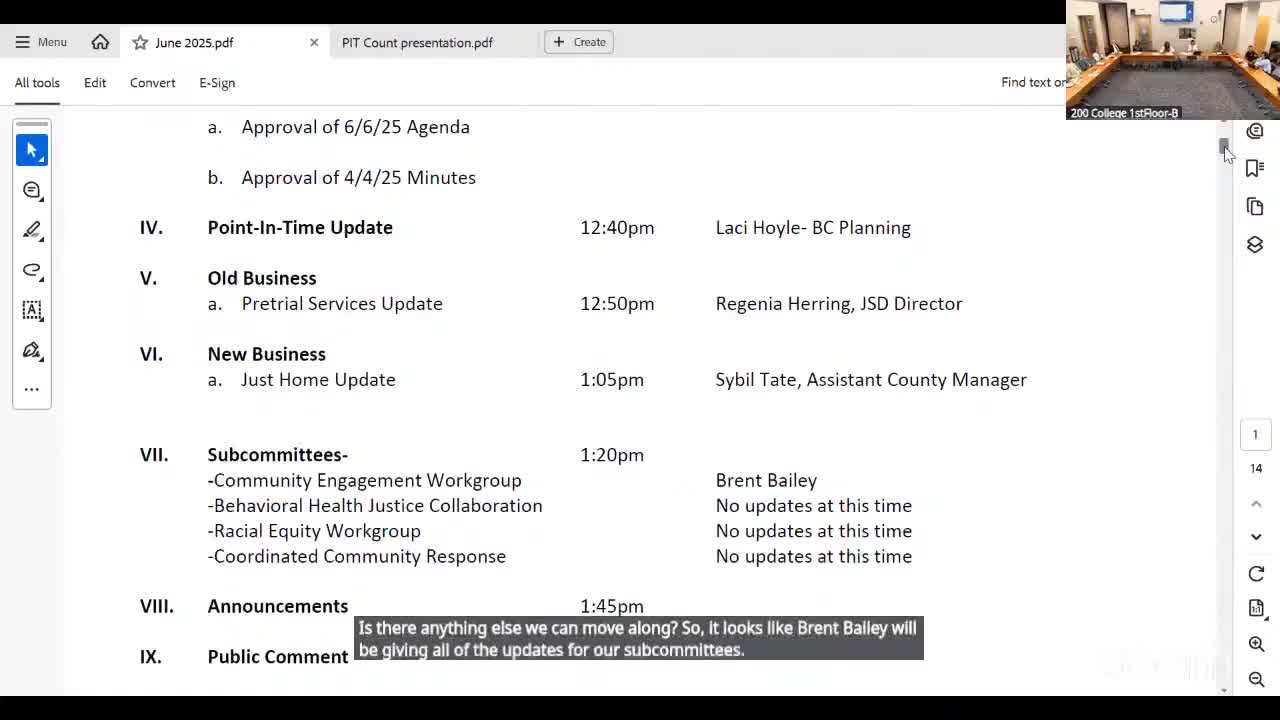
Summary
Buncombe County’s community engagement work group reported outreach plans to gather input from people recently detained, reviewed jail and JRC data for trends tied to housing and recidivism, and discussed the AOC statewide court appearance project as a model for local court advocacy support.
Brett Bailey, staff support for the community engagement work group, updated the meeting on several outreach and data initiatives aimed at improving reentry outcomes and connecting people leaving detention to services.
Why it matters: the work group’s outreach and data analysis target recidivism drivers—housing, language access, and time‑sensitive connections to services—and may inform changes to how information is provided to people while detained and after release.
Bailey said the group is scheduling listening sessions with people recently released from the detention center to learn when and how to introduce resource information so the information is usable. The group is also reviewing JRC (Justice Resource Center) and jail data to identify trends tied to recidivism and barriers such as housing instability. Bailey noted an observation that people of Hispanic/Latino descent appear in jail records but are underrepresented at the JRC, prompting steps to make materials available in Spanish and explore access barriers.
The group heard a presentation from Diana Pyle (Raleigh) about Wake County’s court advocacy program, which places community volunteers in courts to help people navigate hearings and administrative issues; community members asked whether a similar model could be piloted locally. Judges cautioned about unauthorized practice of law and said any volunteer court assistance should be carefully designed and coordinated with the courts and attorneys.
Bailey and others discussed Just Home planning and the county’s role in supporting transitions from prison, noting local transitional housing, state prison reentry initiatives and available subsidy investments as complementary resources. The work group also plans to review the Administrative Office of the Courts’ statewide Court Appearance Project report and consider inviting Eric Jackson (who chairs the group’s input and analysis subcommittee) to present findings and recommendations to the JRAC.
Ending: the work group will continue outreach sessions, expand language access of materials, coordinate with court and justice partners on any advocacy pilots, and integrate existing data reviews into the Just Home planning process.