
Buncombe County officials report slight rise in homelessness, highlight FEMA sheltering impact
Get AI-powered insights, summaries, and transcripts
Subscribe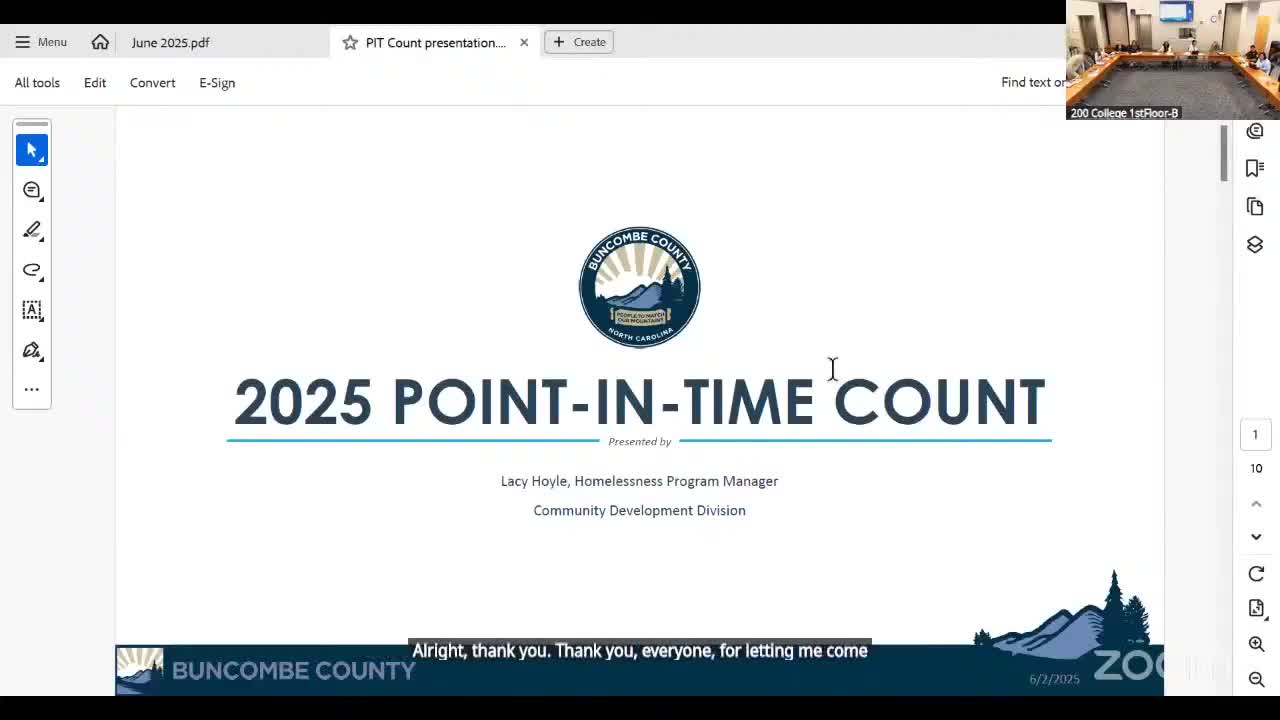
Summary
Buncombe County presented results from its 2025 point‑in‑time (PIT) count: total unsheltered individuals rose to 328, transitional housing decreased after a facility loss, and FEMA temporary sheltering assistance (TSA) placements added 1,548 people to the continuum total reported to HUD.
Lacey Hoyle, Buncombe County homelessness program manager, presented the county’s 2025 point‑in‑time (PIT) count results, reporting increases in unsheltered individuals and describing how FEMA temporary sheltering assistance affected the final continuum tally.
The PIT count is a one‑night census of people who meet HUD’s federal definition of literal homelessness (emergency shelter, transitional housing, or unsheltered). This year’s evening count occurred Jan. 28 from 4 to 7 p.m., with an additional daytime count used to reach encampments and service sites, Hoyle said. The county deployed 135 volunteers for the count.
Why it matters: the PIT count informs local Continuum of Care (CoC) planning and funding priorities and helps planners estimate shelter needs, service gaps and populations that are disproportionately impacted.
Key findings Hoyle highlighted include: 270 people were in emergency shelter on the night counted (the same raw number recorded in 2024), transitional housing beds showed 93 fewer people after the Veterans Restoration Quarters facility was damaged and operated at a smaller alternate site, and the unsheltered count rose by 109 to 328 individuals. Hoyle said 116 of those counted as unsheltered reported becoming unsheltered as a result of Tropical Storm Helene.
Hoyle also explained that HUD procedures require counting people in FEMA’s Transitional Sheltering Assistance (TSA) hotels when placements are paid for by an agency or organization. The county obtained aggregate FEMA data showing 1,548 individuals staying in TSA hotels on the PIT night. HUD‑reported totals for the Buncombe County CoC therefore included those TSA placements, producing a reported total of 2,303 individuals experiencing homelessness for HUD submission. Hoyle cautioned that the HUD total does not mean 2,300 people were unsheltered on the street; many TSA placements were storm‑related and most exited TSA into transitional or permanent housing, she said.
Hoyle reviewed demographic patterns from the CoC’s de‑duplicated surveys (excluding the TSA hotel extrapolation used only for the HUD total). The county continues to see disparities: Black or African American people represented 17.6% of PIT respondents while representing about 6% of county population; people identifying as American Indian/Alaska Native comprised 2.1% of the PIT respondents though roughly 0.6% of county population. Men were overrepresented in the PIT respondents (65.8%) compared with the county population (48.2%), consistent with national PIT trends, Hoyle said. She also noted increases in self‑reported chronic homelessness, serious mental illness, and substance use disorder among respondents.
Geographically, Hoyle said about 94% of PIT respondents were within Asheville city limits; she noted increases in responses from Swannanoa and Barnardsville, which may reflect both storm impacts and improved outreach and volunteer rapport in those routes. She also said no surveys were collected in parts of West Buncombe (Candler/Lester) despite known needs there; nonresponse and the voluntary nature of surveys likely affect coverage.
Audience questions raised methodology and data‑availability issues: county staff said the city of Asheville’s Homeless Strategy Division, as the CoC lead agency, manages HMIS deduplication and HUD submission and can provide further detail about response and utilization rates. Hoyle offered to follow up with additional data on volunteer contact rates, FEMA TSA exit outcomes and bed utilization statistics.
Ending: Hoyle closed by noting the PIT is a snapshot with known limitations but remains a central planning tool for the CoC and local service providers. County and city staff will continue to share supplementary utilization and FEMA transition data with stakeholders to guide shelter planning and system responses.