
Public commenters urge greater transparency, ethics accountability and higher materials stipends
Get AI-powered insights, summaries, and transcripts
Subscribe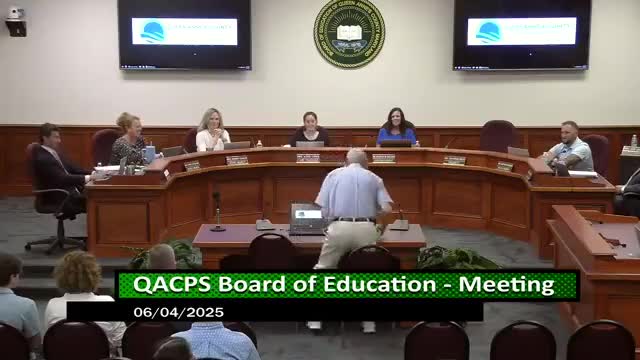
Summary
During public comment at the June 4 school board meeting, speakers asked the board for greater transparency on budgeting and ethics, recognized retirees, and urged the district to increase the materials-of-instruction stipend for teachers.
Several members of the public used the June 4 Queen Anne's County Board of Education meeting to raise concerns about board transparency and ethics, recognize retirees, and call for increases to teachers' materials-of-instruction (MOI) support.
Richard McNeil, representing himself and a retirement group, thanked district staff for organizing a retirement ceremony and said the retirement group awarded two $2,000 scholarships to local graduates (Cassidy McElroy from Kent Island and Alisa Crossley from Queen Anne's). "We will be recognizing them at our luncheon this coming Wednesday," McNeil said. He also praised the district's career and technical education programs and noted concerns about state-level funding hold-ups.
Amanda D'Onofrio, a public commenter, urged the board to improve transparency and accountability. She criticized unanswered emails, questioned the timing and scope of a proposed new board of education building and a furniture contract, and said recent ethics-panel findings showed a need for stronger board accountability. "Silence in the face of ethical violations is unacceptable for people serving the public," D'Onofrio said, urging the board to "step up and do their best in holding themselves and each other accountable."
Cecilia Mitchell, president of QACEA (Queen Anne's County Education Association), thanked the board and district leaders and said she was relieved there were no job losses this year but warned workloads remain "unsustainable". Mitchell thanked district leadership for maintaining monthly meetings between the association and district leaders and urged continued support for resourcing early grades.
A student, Chris Cool, said teachers regularly tell students they must pay out of pocket for classroom materials and presented survey results he said came from polling elementary teachers: 50 respondents across pre-K through grade 5; 92% reported spending more than $100 per school year on materials. Cool urged the board to consider increasing the MOI stipend by $100 across the district, noting that he estimated such an increase would cost the district about $90,000–$100,000 depending on teacher counts. He suggested an alternative of allocating stipends by school based on student and Title I populations.
No formal board action was taken in response to public comment during the June 4 meeting; several of the speakers were recognized and thanked by board members and district staff.