Get Full Government Meeting Transcripts, Videos, & Alerts Forever!
Get email alerts on the School Budget Staffing topic
No spam. Unsubscribe anytime.
Teachers, students and parents urge Freetown-Lakeville committee to restore staff amid FY26 cuts
Summary
Multiple teachers, students and curriculum leaders told the Freetown Lakeville Regional School Committee on June 11 that proposed FY26 budget cuts and the committee's refusal so far to approve $250,000 from E and D funds would eliminate intervention positions and harm reading, math and civics programs.
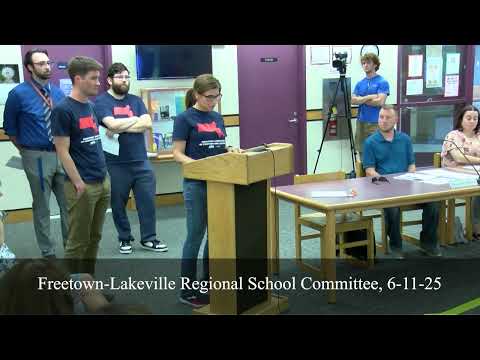
Dozens of teachers, students and local curriculum leaders told the Freetown Lakeville Regional School Committee at its June 11 meeting that proposed budget cuts for fiscal year 2026 would remove staff who support at-risk students and could diminish signature academic programs.
At the public-participation portion of the meeting, long‑time Freetown Elementary School teacher Jill Larue said the district faces both retirements and nonrenewals that will remove “2 and a half positions” at her school even before any additional cuts. Larue described two intervention teachers by name and urged the committee to approve a $250,000 request from the district’s E and D funds that she said would save four positions: “If you can reconsider, that $250,000 will save not just our four positions… it’ll save 20 to 30 students who are not able to receive services,” she said.
Larue identified Suzanne Cunha as the school’s math interventionist and said Cunha currently serves about 38 children a day; Larue described Cunha’s work as having raised students scoring “green” on math measures from 67% to 79% in recent years. Larue also named a specialist she said would be affected by cuts — “Maggie McKayle McKay” — describing that teacher as an Orton‑Gillingham‑trained literacy specialist who sees roughly 20 students across two elementary schools (13 at Freetown Elementary) and who works with the district’s most at‑risk readers.
Student speakers and recent graduates joined teachers in urging the committee to restore funding. Hayden Ricciardi, a tenth‑grade student athlete, asked members to “please reconsider or to revise the FY26 budget” so that a first‑year teacher and coach would not lose his job. Lucas Soares, a recently graduated student, said he spoke on behalf of fellow graduates and told the committee, “We do not want teachers to get fired.” Several members of the 2025 graduating class also attended and spoke during public comment.
Teachers and curriculum leaders said cuts would also reduce elective options and put a newly designated exemplary civic action project at risk. Laura Barnacote, social studies curriculum leader, said a two‑year, yearlong civics action project recently deemed exemplary by the Massachusetts Executive Office of Education depends on staffing breadth at the high school: “To cut a member of our department could mean risking our ability to help students have this meaningful civics experience,” she told the committee.
Joseph Gerlando, a social studies teacher who runs AP Psychology, and Joe Solomon, union vice president, warned that losing teachers across departments could limit Advanced Placement offerings and stunt AP enrollment growth the district has worked to build. Michael Palino, who served as a district bargaining representative, said he voted for a one‑year contract believing E and D funds would be used to hold positions steady and asked for clarification about why those funds had not been approved.
Committee members took public input and later discussed other agenda topics including school handbooks, start‑time modeling and proposed district policies. Committee members did not vote on the $250,000 E and D request discussed by speakers during public comment; at the meeting’s end the committee did vote to authorize a separate transfer of E and D funds for a pool engineering study and related athletic equipment (see “Votes at a glance” for outcomes of official votes taken June 11).
Why it matters: Teachers and students told the committee that the cuts would directly affect early‑grade math and literacy interventions and high‑school civic and AP programming. District staff and community advocates said the roles at stake serve many students identified as “most at risk” for falling behind if intervention services are reduced.
Details and clarifications drawn from testimony - Larue: said Freetown Elementary would lose “2 and a half positions” from the seven retirements/nonrenewals cited at the meeting and that math interventionist Suzanne Cunha serves about 38 children a day. - Larue: described a $250,000 request from “E and D” funds that teachers say would save four positions across the district; the committee did not vote on that specific $250,000 request at the June 11 meeting. The transcript records the $250,000 figure as the amount speakers asked the committee to consider. - Literacy specialist described by Larue (recorded in the transcript as “Maggie McKayle McKay”) was said to serve about 20 students between two elementary schools (13 at Freetown Elementary). - Student appeals included pleas to retain specific teachers and coaches; several student speakers emphasized the personal and academic impact of school staff in their remarks.
Meeting context: Public comments on budget and staffing occupied the meeting’s public‑participation segment. At least eight named speakers addressed staffing and program impacts. The committee later proceeded with reports, handbook updates and a slate of votes in the evening’s action items.
Ending note: Speakers asked the committee to revisit the use of E and D funds to preserve interventionists and elective programming. The committee did not take a vote on the $250,000 request during public comment; for the formal votes the committee did take on June 11, see the companion “Votes at a glance” article.