Get Full Government Meeting Transcripts, Videos, & Alerts Forever!
Get email alerts on the Education Incentive Pay Eligibility topic
No spam. Unsubscribe anytime.
Subcommittee debates who counts as "eligible" for firefighter education incentive pay, including payouts after death
Summary
A rules subcommittee reviewed draft changes to education incentive pay rules, focusing on definitions of "eligible" versus "qualified," whether the commission should pay members who died or separated before meeting year‑end roster requirements, and how to write clear rule language to avoid ad hoc exceptions.
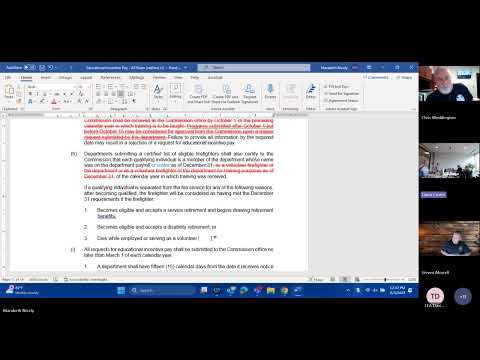
At a June 5 rules subcommittee meeting, members discussed whether firefighters who separated, retired or died before the December 31 roster date should receive state education incentive pay (EIP) even if they had completed training hours earlier in the year.
The discussion centered on defining two terms that appear in draft rules: “eligible” (meeting minimum training benchmarks, usually 30 hours for volunteers and 40 hours for career personnel) and “qualified” (meeting eligibility and being on the department roster on Dec. 31 or meeting specified exceptions). Subcommittee members said the current draft uses the words interchangeably and that ambiguity has led to inconsistent payouts.
Why it matters: education incentive pay is a recurring budget item and a frequent source of appeals from departments and families. The subcommittee said clearer rules will reduce ad hoc decisions, which have in some years resulted in the commission paying individuals who had not completed the minimum training but were paid historically.
Members pressed staff to clarify whether qualifying events that let a departed individual be treated as on the Dec. 31 roster (examples discussed: retirement/acceptance of service retirement, disability retirement, death while employed, certain military deployments) must be prefaced by an explicit statement that the person first satisfied the minimum training benchmark. Several members argued the rule should require proof that the minimum hours were completed before the qualifying event, so that the commission does not create broad, case‑by‑case exceptions.
Committee members and staff noted past practice: in recent years the office paid some deceased firefighters although they had not completed the minimum training; that practice prompted the current rewrite. Some members said occasional compassionate payouts had been done historically but warned that formalizing broad exceptions would create many future appeals (for medical leave, deployments of short duration, or other interruptions). Others pointed out the volume of such cases would likely remain small but could set precedent.
The subcommittee asked staff to consolidate eligibility and qualifying exceptions into one place in the rule, to spell out the minimum training requirement in plain language (e.g., “completed the required 30 or 40 hours”), and to return with redlined language that removes the current ambiguity. Staff agreed to rewrite the section and bring it back to a future rules meeting.
Ending: The subcommittee did not adopt a final change; members directed staff to recast the eligibility/qualifying language, add cross‑references to existing statutes cited in the draft, and bring a consolidated draft back for review before formal filing.