Get Full Government Meeting Transcripts, Videos, & Alerts Forever!
Get email alerts on the Immigration Funding Restrictions topic
No spam. Unsubscribe anytime.
Council approves ordinance limiting city-funded services for unauthorized immigrants after heated debate
Summary
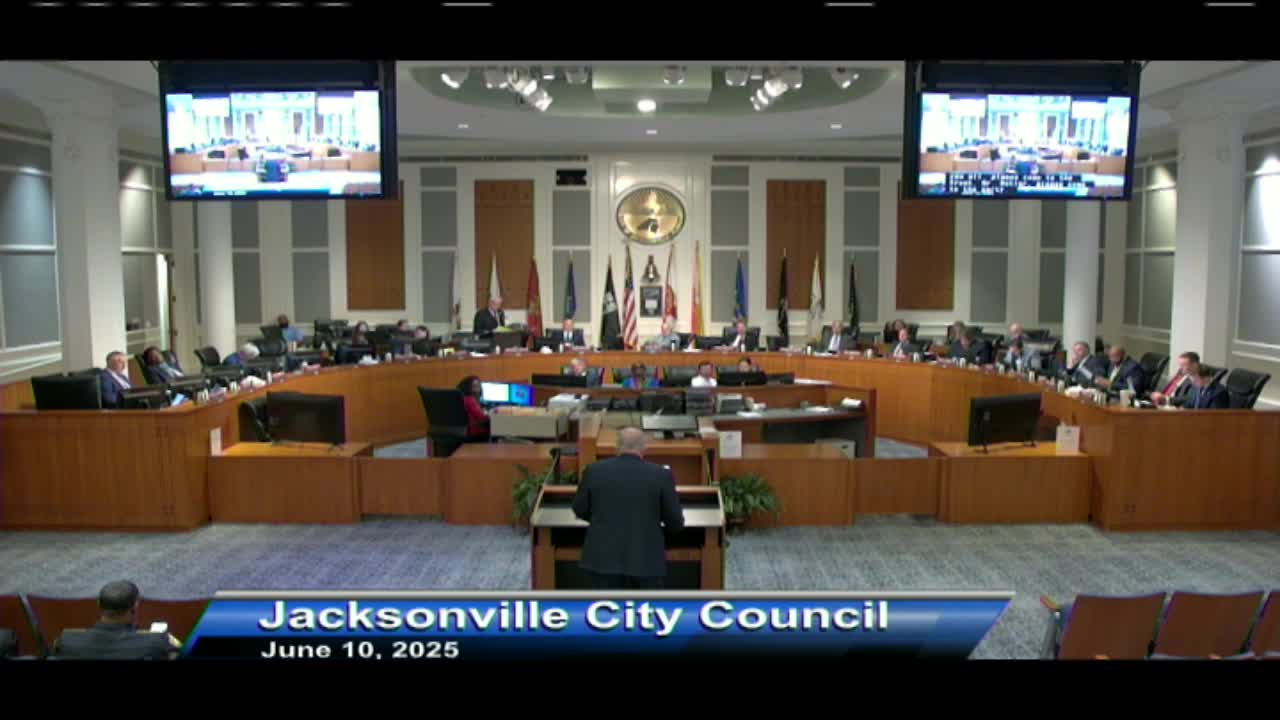
After more than three hours of debate and public comment, the Jacksonville City Council approved ordinance 20 25 0 1 3 8, restricting use of some city grant and contract dollars for services that knowingly serve unauthorized immigrants; the measure passed 11-7 with multiple carve-outs and exemptions added on the floor.
Jacksonville City Council on Tuesday approved ordinance 20 25 0 1 3 8, a measure that restricts the use of certain city grant and contract dollars for programs that knowingly provide services to unauthorized immigrants. The final vote was 11 yeas and 7 nays after the council adopted four separate floor amendments that added exemptions for categories including children’s services, victims of domestic violence, pregnant women and certain public-health and military services.
The ordinance drew large public turnout and intense public comment, with 63 speakers during the public-comment period. Dozens of speakers urged the council to reject the measure; several nonprofit leaders warned the new rules would conflict with federal contracts and federal law.
Citywide implications: Supporters framed the ordinance as a taxpayer‑protection and accountability measure; opponents called it discriminatory, legally risky and likely to reduce access to health, education and emergency services for children and other vulnerable residents.
What the ordinance does: The final language ties compliance to city contracts and grants and requires reporting on use of city funds. The council added a long list of exceptions before the final vote. Those exceptions — adopted as floor amendments — exempt children’s programming and providers that serve children, victims of domestic violence and trafficking, services related to infectious‑disease response by the Duval County health department, active‑duty military members, designated legal aid services, and pregnant women. The council also left a one‑year prospective delay for some Kids Hope Alliance contract changes to allow time for implementation.
Council debate: Councilmember Roy Diamond, the ordinance’s sponsor, said the measure was a response to what he described as federal inaction and an unfunded local burden: “The last federal administration let the border be wide open, and 20,000,000 undocumented immigrants came into America,” he said, arguing the city must know how its dollars are spent. Opponents said the ordinance would chill service delivery, create administrative burdens and provoke costly legal challenges.
Several council members pointed to practical problems and enforcement questions. Councilmember Arias asked how the city would administer and audit the rule; an administration official said enforcement would rely on standard contract remedies, including return of misspent funds if a violation were found. Other members warned the ordinance would reduce trust between immigrant communities and city agencies, undermining calls to 911 and other public‑safety reporting.
Public comments and nonprofits: Feeding Northeast Florida’s representative, Coleman Shepherd, told the council, “Ordinance 138, should it be passed, would put requirements in place that are in conflict with our contracts with Feeding America and the USDA,” saying the new process could force frontline providers to turn people away. Speakers from immigrant‑rights, faith and legal‑aid groups urged the council to protect children and preserve existing service networks.
Legal risks and next steps: Multiple speakers and council members warned that the ordinance could prompt litigation under federal law. The council adopted the ordinance as amended; implementation will require administrative rule‑making and contract language changes in affected city grant programs.
By the numbers: The final roll call was 11 yeas, 7 nays.
Community reaction and outlook: The vote prompted applause and shouts from both opponents and supporters in the chamber. Opponents vowed legal challenges; supporters said the council had established needed fiscal and programmatic accountability. City staff and affected nonprofits will now begin the work of translating the ordinance into contract language and reporting systems.