Get Full Government Meeting Transcripts, Videos, & Alerts Forever!
Get email alerts on the Streetlights topic
No spam. Unsubscribe anytime.
Transportation staff propose 150‑foot notification radius, HOA outreach option for new streetlights
Summary
Staff presented a draft community outreach policy that would require notification for new streetlights within 150 feet of residences, set a staged follow‑up timeline and allow an HOA‑led outreach process subject to staff verification.
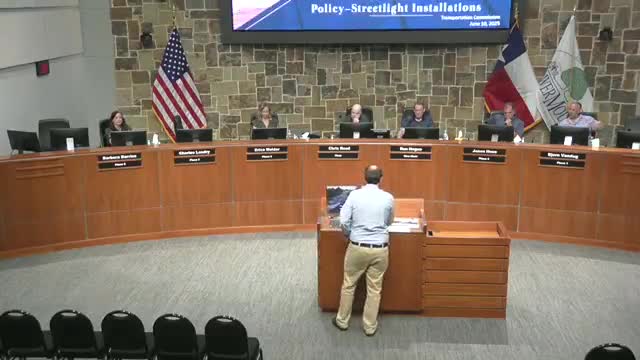
At the June 10 Flower Mound Transportation Commission work session, staff presented a draft community outreach policy to standardize public notice and verification when installing new streetlights near residences.
Thomas (staff) said the policy was designed to remove ad‑hoc practices and create a predictable sequence of outreach steps. "Anytime a new streetlight installation is within a 150 feet of residential property, community outreach would be required," Thomas told commissioners. Under the draft, staff would identify impacted property owners within a 150‑foot radius of a proposed pole, mail notices and solicit feedback; property owners would have 30 days to respond.
The proposed outreach and follow‑up sequence for town‑initiated projects is:
- Initial mailed notice with 30 days to respond. - If no response, a second mailed notice with an additional 30 days. - If still no response, a door hanger and a final 15‑day response window. - If a property owner does not respond after those steps (a total of up to 75 days), the property owner would be considered in support of the project for the purpose of decision making.
For HOA‑initiated requests, the draft makes the HOA responsible for performing outreach and submitting proof of delivery and collected feedback to the town; if staff cannot verify a response, staff will follow the town‑initiated procedures for that property owner. Thomas said staff removed overly prescriptive steps to retain flexibility around how HOAs prove delivery but will verify HOA submissions before accepting them.
Decision rule and waivers: Staff proposed that installation proceed when a simple majority (>50%) of impacted property owners support the project. In the case of a 50/50 split, staff would bring the item to the Transportation Commission for a recommendation. The draft also allows staff to waive the outreach requirement for installations on town‑designated thoroughfares addressing documented public‑safety concerns; assistant director approval would be required and staff would still notify impacted partners when a waiver is used.
Commission feedback and implementation: Commissioners pressed staff on the standard for "proof of delivery," with several arguing for clearer minimums (examples discussed included DocuSign, read receipts or signed acknowledgements). Thomas said he did not plan to require certified mail but that staff would verify outreach and follow up directly if the HOA’s materials were not verifiable. On timing, staff said the HOA route can be faster if the HOA collects responses promptly; if staff must follow up directly the full 75‑day process may apply. Thomas said staff preferred a version where HOAs do initial outreach and submit verification to the town, a process the commission generally favored. Staff will return the draft as a regular agenda item incorporating the commission’s feedback.