Get Full Government Meeting Transcripts, Videos, & Alerts Forever!
Get email alerts on the Solar Interconnection topic
No spam. Unsubscribe anytime.
Austin commissioners hear complaints about months‑long delays connecting local solar; vendors call for harmonized metering rules
Summary
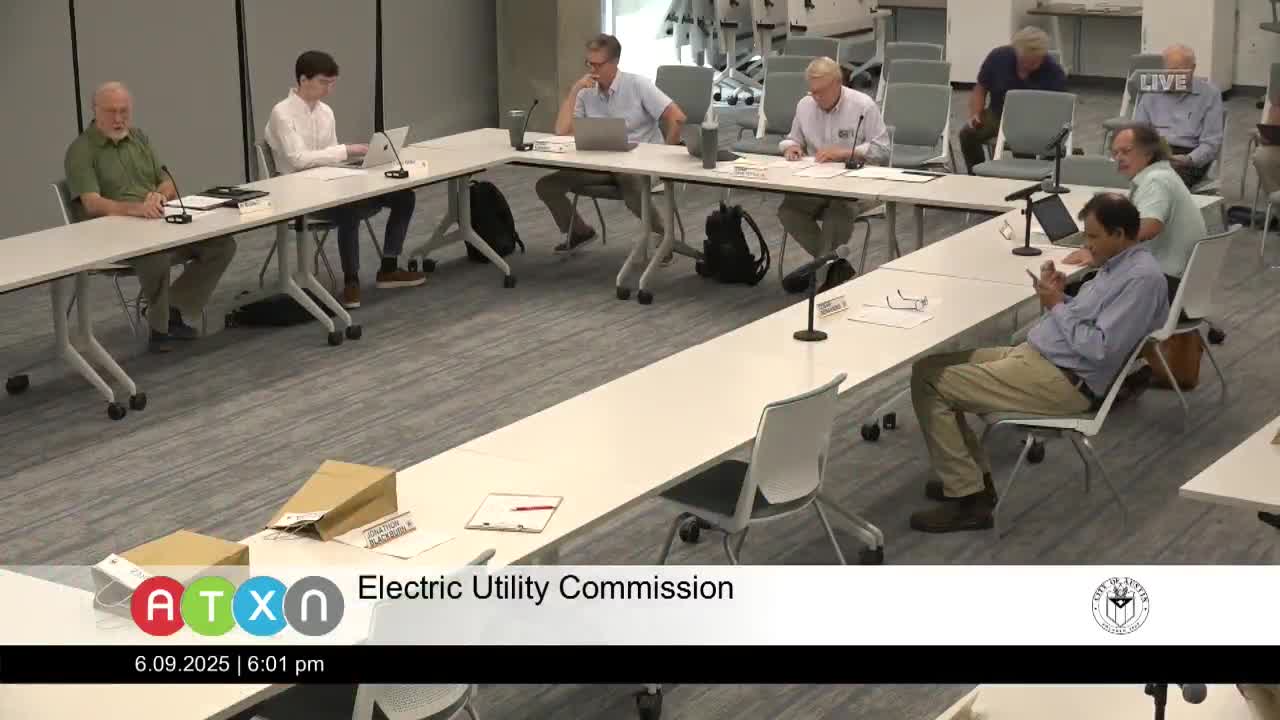
Public commenters told the Electricity Utility Commission on June 9 that completed solar installations have sat offline for months because of metering changes and inconsistent guidance from Austin Energy.
Public commenters told the Electricity Utility Commission on June 9 that completed, utility‑scale and commercial rooftop solar systems have been held from operating for months because of new or inconsistently applied metering requirements.
The most detailed complaint came from David Hogan, lead technical contact for St. Matthew’s Episcopal Church in Northwest Austin. Hogan said Lighthouse Solar completed a 110‑kilowatt installation, that Austin Energy performed an on‑site inspection and issued a March 27 letter saying the system had “permission to operate,” and that Austin Energy’s paperwork stated the system would be connected in “5 to 10 days.” Instead, Hogan said, the church learned weeks later — verbally through its vendor — that Austin Energy’s metering group required an unplanned modernization of the service interface, including new current transformers (CTs). That change, Hogan said, would require significant unplanned expense. He told the commission the system cost roughly $220,000 and that the church had received a $99,000 rebate check May 11 but still was not connected.
Why it matters: speakers said the delays undo the financial assumptions behind customer investments and slow Austin’s stated goals to add local solar and storage. Vendors warned that late‑stage requirements can make small commercial projects uneconomic and undercut Austin Energy’s stated resource and climate plans.
Stan Pipkin, owner of Lighthouse Solar, told the commission he has worked with Austin Energy for about 17 years and called the problem “a real blockage.” He said guidelines are “poorly written” and often leave customers and vendors unable to predict whether they will face additional meter or service‑interface work after final inspection. “If it is coming at the end, it is really just not tenable at all,” Pipkin said. He asked the utility to develop clear, front‑loaded standards so developers and customers can predict costs and schedule projects without surprise upgrades.
Dale Beulah, speaking during public communication, urged the utility to “promote batteries” and local storage as a way to reduce wholesale costs and congestion; he also voiced support for a City Council draft resolution asking Austin Energy to add solar to city‑owned buildings. Jorge Veil, an Austin Energy repairer and member of Third Act Texas, urged planning for far greater battery capacity, saying municipal peers have moved faster and that Austin should “plan for a lot more” storage.
Austin Energy response and next steps: Stuart Riley, interim general manager, said the metering team and solar team had not yet finalized harmonized guidance in the case cited and that the St. Matthew’s matter had been delayed by storm response activity in late May. Riley said Austin Energy staff would follow up directly with the church and Lighthouse Solar and would report updates to the commission once resolved.
Commission discussion: commissioners asked staff to clarify whether metering requests represented safety or reliability requirements and whether customers should be grandfathered under preexisting approvals. Multiple commissioners urged a single point of contact inside Austin Energy — effectively an ombudsman for customer solar projects — or a harmonized checklist so the solar, metering and development services groups provide consistent, documented requirements up front.
What was requested of the utility: speakers and commissioners asked Austin Energy to (1) follow up with St. Matthew’s and Lighthouse Solar to complete connection under the originally approved plan or explain the technical safety rationale for any new requirement; (2) harmonize and publish interconnection and metering requirements across departments; and (3) consider grandfathering projects under approvals granted before any change in metering standard.
Quotable: “We would like to be connected under the approved plan that we submitted initially up front,” David Hogan said. Stan Pipkin said the late‑stage CT and metering impacts could represent “10% up to 100% of the value of the solar project” in worst cases.
Ending: Austin Energy told the commission it will report back after staff from metering and the solar program coordinate and communicate a path forward for the St. Matthew’s project. Commissioners asked staff to place a fuller briefing on interconnection timelines, meter modernization triggers and any planned changes to the line‑extension or meter policies on a future EUC agenda.