Get Full Government Meeting Transcripts, Videos, & Alerts Forever!
Get email alerts on the Municipal Budget topic
No spam. Unsubscribe anytime.
Decatur officials outline FY2026 budget timing, tax-rate options and senior exemption discussion
Summary
City staff reviewed the FY2026 budget calendar, explained truth-in-taxation concepts including no-new-revenue, voter-approval and de minimis rates, and flagged a possible increase to the 65-and-over/disabled property-tax exemption for council consideration.
The City of Decatur’s leadership opened Budget Day with an overview of the fiscal year 2026 calendar and the tax-rate choices that will shape the coming year’s property-tax levy. City Manager Nate told the council that staff will not have final property values until “the last week in July,” and that the council must begin deliberations now to meet the city’s September budget deadlines.
The presentation explained three commonly used measures under state law: the no-new-revenue rate (last year’s levy divided by the expected total value), the no-new-revenue maintenance-and-operations rate (last year’s levy minus last year’s debt, divided by current expected value), and the voter-approval rate (maintenance-and-operations rate plus a 3.5% operations increase, plus debt). Nate also summarized the de minimis option — an additional increment that would generate about $500,000 in maintenance-and-operations revenue if adopted — and noted how different adopted rates trigger petition or election processes.
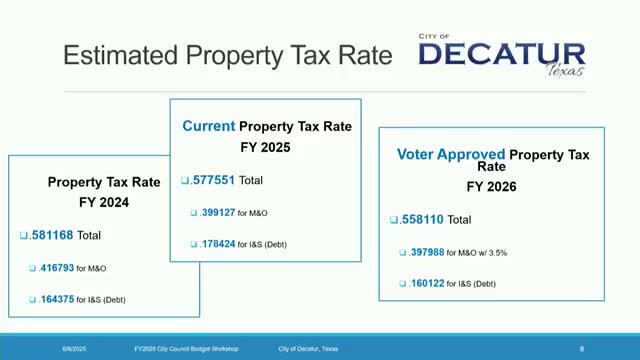
Nate said the current FY2026 forecasted taxable value for Decatur is roughly $1.455 billion, up from about $1.378 billion in 2025, and that the city’s voter-approval total tax rate under the current scenario would be about 0.55811 (39¢ for maintenance and operations, 16¢ for debt). “We won’t have hard property values until the last week in July,” he said; “if we don’t get the conversation started now, we won’t have enough time to meet our September deadlines.”
Nate walked council members through a practical example: under the illustrated voter-approval rate, a residential owner with $100,000 of taxable value would see approximately a $20 reduction in city property tax compared with last year’s payment. He also cautioned that new-construction value drives revenues and that staff has penciled in $25 million of new construction for FY2026; actual new-construction receipts could raise or lower projected revenues.
The council was also asked to consider an adjustment to the city’s age-65-and-disabled tax exemption. Staff showed a scenario increasing the exemption from $25,000 to $35,000 and estimated a levy reduction of about $120,000 for the city alongside an average taxpayer benefit of approximately $195. City staff noted that a resolution would be required and that a copy of the minutes and a resolution must be provided to the tax office before July 1 to implement a change for FY2026.
No formal action was taken; council members and staff agreed to continue budget work in upcoming meetings and to bring specific tax-rate resolutions and public-hearing scheduling to the August and September meeting dates outlined in the presentation.