Get Full Government Meeting Transcripts, Videos, & Alerts Forever!
Get email alerts on the Oral Fluid Roadside Drug Testing topic
No spam. Unsubscribe anytime.
House committee hears testimony on allowing oral-fluid roadside drug screening
Summary
The Michigan House Rules Committee heard testimony on legislation to allow police officers to use handheld oral‑fluid screening devices during traffic stops to detect recent drug use.
The Michigan House Rules Committee heard testimony on legislation to allow police officers to use handheld oral‑fluid screening devices during traffic stops to detect recent drug use.
Supporters, including Representatives Beagle and Julie Rogers and retired forensic toxicology laboratory director Kristen Burke, told the committee the devices provide rapid, noninvasive information that can help officers determine whether further evidentiary testing is warranted. Opponents, including Tim Beck of the Michigan Republican Cannabis Caucus and representatives of criminal defense groups who filed cards, said the technology does not prove impairment and raised concerns about wrongful arrests.
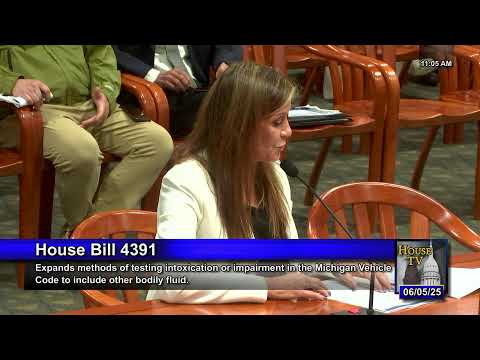
The bills under discussion were House Bill 4391 and HB 4390; committee members heard testimony and informational presentations but did not take a committee vote on the measures at the meeting.
Representative Beagle, who described herself as a law‑enforcement officer with 32 years of experience, said the handheld device is intended as a roadside screening tool rather than proof of impairment or admissible evidence. "All it does is show the officer, okay, is is is your suspicion's correct?" she said, adding that the device identifies whether a drug from one of several drug classes may be present in the driver’s system and that any laboratory confirmation would follow.
Representative Julie Rogers, who described the package as tied to Rep. Beagle’s bill, said the legislation would amend the Michigan Vehicle Code to allow collection of oral fluid (often called saliva) for preliminary testing at the roadside. Rogers cited state crash data and national trends as rationale for the bills and said the devices would be "a reliable, noninvasive, and efficient tool" when used alongside observable impairment and field sobriety testing.
Kristen Burke, who retired in 2022 as director of the California Department of Justice Forensic Toxicology Laboratory and identified herself as having over 27 years of forensic toxicology experience, told the committee that scientific studies comparing roadside oral‑fluid devices with blood sampling show the screening devices can help officers identify recent drug use more quickly than waiting for lab blood results. She explained technical limits and detection differences across drug classes and cautioned the devices are screening tools that should be used with other evidence. "Like any screening technology, these devices may sometimes produce false positive or false negative results," Burke said.
Opponents’ testimony and public‑comment cards raised legal and practical concerns. Tim Beck said earlier Michigan studies questioned the effectiveness of oral‑fluid testing for measuring impairment and called the devices "voodoo science" and "junk science." The committee record also shows cards filed by the Criminal Defense Attorneys of Michigan and the ACLU of Michigan opposing the bills and support cards from groups including AAA, Mothers Against Drunk Driving, the Michigan Sheriffs Association and the Michigan Association of Chiefs of Police.
Proponents described how the process would work if the roadside screen were positive: a second oral swab would be taken (with consent) and sent to a qualified laboratory for confirmatory testing that can identify specific drugs and approximate levels. Members emphasized that roadside results are not the same as definitive laboratory tests and described the handheld devices as a way to obtain time‑proximate information at the scene.
Committee members asked about rulemaking: Chair Schuette noted the bills had been referred to Rules because the Michigan State Police would need to promulgate rules for chemical testing administration. Rogers said MSP conducted two pilot programs and had supported the legislation and that other states, including Alabama and New York, have operational programs or studies to guide implementation.
The committee did not vote on HB 4391 or HB 4390 during the hearing; testimony and submitted materials will remain on the record as the bills proceed through the legislative process.