Get Full Government Meeting Transcripts, Videos, & Alerts Forever!
Get email alerts on the Historic Preservation topic
No spam. Unsubscribe anytime.
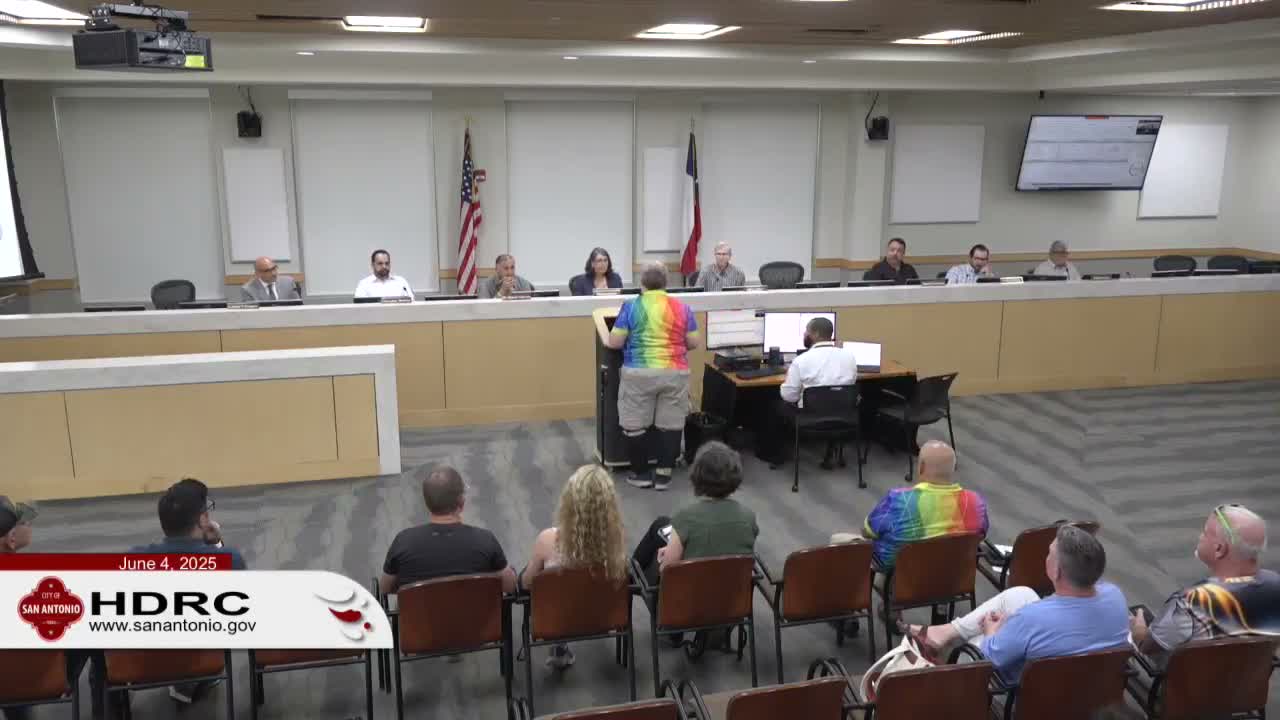
Historic review panel approves Pride Cultural Heritage District after broad public support
Summary
The San Antonio Historic and Design Review Commission voted to designate a Pride Cultural Heritage District after multiple public speakers and commissioners discussed the cultural and economic significance of recognizing LGBT history in a defined geographic area.
The San Antonio Historic and Design Review Commission voted to approve the designation of a Pride Cultural Heritage District following public testimony and commissioner discussion.
Supporters said the designation would formally recognize the neighborhood's long association with LGBT life and could help economic revitalization. "This has been consistent in the last 22 years," said James Puente, who gave his address and described the area as "a home for businesses and residences" tied to the LGBT community. Luis Ve1zquez, identified as secretary of the local LGBT Chamber of Commerce, said the district could attract small-business investment similar to other U.S. cities.
Gloria Colunga, the commission's cultural historian, explained the distinction the staff report used between "culture" and "way of life," saying culture includes traditions, music, architecture and other expressive forms that the designation aims to acknowledge. "The impact the LGBT culture has given San Antonio includes food, music, uses, spaces, architecture, art," Colunga said.
Commissioners heard contrasting views at the meeting. One commissioner said the report felt "marginalizing" and cautioned against putting culture in a geographic "box." Other commissioners replied that the commission's task was to recognize a geographic district and that additional, citywide work to acknowledge culture could follow.
After discussion the commission moved the item for a vote. The roll call recorded on the transcript shows a majority in favor, with one commissioner recorded as absent; the motion passed.
The commission's approval establishes a locally recognized area intended to acknowledge and celebrate the LGBT community's historical and contemporary contributions in that part of the city. The designation does not itself change zoning or replace any other permit process; staff reminded the public that separate municipal permits remain required for physical work.
Speakers included several community members and local historians who urged unanimous approval, and the commission agreed to the designation by roll call. The commission staff will issue any certificates of appropriateness and related notices by email within 10 days, as is the standard process.