Get Full Government Meeting Transcripts, Videos, & Alerts Forever!
Get email alerts on the Transmission Line Project topic
No spam. Unsubscribe anytime.
Elbert County staff recommends denial of Xcel Energy’s 48‑mile transmission route; hearing continued after hours of public comment
Summary
Elbert County planning staff recommended the Planning Commission recommend denial of Xcel Energy’s permit and special‑use applications for a 48‑mile, 345‑kV transmission line through the county, citing unresolved fire‑protection and infrastructure questions; the commission continued the hearing to June 4 for more information.
Elbert County planning staff recommended the Planning Commission recommend denial on Tuesday of Xcel Energy’s application for a major 1041 permit and Special Use by Review (SUR) for a 48‑mile, 345‑kilovolt double‑circuit transmission line in the county, saying key questions about wildfire risk, proof of fire protection and potential burdens on local services remain unresolved.
Stephanie Blachoviak, a certified land‑use planner with SWCA Environmental Consultants hired by Elbert County, told the commission: “Based on review of the application materials, review by applicable Elbert County departments and outside agencies and consideration of the approval criteria, staff recommends the Planning Commission make a recommendation of denial for the EXCEL Colorado Power Pathway major 1041 permit application.”
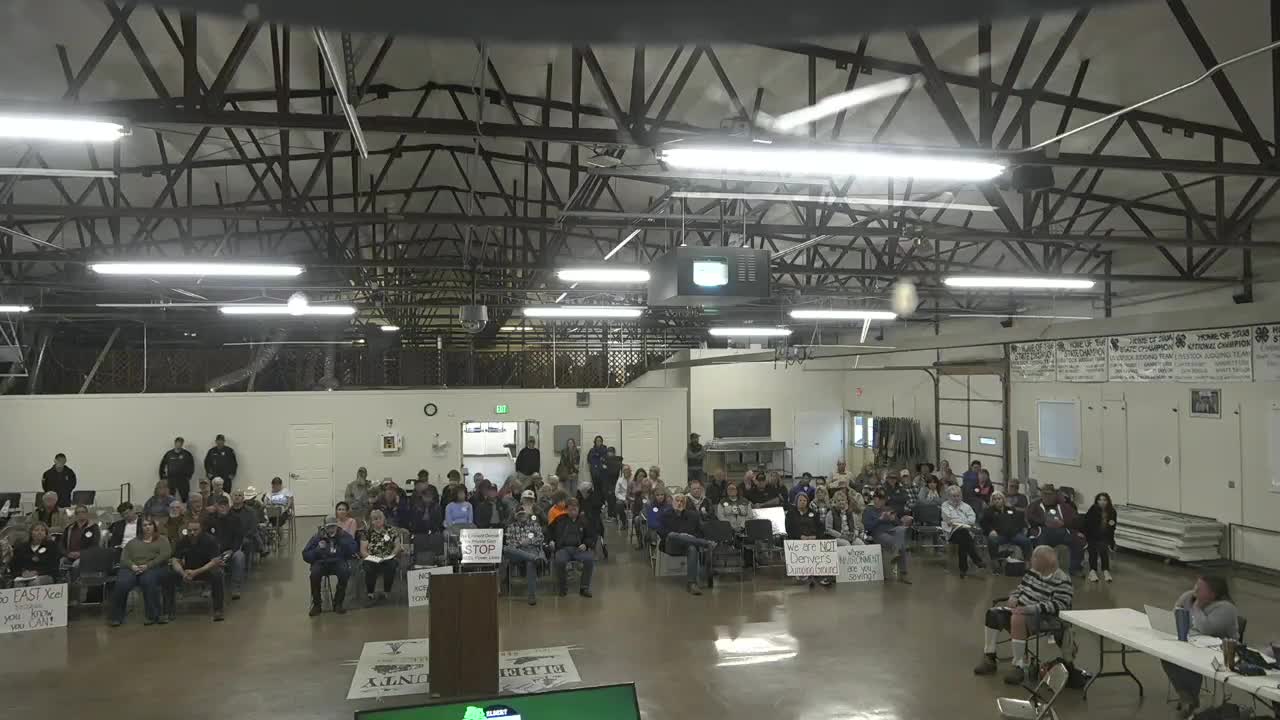
The planning commission opened a quasi‑judicial public hearing on applications identified as the ExCEL Colorado Power Pathway 1041 permit and SUR. After roughly three hours of staff and applicant presentations and more than two hours of public comment, the commission voted to continue the hearing to 6 p.m. on June 4 so commissioners can ask follow‑up questions and obtain additional information before making a formal recommendation to the Board of County Commissioners.
Why staff recommended denial
Staff told the commission it found the applicant had met some technical criteria—such as obtaining property rights, protecting water quality and certain sustainability measures—but had not adequately addressed several items tied to public safety and local capacity. Among the outstanding issues staff cited were lack of executed fire prevention and safety agreement forms from Kiowa Fire Protection District and Big Sandy Fire Protection District; unresolved comments from referral agencies including the U.S. Fish and Wildlife Service and Colorado Department of Public Health and Environment (CDPHE); and incomplete information on a road use agreement and development agreement with County Public Works.
Blachoviak said staff had specific concerns about the project’s wildfire risk analysis and the degree to which the applicant had demonstrated that potential impacts on fire prevention, response and suppression could be mitigated without imposing an undue financial burden on the county or local fire districts.
What Xcel told the commission
Representatives for Xcel Energy described the proposal as part of the Colorado Power Pathway, a multi‑segment transmission project the company says will increase statewide grid reliability and interconnect generation across Colorado. Andrew Holder, Xcel’s director of community relations and local government affairs for Colorado, said the company has sought local engagement and pointed to tax payments and a proposed county impact fee as local benefits.
“When our customers hit their light switch … we are able to deliver that 99.9% of the time,” Holder said, adding the project will produce property tax valuation increases in counties it crosses and that the company anticipates an approximately $2,500,000 impact fee to Elbert County tied to the project.
Xcel’s presenters also said they have submitted routing and siting analyses and responses to referral comments and that some discussions with local agencies are ongoing. The applicant acknowledged Tri County Fire Protection District has signed a fire‑prevention agreement, and said it is working to finalize agreements with other districts. Xcel officials told commissioners undergrounding the line for the full route would be technically challenging and far more expensive than an overhead build; they said prior regulatory reviews of the overall Pathway project found full undergrounding to be impractical.
Public comment: safety, property rights, values and health
Dozens of residents, many of whom live within a few miles of the proposed route, urged denial. Speakers raised recurring concerns about wildfire risk near the transmission line and the ability of volunteer fire districts to respond, eminent‑domain proceedings, loss of property value, viewscape changes, impacts to schools and the safety of children during school drop‑off, and health worries tied to EMF exposure.
“I would like to thank the planning commission for listening to the residents that live within 5 miles of the proposed solar farm … You were bombarded with over 2,500 pages of information on a mega utility industrial project proposal only 5 days before you had to make a decision,” said Sue Willard, identifying herself as a long‑time Elbert County resident during public comment; she urged the commission to follow county regulations.
Pam Struthers, who said she served 12 years as a volunteer firefighter for Kiowa Fire Protection District, urged the commission to weigh local firefighting capacity. “The transmission lines and associated infrastructure… have the potential to ignite wildfires, especially during dry, and windy conditions,” Struthers said, and described limited local staffing and water resources.
Several commenters said Xcel had begun eminent‑domain outreach to landowners; at least one speaker read a company email notifying a property owner that condemnation proceedings would be filed after appraisal. Residents said many landowners felt pressured or unable to take legal action and that offers they’d received were inadequate.
How the project would be built and its footprint
Staff and the applicant described the route as part of segment 5 of the broader Colorado Power Pathway. Project materials in the county record identify about 48 miles of new 345 kV double‑circuit transmission line crossing primarily agricultural (A), residential‑agriculture (RA/RA‑1) and some Economic Development Zone (EDZ) properties. The applicant’s narrative describes roughly 275 new steel pole structures (typically single‑pole configurations, with two‑pole structures at turning points), typical pole heights of about 105–140 feet, a nominal 150‑foot transmission corridor (75 feet each side of centerline), and typical pole spans near 950 feet. The record shows an approximate permanent disturbance figure of about 97 acres and a temporary construction disturbance described in the staff presentation as “about 3 10 acres” (as stated by staff).
Staff also presented the project’s visual analysis key observation points and a wildfire probability map from the Colorado Forest Atlas; staff said some of the higher probability areas and fire‑behavior estimates had not been addressed to the county’s satisfaction.
Next steps
The Planning Commission paused its consideration and voted to continue the hearing to 6 p.m. June 4 so commissioners can pose a list of detailed technical and policy questions to staff and the applicant before rendering a recommendation to the Board of County Commissioners. During the same meeting the commission approved the May 6 meeting minutes, and later adjourned for the evening.
The application remains pending; staff’s recommendation and the record assembled at the public hearing will be forwarded to the Board of County Commissioners along with the commission’s recommendation at a later date.