Get Full Government Meeting Transcripts, Videos, & Alerts Forever!
Get email alerts on the Academic Master Plan topic
No spam. Unsubscribe anytime.
University of Guam regents approve five-year academic master plan, amend policy statement and authorize borrowing for furniture
Summary
At a May 29 special meeting, the University of Guam Board of Regents approved Resolution 2511 adopting the Academic Master Plan 2025–2030, approved amendments to a campus policy statement under Resolution 2512 and authorized borrowing from the IAI fund under Resolution 2513 to pay for furniture, fixtures and equipment for new campus buildings.
Hagatña, Guam — The University of Guam Board of Regents on May 29 approved a set of measures including a five-year Academic Master Plan, minor edits to a campus policy statement on “respect, compassion and community,” and authorization for the president to borrow from an internal fund to cover expected shortfalls for furniture, fixtures and equipment (FF&E) in several new buildings.
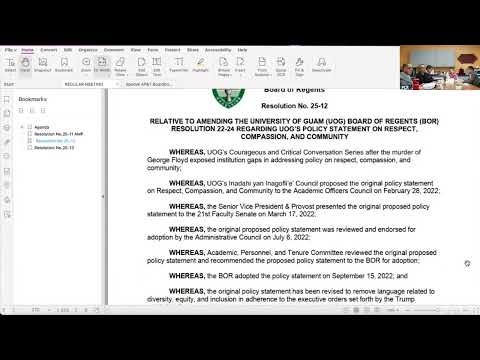
The board passed Resolution 2511 to adopt the Academic Master Plan 2025–2030, which campus leaders said trims degree credit requirements and adds new curricular and advising changes intended to improve completion and support for nontraditional students. Regents also approved Resolution 2512 to amend Board Resolution 2224’s policy statement on respect and compassion, and Resolution 2513 to authorize the president to borrow from the IAI (sometimes described in the discussion as the International Accounting Institute) fund to purchase FF&E for newly constructed campus buildings.
Board members described the Academic Master Plan as a multi-year blueprint for curriculum, advising and enrollment strategies. Senior university leadership highlighted changes that include reducing some bachelor-degree credit totals from 124 to 120 credit hours, adding internships as a core requirement for degree programs, offering full-year course-scheduling plans to help students map pathways, and lowering some upper-division credit requirements from 40 to 36 credits. The plan also calls for advisory councils for each college and school and for actions to reduce hidden prerequisites that can delay students’ progress. In presenting the item, a regent said the Faculty Senate and other campus constituencies had reviewed and discussed the plan and recommended approval.
Regent Naga formally moved to approve the Academic Master Plan. “I would like to make a motion to approve the academic master plan,” the regent said on the record. The motion was seconded; a voice vote followed and the chair announced the motion carried with no opposition heard.
Regents discussed Resolution 2512 as largely a technical update to an existing board policy so the university’s statement aligned with requirements from the new administration. The chair characterized the changes as small wording edits that preserved the policy’s intent: “There were just a few minor tweaks that we had to make, and we understand it kept the … same spirit of [the policy],” the chair said. Regents voted to approve the amendment; the board chair called the voice vote and no opposition was recorded.
Resolution 2513 drew more detailed budget and implementation discussion. The Investment Committee brought the item forward after reviewing a funding shortfall for FF&E tied to several projects. The university reported that a grant would cover most FF&E for the Student Success Center, but the Engineering Building, a newly referenced building cited in the meeting transcript, and the Nursing Annex may face shortfalls. The board authorized the president to borrow from the IAI fund to meet those shortfalls with the expectation that subsequent donations and other revenue sources would replenish the fund.
Randy, the university’s vice president for administration and finance, said the IAI account balance was “I believe there's a $5 million roughly,” and described the existing revenue streams that support related debt: a $500,000 annual appropriation from the Legislature, $100,000 per year from the university, $100,000 per year from the endowment and about $85,000 per year from the fund in question. Randy told the board the balance and the ongoing revenue mix should be sufficient to service the debt over the remainder of the loan term if reimbursements did not materialize as anticipated.
Investment Committee members said General Counsel advised that because the resolution had been changed after its initial public advertisement it had been appropriate for the committee to approve it but that the item should be re-advertised before a final action at the full board; the committee nevertheless recommended the measure to the full board. Regents approved Resolution 2513; the board chair called for a voice vote and announced the motion carried with no opposition heard.
Votes at a glance: Resolution 2511 (Academic Master Plan 2025–2030) — approved (motion moved by Regent Naga, seconded by another regent); Resolution 2512 (amendment to Board Resolution 2224: UOG policy statement on respect, compassion and community) — approved (motion moved and seconded; minor wording changes described in discussion); Resolution 2513 (authorize president to borrow from IAI fund for FF&E for new buildings) — approved (Investment Committee recommended; board approved with expectation of replenishment from donations and building revenue).
The meeting record shows the board used voice votes and the chair announced each motion carried with no opposition heard. Regents said the academic plan will be communicated across campus, reviewed annually and used to guide implementation over the next five years. The board adjourned after completing the agenda.