
Council advances fee, fine and parking changes; key amendments set for June 9 vote
Get AI-powered insights, summaries, and transcripts
Sign Up Free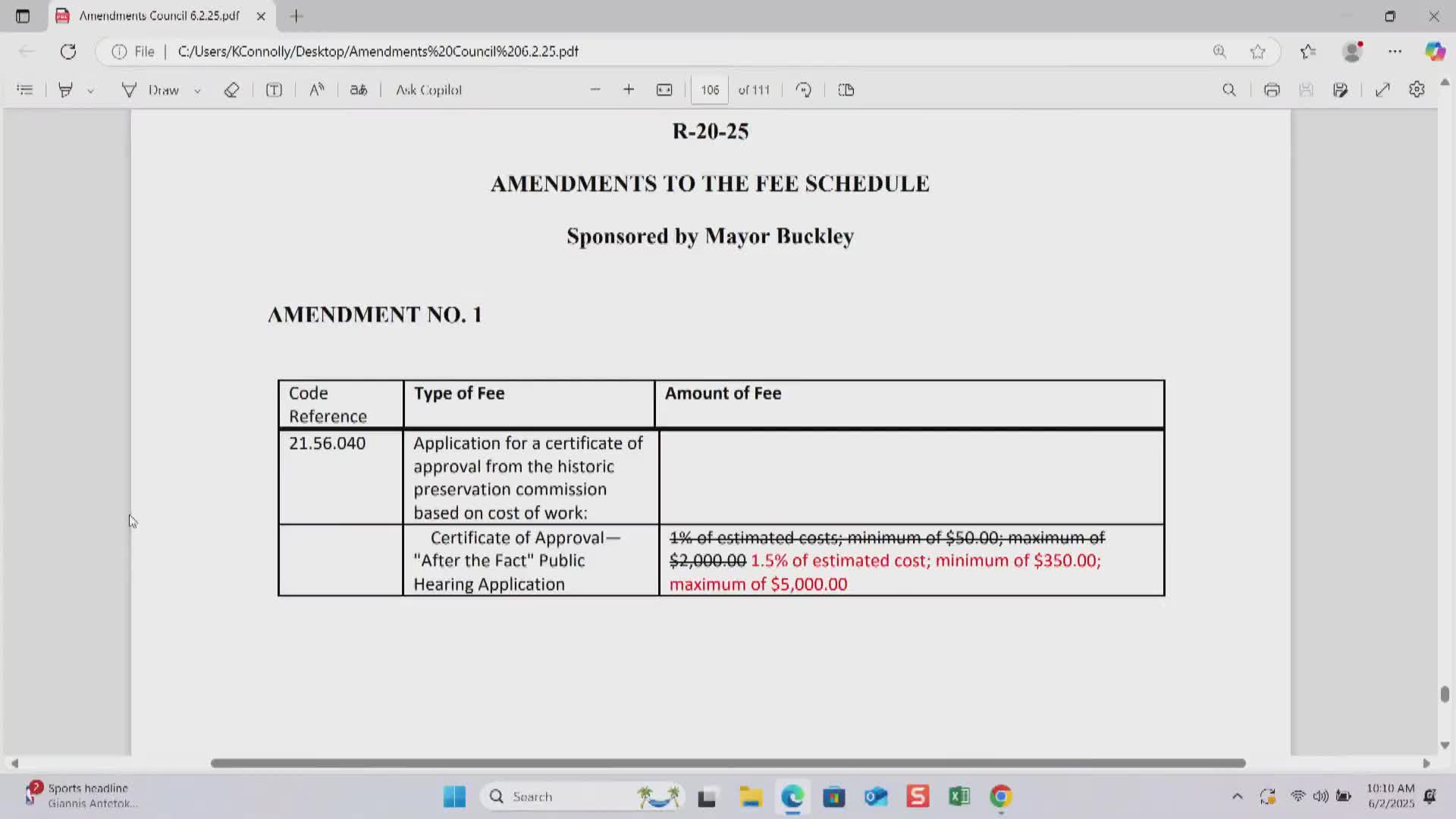
Summary
The Annapolis City Council on June 2 advanced a package of fee- and fine-related amendments, debated new parking enforcement rules and approved a sustainable mobility fund, leaving final adoption and several items for the regular June 9 meeting.
A special meeting of the Annapolis City Council on June 2 produced a series of changes and votes related to the city’s fee and fine schedules and parking enforcement policies, while several items were postponed to the regular June 9 meeting for final action.
Council members approved a sequence of amendments to the fine schedule that city staff said were intended to better align fines with enforcement costs. Director Jakubiak described one technical change as a cleanup: “this modifies code reference 21.56.040… and changes it to 1.5% of estimated cost, minimum of $3.50, maximum of $5,000,” referring to a fee tied to certificates of approval after the fact for public hearings. The council voted to postpone final adoption of the larger fee schedule to allow members more time to review related ordinance language and bundled budget amendments.
Nut graf: The meeting combined technical code cleanups with higher-profile changes to how the city handles sidewalk maintenance, parking in city garages and a new sustainable mobility fund tied to outdoor dining and private off‑street parking. Council members argued over policy trade-offs — whether to raise fines to deter violations or use fees and new funds to mitigate impacts on mobility and local businesses.
Most consequential votes and debates - Sidewalk penalties and snow removal: The council approved an amendment that increases certain sidewalk-related penalties and creates categories for commercial and multifamily sidewalk maintenance fines. That first amendment to the fine schedule passed on a 5–3 roll call. Several council members argued the change should be coordinated with separate snow‑removal legislation because one sponsor preferred a fee-for-cost model rather than simply raising fines. - Parking garage and off‑street violations: Council members debated a proposed new penalty for off‑street parking violations tied to expired or unpaid sessions in gateless garages. Director Marcus Moore said the city’s parking software can be updated to handle the new penalty and described the penalty as intended to capture motorists who enter a gateless garage and do not start a parking session: “We just have to… make the change in the system itself.” After extended debate about effects on drivers and downtown visitors, the council approved the wording that will be returned on June 9 for final action. The roll-call on a related amendment to the fine schedule (off‑street/expired session fines) recorded 6 yes, 1 no and 1 abstention in favor of moving the language forward. - Sustainable mobility fund / outdoor dining fees: Council members adopted language creating a sustainable mobility fund and an outdoor‑dining fee. The amendment folded existing speed‑camera receipts into the new fund and established a per‑seat or per‑space fee for outdoor dining and some private off‑street parking uses. Supporters said the fund is intended to pay for sidewalks, bike lanes and micro‑mobility alternatives; critics warned the charge may be passed to small businesses and make outdoor dining costlier for patrons. The council voted to advance the amendment with a plan to finalize numbers and implementation details on June 9. - Speed cameras and staffing: The council added funding to staff up the traffic safety effort tied to speed and red‑light cameras. Council members debated whether oversight should be a sworn traffic sergeant or a civilian/contract position and whether camera placement should be driven by public‑safety crash data rather than revenue potential. Director Marcus Moore urged a dedicated manager to coordinate placement, vendor work and community outreach.
Why it matters: These fee and fine changes will affect the cost of city services for residents and businesses, the operations of gateless parking garages and how the city funds nonautomobile mobility projects. Council members emphasized that some increases are intended to recover city costs and to discourage after‑the‑fact approvals and unsafe parking behavior, while opponents said the city should avoid pricing low‑income residents or small businesses out of public life.
What’s next: The council left final adoption of several fee and fine schedule items for its regular June 9 meeting. Staff will provide updated language showing exactly where fees and fines will be applied and the administration will supply implementation details for parking software, garage vendors and the sustainable mobility fund.
Ending: With votes taken and some close roll calls recorded, council members asked staff to circulate clear, line‑by‑line text and fiscal balancing numbers before the June 9 meeting so members can finalize the package.