Get Full Government Meeting Transcripts, Videos, & Alerts Forever!
Get email alerts on the District Policy Review topic
No spam. Unsubscribe anytime.
Sierra Vista board reviews ASBA model policy updates, debates keeping district-specific language
Summary
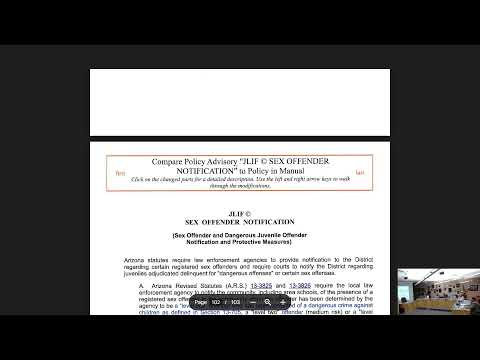
The Sierra Vista Unified School District Governing Board spent a work session reviewing suggested policy changes from the Arizona School Boards Association (ASBA), with staff recommending most of the association’s wording updates while asking the board to reject three district-specific replacements.
The Sierra Vista Unified School District Governing Board spent a work session reviewing suggested policy changes from the Arizona School Boards Association (ASBA), with staff recommending most of the association’s wording updates while asking the board to reject three district-specific replacements.
The discussion focused on whether to accept ASBA’s more general, statewide model wording or to retain the district’s more detailed, locally tailored language. Brent, the district staff presenter, told the board that ASBA’s revisions “are trying to make these policies that are going out less district specific and more general.” Board member Frank Conroy urged caution: “I would urge everybody to consider a no change,” arguing that the district’s existing statements better acknowledge parents, teachers and the community.
Board members discussed three specific policies staff recommended denying: GBK (staff grievance), GCF and GDF (hiring). Brent said the district had already revised its grievance and hiring language after consulting the district attorney and that adopting ASBA’s replacements would “completely override what we actually do.” On hiring changes, staff noted ASBA’s model would add requirements for reporting certain offenses and a broader reference-check requirement; HR staff (Ms. Gomez) and the presenter warned that requiring contact with more prior employers would make an already difficult hiring process harder because “we already have difficulty getting callbacks from their most recent employers.”
Members debated the ASBA-proposed rewrite of the policy preface (the district’s foundational “beliefs/mission” section). Some board members favored keeping the district’s current, more specific paragraphs that name roles for parents, teachers, principals and the board. Supporters of the ASBA wording said a shorter, general preface preserves district flexibility and pointed to more detailed, cross-referenced policies later in the manual (for example, KB on parental involvement). Brent noted that ASBA’s change often moves statutory language into the policy text so readers do not need to consult multiple statutes.
The board examined multiple other model changes that either condensed language, moved statutory wording into policy for clarity, or added subheadings that make responsibilities (for example, board powers, board president duties, oath of office, open-meeting rules, and superintendent duties) more explicit. Staff highlighted several technical points for the board to decide during first reading: whether to retain district-specific language (which would remove the ASBA copyright), what date to put for open-enrollment deadlines in the ASBA fill-in template (staff recommended using the district’s internal practice rather than a hard state-enforced cutoff), and whether to include optional subsections in certain policies.
Board members asked and staff answered procedural questions about how policy changes will move forward: the work session is to guide which ASBA suggestions will be placed on a future agenda for first reading. Brent explained that if the board wants specific language restored, board members can submit suggested edits between the first and second readings for formal consideration.
Two formal procedural actions were recorded during the meeting: the board adopted the meeting agenda at the start of the session and later voted to adjourn. Both votes were recorded as passing 5–0.
The work session included repeated references to legal citations (for example, ARS provisions governing board duties and parental-involvement statutes), and staff repeatedly recommended coordinating any district-specific drafting with the district attorney to avoid creating an unmanageable, non-copywritten policy manual that would require frequent legal review.
The board did not take final votes on any policy adoptions at this work session; staff will place items the board wishes to proceed with on an upcoming regular-meeting agenda for first and second readings as required by board practice and statute.