Get Full Government Meeting Transcripts, Videos, & Alerts Forever!
Get email alerts on the Cdbg Funding topic
No spam. Unsubscribe anytime.
Staff recommend Waukesha’s $246,954 CDBG allocation, prioritizing ADA playground surfacing, public art and senior services
Summary
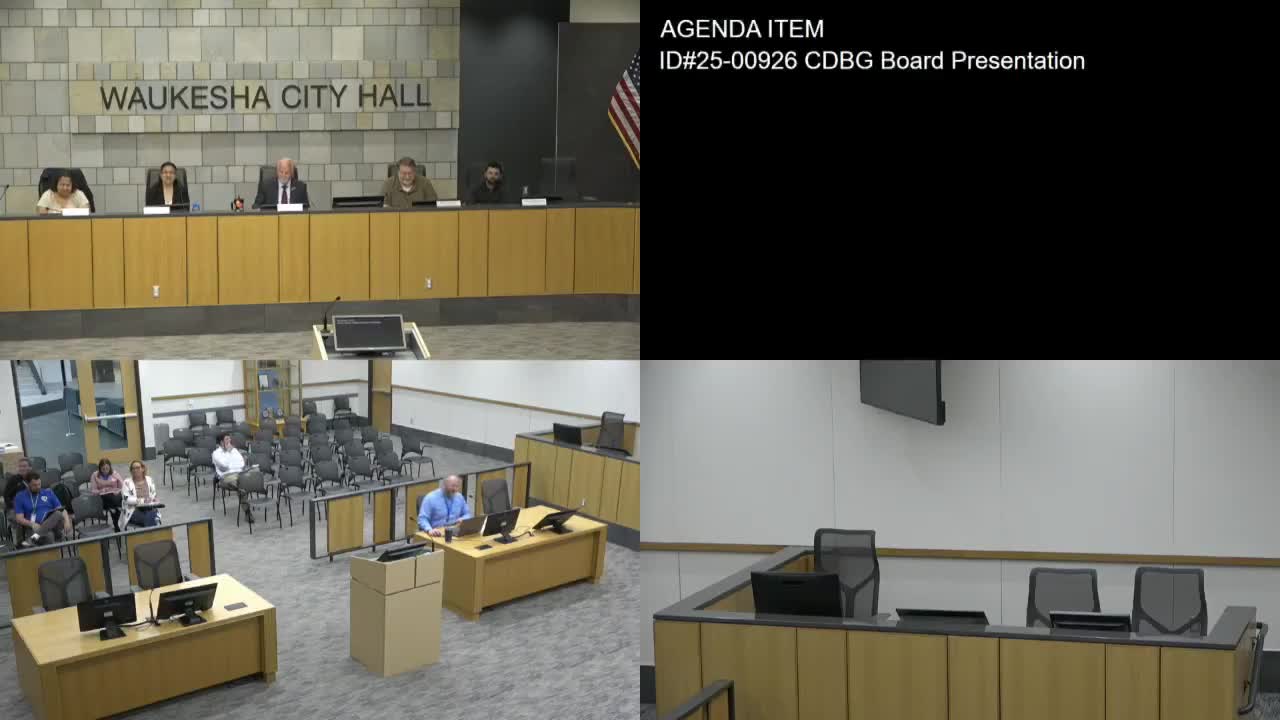
City staff recommended distributing $246,954 in 2026 Community Development Block Grant funds with 85% for facilities projects and 15% for programs, and plan to forward an allocation resolution to the City Council for approval.
City staff recommended distributing $246,954 in 2026 Community Development Block Grant (CDBG) funds with 85% ($209,911) directed to facilities projects and 15% ($37,043) for social programs, and said they will forward an allocation resolution to the City Council for approval.
The recommendation—which staff said reflects county and HUD entitlement rules that limit program spending—would fund ADA surfacing work at two playgrounds, façade and awning grants, a landmarks paint-and-repair pool of grants, and public-art projects. On the programs side staff recommended fully funding a senior activity coordinator position, topping up a combined Swim, Park & Play summer program, and continuing support for a part‑time adaptive inclusion specialist who works at before/after-school and summer sites.
A city staff member presenting the allocation overview said the total available for 2026 is $246,954 and that 85% of that must be used for facilities, yielding $209,911 for projects and $37,043 for programs. The presenter said the total amount requested across projects and programs was about $306,000, and staff adjusted the recommended amounts to fit the available entitlement.
Melissa Lipska, Parks and Forestry Operations Manager, said the parks ADA funds are intended for pour-in-place rubber surfacing at Buckner Park and Greenway Terrace playgrounds. "It's the pour in place rubber surfacing. That ensures that, at any given time, we are 100% compliant with ADA as far as the surfacing goes," Lipska said, noting that mulch and wood chips can quickly become noncompliant.
Staff recommended $128,962 toward the ADA playground surfacing; Lipska said the remaining cost would be requested through the city's Capital Improvement Program (CIP) budget cycle. The ADA surfacing project had been requested at $226,000 but staff recommended the lower match to fit the entitlement total.
Charlie Griffith, a staff member who spoke about the landmarks program, said the city has nine historic districts and 31 individually designated landmarks—about 400 properties overall—most of which are in low- and moderate-income census tracts. He described the paint-and-repair grants as covering up to 15% of a project's cost, paid after project completion and capped at $3,000 per application. Griffith said last year the city allocated $20,000 to the program and approved nine grants; the staff recommendation for the upcoming allocation is $25,000 for landmarks paint and repair grants.
Public art funds were recommended at $30,949 to support projects the city has been advancing, including completion of Freedman Alley murals, utility box wraps slated for downtown this summer, and exploratory placemaking along Riverfront Street.
On façade grants, staff recommended $25,000. A staff speaker said that in 2024 $15,000 in façade grants leveraged about $260,000 in downtown building improvements and cited recent recipients including Martinez Law Office and a renovation at 344 Broadway Avenue.
On programs, Mark Thompson, recreation supervisor, described the senior activity coordinator and broader senior programming. "Our senior activity coordinator application... is all about removing seniors from living in isolation," Thompson said. He said the city served roughly 2,000 unduplicated seniors across fee-based and free programs last year and about 1,200 unduplicated participants in free offerings.
Gayla Evers, recreation supervisor, summarized the combined Swim, Park & Play summer program for children at Hoard and Buckner parks, describing an eight‑day, two‑week enrichment model that pairs recreation activities and a half‑hour swim lesson and provides a free lunch through a partnership with Saint Vincent de Paul. Evers said the county requested combining two previously separate small grants into one so individual grants exceed $5,000.
Evers and other parks staff said the adaptive inclusion specialist is a part‑time position serving 11 before/after‑school sites and nine summer day camps to help children with IEPs participate in programs that otherwise could not afford one‑to‑one aides. "We are able to keep kiddos in the program more successfully now than ever before," Evers said, and staff recommended funding the specialist at the requested $15,300.
Staff also discussed a reallocation of unspent 2025 CDBG funds after the county adjusted entitlement estimates; presenters said public infrastructure funds from 2025 had no specific plan and could be repurposed under the reallocation resolution. A staff member explained that under a memorandum of understanding the city uses Waukesha County as the intermediary with HUD; the county administers many program dollars on the city's behalf and directs some funding to noncity entities such as Hebron House and Habitat for Humanity.
The presenter said the allocation recommendation will be brought to the City Council for approval at its June 3 meeting, and that staff sometimes return later in the year to reallocate smaller amounts between projects if needed. No formal vote or council action occurred at the staff meeting.
Clarifying details discussed in the meeting include: total 2026 CDBG entitlement of $246,954; 85% facilities allocation ($209,911) and 15% programs ($37,043); project requests (ADA surfacing requested $226,000; façade/signs/awnings $25,000; landmarks paint/repair $25,000; public art ~$30,000); staff recommendations (ADA $128,962; façade $25,000; landmarks $25,000; public art $30,949; senior activity coordinator $15,000; Swim/Park & Play combined allocation increased to $6,743 from a $3,880 request; adaptive inclusion specialist $15,300). Several staff noted that remaining project costs may be covered through the CIP process or other city funding sources such as ARPA loans, and that CDBG‑funded construction projects are subject to prevailing wage rules while ARPA loans are not.
The staff recommendation packet and the reallocation resolution will move to the City Council for final approval; staff said council consideration is scheduled for June 3.