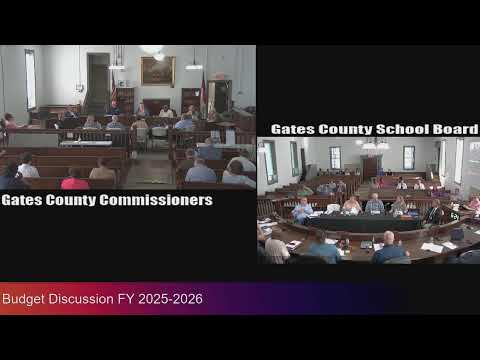
Gates County school leaders present $2.8 million "additional needs" request as commissioners press for priorities
Loading...
Summary
Gates County Schools leaders presented a planning budget and a $2.845 million “additional needs” list for fiscal 2025–26 and answered commissioners’ questions about declining enrollment, fund balance and potential cost-saving steps including the pending consolidation study.
GATESVILLE, N.C. — Leaders of Gates County Schools presented the county Board of Commissioners a planning budget and a $2.845 million “additional needs” request for fiscal 2025–26 on May 14, while commissioners pressed the school board for a prioritized list of what to fund and asked for details on staffing, enrollment decline and potential cost savings.
The request was presented by Dr. Barry Williams, superintendent of Gates County Schools, and Chief Financial Officer Stephen Harrell, who described the superintendent’s package as a template showing the full cost of the district’s needs. "We are here tonight to share the Board of Education's approved budget," Dr. Williams said. Ms. Casper, speaking on behalf of the superintendent’s executive cabinet, summarized the additional-request priorities and said, "we are requesting an increase in the investment provided to our 1,376 young scholars enrolled in Gates County Schools."
Why it matters: Commissioners and school leaders are working in a revaluation year when the county is aiming for a revenue-neutral tax rate, meaning any local increase would be politically and financially sensitive for taxpayers. The school system’s presentation laid out how declining average daily membership (ADM) and changes in federal and state funding affect recurring operating needs and left commissioners seeking a shorter, prioritized list of items the county might fund this year.
Most important facts first: the district presented a planning-line request of $2,845,000 in additional funding above the roughly $2,953,000 of local funding the district typically receives; the superintendent described the $2.845 million as a template that the board used to show what “would be needed” if all line items were funded. The district also reported a combined planning total of about $5,833,000 when the additional request and base funding are combined.
What the money would buy: school leaders highlighted five near-term priorities they said would most affect student outcomes: expanded classroom and lab devices (technology; about $200,000 requested for new computer labs and Chromebook replenishment), targeted support for low-performing schools including reading and instructional coaches (reading / low-performance support and instructional coaches combined in the presentation), additional support for exceptional children (EC) services (about $150,000 requested), and health/counseling positions (a middle-school counselor plus two additional nurses were discussed). The whole supplemental list also included curriculum purchases, a testing coordinator position for the high school, and two proposed director positions (secondary and special populations).
Grants, capital projects and limits on funding: CFO Stephen Harrell and facilities staff reviewed a decade of capital grants the district has received and said grants totaling roughly $30,000,000 had been awarded for school construction and upgrades over many years, including multi-million-dollar projects for Central Middle School and Gates County High School and renovations at multiple elementary schools. Harrell noted limits on some state funding sources: "Real property acquisitions, mobile or modular classroom purchases ... purchases of computers ... and school campus features such as roads, parking lots, playgrounds, tennis courts ... are prohibited" from lottery grant spending. Facilities staff described current needs and ongoing grant-funded renovation work that they said carries no additional cost to Gates County taxpayers.
Enrollment, fund balance and federal funds: district staff said ADM has declined from earlier highs (2015-era ADM figures cited during the meeting) to 1,411 this year and a projected 1,373 for 2025–26. Harrell said the county previously appropriated $828,000 to the schools and that appropriation has not been spent: "that money hasn't been touched yet." He also described the district’s planning fund-balance trajectory and the end of large federal ESSER funding as reasons the district’s operating budget is tighter this year.
Commissioners’ questions and requested next steps: Commissioners repeatedly asked for a shorter, prioritized “must-have” list and for operational steps the district has taken to reduce costs as enrollment declined. Commissioner Emily Truman, chairman of the Gates County Board of Commissioners, said the county’s goal is to remain revenue neutral and asked the school board to separate absolute priorities from desirable items. Multiple commissioners asked whether consolidation or partial grade reconfigurations had been considered; Dr. Williams said a consolidation study being conducted by consultant Dr. Jim Watson is ongoing and will return results this summer with options for the board to consider.
Procedural actions: the joint meeting approved the respective agendas, accepted an addition to open the meeting with prayer and the Pledge of Allegiance, recessed for board discussion, and adjourned after the joint session. No formal budget appropriation or county funding decision was made at the meeting; county staff said the county manager will present the commissioners’ budget at the Board of Commissioners’ June 2 meeting.
Context and next steps: school staff framed several requests as investments aimed at improving student outcomes after the district’s recent low-performing designation on state accountability measures. Commissioners asked the school board to return a prioritized list — a short “must-have” subset and a second tier of “would like to have” items — so the commissioners can consider what to include in a revenue-neutral county budget. Dr. Williams said the $2.845 million is a planning template and not a formal budget resolution. The consolidation study and the county manager’s upcoming budget presentation are the immediate next steps for decision-making.
Ending: Both boards and staff emphasized willingness to continue joint quarterly meetings and public outreach. County Manager Sauer said the commissioners will present a county budget on June 2 and requested continued public engagement before any final appropriation decisions are made.