Get Full Government Meeting Transcripts, Videos, & Alerts Forever!
Get email alerts on the Humanitarian Aid Gaza topic
No spam. Unsubscribe anytime.
UN says Israel denied six coordinated humanitarian movements to Gaza; warns aid pipeline unable to meet needs
Summary
The United Nations said Israeli authorities denied six coordinated UN humanitarian movements to Gaza and that approved cargo is not reaching Palestinians in sufficient quantities, while OCHA and UN officials warned that existing distribution schemes cannot meet the needs of some 2.1 million people.
The United Nations said Israeli authorities denied six coordinated humanitarian movements into Gaza and that trucks whose entry the UN had sought were not available for UN personnel to collect, undermining efforts to deliver aid to about 2,100,000 Palestinians.
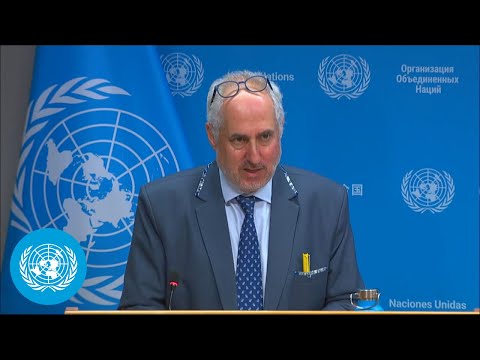
"It is not for lack of trying," the UN spokesperson said, adding: "They sure ain't making it easy for us." The spokesman said about 900 truckloads had been submitted for Israeli approval, roughly 800 were approved, and that only a fraction reached the Palestinian side through the Karim Shalom crossing. The spokesperson said UN teams and partners were limited by insecurity and restricted access even where goods had been cleared for the Israeli side.
The Office for the Coordination of Humanitarian Affairs (OCHA) told the briefing that 600 days into the escalation in Gaza, ongoing air and ground operations were "further dismantling the means of survival" for the territory's population. Jonathan Whittall, head of OCHA's office for the occupied Palestinian territory, said the recent images and reports illustrate "how the collective punishment of Palestinians continues and the assault on their control of aid."
UN officials said current ad hoc distribution schemes — including four distribution hubs secured by private U.S. security contractors in central and southern Gaza — reach only people who can access those hubs and cannot substitute for an enabled, system-wide humanitarian operation that reaches civilians "wherever they are." The spokesperson said that during the ceasefire, the UN and partners had demonstrated the ability to deliver when restrictions on aid were eased and urged that the existing system be re-enabled.
Sigrid Kog, the acting UN special coordinator for the Middle East peace process, briefed the Security Council earlier and warned that the two-state solution is "on life support," saying settlement expansion, land seizures and settler violence in the West Bank are accelerating de facto annexation and could make a two-state outcome physically impossible if unchecked.
UN officials also repeated calls for unimpeded access through multiple crossings, for Israeli facilitation of humanitarian movement inside Gaza, and for reestablishing the full flow of aid, including fuel deliveries. The spokesperson said all six UN requests for coordinated movements that day had been denied by Israeli authorities and that the denials included requests to retrieve fuel and to travel to Karim Shalom.
The briefing included repeated appeals to respect humanitarian principles. When asked about cooperating with alternative distribution actors, the UN spokesperson said: "We will not bend on our principles. We will not participate in operations that do not meet our humanitarian principles."