Get Full Government Meeting Transcripts, Videos, & Alerts Forever!
Get email alerts on the Land Use Development Regulations topic
No spam. Unsubscribe anytime.
Skagit County unveils Title 14 reorganization to simplify development regulations
Summary
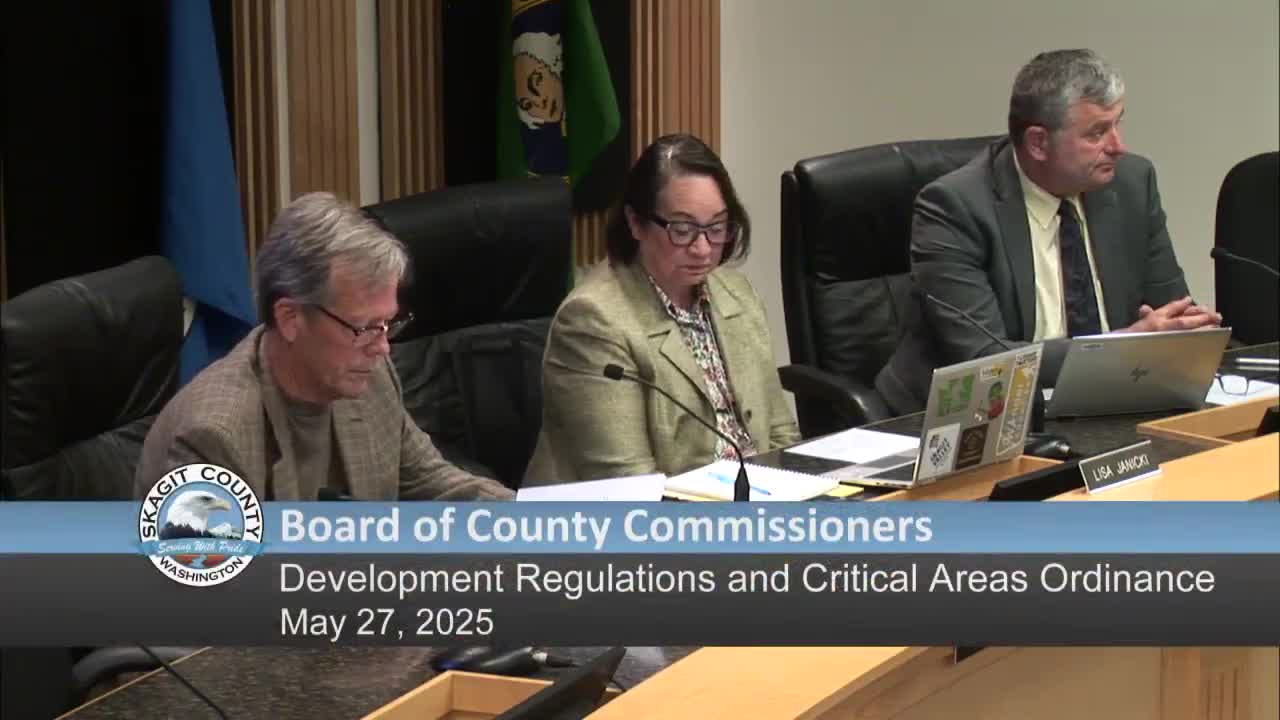
Skagit County planning staff on May 27 presented a reorganization and limited rewrite of Title 14, the county’s development regulations, intended to make the code easier to navigate, standardize definitions and prepare the county for a modern online code platform.
Skagit County planning staff on May 27 presented a reorganization and limited rewrite of Title 14, the county’s development regulations, intended to make the code easier to navigate, standardize definitions and prepare the county for a modern online code platform.
The revision reorganizes more than 20 chapters into seven divisions, breaks long chapters (notably the zoning chapter) into shorter topical chapters, moves use standards out of definitions and converts many long text paragraphs into tables, Planning and Development Services consultant Ryan Walters said. “Title 14 … is the county’s development regulations,” Walters told the commissioners, adding the project is primarily “mechanical” rather than a comprehensive rewrite.
Planners said the effort responds to an outdated structure (parts predate 1990), public feedback and state law changes tied to the county’s comprehensive plan update. The draft keeps many existing substantive rules in place while clarifying organization and terms; staff highlighted specific rewrites for setbacks, legal lots of record, use standards and a new “how to use the development code” chapter.
Why this matters: County staff said reorganizing Title 14 should reduce user error, shorten review times and make it easier for applicants, elected officials and staff to locate standards — a tangible improvement for permitting and enforcement. The rework is also intended to make the code compatible with modern online code publishing tools that display tables and definitions with hover text.
Key details - The revision creates numbered divisions that align with chapter numbering to aid navigation and breaks the large zoning chapter (previously 14.16) into many smaller chapters including new use standard chapters (proposed 14.18 and others). Walters said tables will list uses (P = permitted, AC = accessory, HE = hearing examiner special use, AD = administrative special use) and standards will be located in use-standard chapters rather than embedded in definitions. - Setbacks received a “heavy rewrite,” adding illustrations, simplifying double-front setbacks and clarifying measurements for flag lots and other irregular parcels. The draft also pulls setback rules out of the definitions chapter and into a dedicated setbacks chapter. - Natural resource lands (existing chapter 14.38) were consolidated into a single chapter but retained their chapter number; staff noted a reservation in the scheme for future subdivision of critical areas into separate chapters. - The update incorporated several items directed by the comprehensive plan update and recent state law changes, including middle housing provisions and limits tied to sewer service for some higher-density options. Consultants told the board that some provisions (for example, unit lot subdivisions) were retained even though later legislative changes removed a statewide requirement.
Public process and next steps Planning staff said the Planning Commission made a recommendation on the development regulations May 20; the code will continue through a multi-draft public comment process. Staff announced a public comment period from May 29 through June 16, with a county Board public hearing on June 16 and an opportunity for the Board of County Commissioners to adopt the comprehensive plan update and development regulations on June 23. The critical areas code update is still under Planning Commission review and will be scheduled for the Board later in the summer.
Cautions and limits Walters stressed that the update is not a full rewrite: "If we were doing a complete rewrite of the code, we would need quite a bit more time," he said. Commissioners and staff repeatedly noted that some references and chapter numbers will change and that the online display and cross-references will be updated in subsequent drafts. Several commissioners asked for clarity on how sewer connection requirements (required by recent state law for some limited-area higher-density development) will apply to specific LAMIRD/UGA areas such as Big Lake, Alger and Edison; staff said they would research whether the state requirement requires connection to an existing sewer system and report back.
What to watch - Draft 2 will be posted and shared for a second round of comments; staff said a third draft will follow and the Board hearing is scheduled for June 16. - The Planning Commission will continue deliberations on the critical areas update at its June 17 meeting. - Staff said they will investigate whether the state sewer requirement references connection to an existing system (staff comment: “We can look into that more”) and will clarify which LAMIRD/UGA areas, if any, meet the existing sewer connection criteria.
Ending County planners said the reorganization aims to reduce surprises for applicants and staff, not to substantially change policy except where the comprehensive plan or state law requires it. "It should be harder to find surprises in the code," Walters said. The Board did not take immediate action on the draft; the matter will return after the public-comment and Planning Commission processes.