Get Full Government Meeting Transcripts, Videos, & Alerts Forever!
Get email alerts on the Procurement Oracle Amp topic
No spam. Unsubscribe anytime.
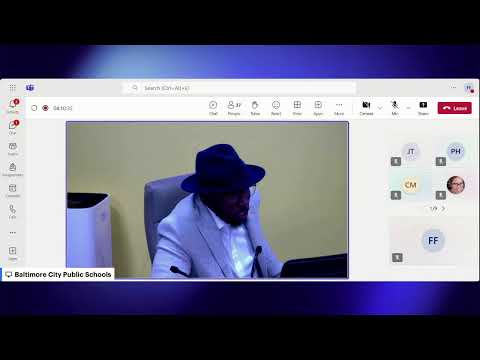
Baltimore City school board delays vote on Oracle/AMP procurement for two weeks amid member questions
Summary
Commissioners voted to postpone a decision on procurement item 14.01 (Oracle/AMP rollout) until June 10 after several members requested more detail and staff warned further delay risks project disruption.
The Baltimore City Board of School Commissioners voted on May 27 to delay action on procurement item 14.01 — the districts ongoing Oracle/AMP enterprise system implementation — until the June 10 meeting, after several commissioners sought additional details about cost, rollout timing and operational impacts.
Vice Chair Parker said staff had provided background on the RFP and candidate selection earlier in the process, but a number of commissioners asked for more time to review the programs trajectory and how it aligns with budget and operations. Commissioner Ames Messenger moved to postpone the vote for two weeks; Commissioner Coy seconded. The motion passed after a roll call vote that produced a majority of recorded "yes" votes and one abstention.
Commissioners pressing for the delay cited outstanding questions about the implementation timeline and whether the district would have sufficient reporting and budget transparency at later phases. "We'd like some more information to be really confident that this Oracle Suite decision is going to get us where we want to go," Commissioner Ames Messenger said, urging more clarity on how the system will support accounts payable, human capital and school budgets.
Chief Tommy Jones and Chief Financial Officer Chris Doherty described the status of the multiyear implementation and warned that longer delays could have ripple effects. "We are contractually obligated to meet certain dates to sign our contracts and renew for the next year," Chief Jones said; he also said postponing indefinitely could prompt vendors to refuse further work or impose additional fees. Doherty described the project as a phased, complex enterprise-resource-planning transition and said the district has already addressed many early implementation issues but still faces additional work in phases two and three.
Doherty added that the district has paid vendors and stabilized several finance processes under phase one, and that the remaining work, while challenging, was moving forward. "The next year or two is going to be like living in a home that's being remodeled," he said, cautioning that additional delay could amplify costs and schedule risk but noting the project team expects to complete the remaining phases.
The boards vote to defer item 14.01 was procedural: commissioners pledged to use the extra two weeks to gather more detailed documentation from staff and the vendor on implementation milestones, cost trajectory and how the system will surface school-level budgeting and procurement data.
The item will return to the board on June 10 for further consideration.
Votes at a glance: The motion to delay item 14.01 was moved by Commissioner Ames Messenger and seconded by Commissioner Coy. The roll-call vote recorded a majority of "yes" votes with one abstention (Commissioner Redding Longer). The motion passed and the item was tabled until the June 10 meeting.
Ending: Staff said they would supply additional documentation to commissioners before the June 10 meeting. The board asked staff to provide clearer timelines, evidence of vendor obligations, and examples of the specific dashboards and reports schools and board members will be able to use when the system is fully implemented.