Get Full Government Meeting Transcripts, Videos, & Alerts Forever!
Get email alerts on the State Legislation topic
No spam. Unsubscribe anytime.
County hears legislative update on ambulance reimbursements, local sales tax shift and Duck River protections
Summary
At the Maury County Commission meeting May 19, contract lobbyist James Dunn briefed commissioners on several state bills affecting county finances and environmental protections, including a study on ambulance reimbursement, a shift in local sales-tax distribution and a shelved proposal affecting Duck River scenic protections.
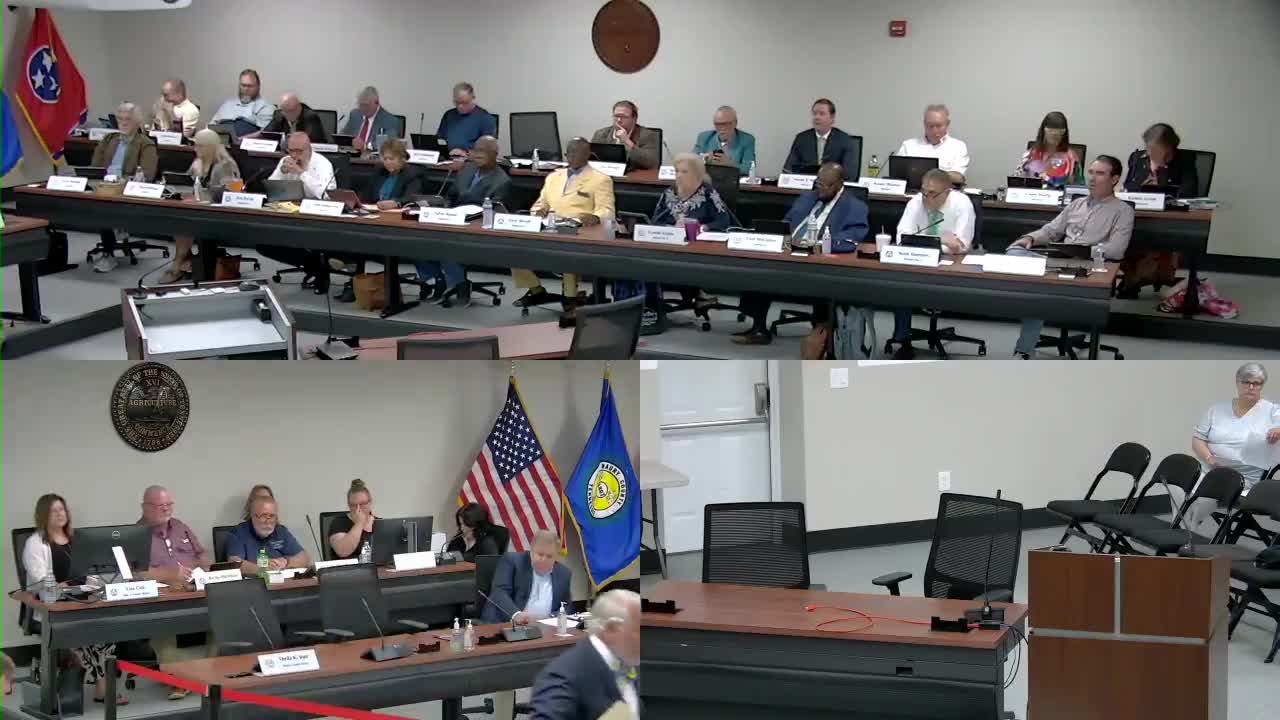
Maury County — At its May 19, 2025, meeting the Maury County Commission received an update from James Dunn, the county’s contract lobbyist with the law firm Frost Brown Todd, on state legislation that could affect county revenues and services.
Dunn told commissioners that a bill originally drafted to require cities to reimburse counties for ambulance services was amended into a study. "We have amended that bill to create a study," Dunn said, and the measure was routed to the Tennessee Advisory Commission on Intergovernmental Relations (TACIR) to gather data on how ambulance services are structured and reimbursed across Tennessee’s 95 counties. Dunn said TACIR will study Medicare and Medicaid reimbursement rates and other county and municipal arrangements and that county representatives will have opportunities to provide input during the study period.
The change means no immediate statutory reimbursement requirement was imposed; instead, Dunn said the study should produce data the county and state lawmakers can use to shape future legislation. "We will have to consider new legislation… but that'll be based on that study," he told the commission.
Dunn also briefed the commission on enacted legislation that changes how a portion of state-collected local sales tax is distributed. He said House Bill 1329 and Senate Bill 1315 cut in half the state’s administrative portion of the local option sales tax so the reduced state share will be returned to counties and cities; across Tennessee that shift is about $17 million, Dunn said. He did not have a county-specific dollar figure at the meeting and said the administration is still awaiting detailed calculations for Maury County.
On environmental matters, Dunn said a proposal that would have rolled back restrictions intended to protect parts of the Duck River did not move forward this session after its sponsor agreed not to press it. He said the state has funded a multi-year Duck River study — initially proposed near $100 million and later reduced to about $60 million — and that lawmakers and the governor are engaged on the topic.
Commissioners raised a related concern about recent legislation on public notices. Commissioner Daniel said he was reviewing Senate Bill 760 and House Bill 773, which he described as changes to public notice requirements that could add costs for local governments and third-party posting requirements. Dunn said he would check the enrolled public chapters and fiscal notes and report back to the commission.
Why it matters: the ambulance reimbursement study could lead to future mandates or funding shifts affecting county budgets and EMS contracts. The local sales tax distribution change increases funds flowing to counties and cities but the county’s specific share was "not specified" at the meeting. The Duck River matter remains under legislative and executive review and could return in the second year of the General Assembly.
What commissioners asked and next steps: commissioners asked whether the ambulance-study findings require a new bill to accomplish reimbursement changes; Dunn said the enacted amendment that created the study is final and any new statutory approach would require fresh legislation. He advised the commission that TACIR will hold meetings and that Maury County representatives, county mayors and the County Mayors Association will have opportunities to provide input before any new bill is filed. Dunn also said he would follow up on Senate Bill 760 and House Bill 773 and share any public chapter/fiscal-note details with the commission.
Speakers quoted or paraphrased in this article appear in the article’s speaker list; direct quotations are verbatim from the transcript where possible.