Get Full Government Meeting Transcripts, Videos, & Alerts Forever!
Get email alerts on the Impact Fees topic
No spam. Unsubscribe anytime.
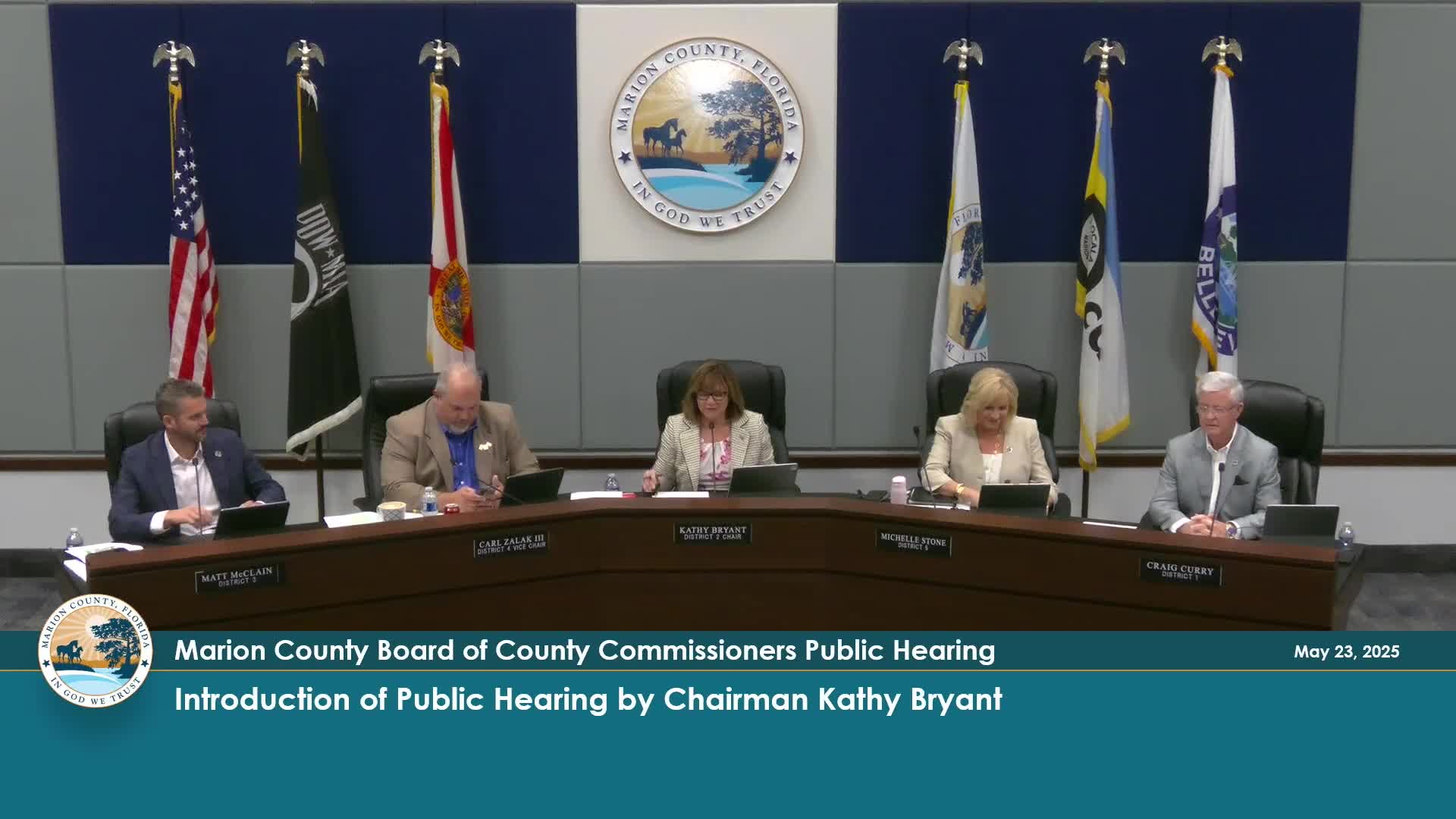
Marion County adopts fire-rescue and EMS impact fees; ordinance sets collections to begin Oct. 1
Summary
The Marion County Board of County Commissioners unanimously adopted an ordinance creating fire-rescue and EMS impact fees, approving a consultant—s study and setting fee collection to begin Oct. 1, county counsel said.
The Marion County Board of County Commissioners unanimously adopted an ordinance creating fire-rescue and emergency medical services (EMS) impact fees, approving a consultant—s impact-fee study and adopting a fee schedule the board directed be collected beginning Oct. 1, county counsel said.
The ordinance creates Division 3 of Chapter 10, Article 11 of the Marion County Code and establishes separate countywide EMS fees and fire fees that will apply to the unincorporated county and the municipalities of Valley View, Dunnellon, Reddick and McIntosh where noted. The ordinance also includes developer-credit provisions for contributions such as land or station construction.
The fee study presented to the board documents the county—s inventory of fire and EMS capital facilities, estimates the cost of adding capacity for growth, subtracts anticipated funding from other revenue sources, and divides the net capital cost across demand to compute per-unit fees. "Impact fees by definition are 1 time capital charge to new development," the consultant said at the hearing, describing the study's consumption-based methodology.
Key figures reported in the study include 32 fire stations; roughly 174,000 square feet of fire-rescue facilities and about 94,000 square feet attributed to EMS; an estimated land value of $65,000 per acre; building unit-cost ranges of about $300 to $500 per square foot depending on station type; and a level-of-service of roughly 9,700 people per fire station and about 18,000 per EMS station. The consultant reported a net per-resident capital cost of about $475 for fire and about $150 for EMS after credits for other revenues (primarily sales tax), producing example fees of about $750 for fire and $240 for EMS for a 2,000-square-foot single-family home (combined about $990). The study projected annual revenue from the fees in a range of about $4.6 million to $5.6 million depending on permitting levels.
Outside counsel Heather Ensenosa, of the law firm Nabors, Giblin & Nickerson, advised the board the ordinance contains the required findings, definitions and developer-credit language and adopts the consultant—s study into the record. Ensenosa said the ordinance makes fees a condition of certificate of occupancy, in line with similar local fees, and that the ordinance sets collection to begin Oct. 1 for permits or certificates of occupancy filed on or after that date.
Ensenosa also cited state law in support of the fees, saying the Florida Impact Fee Act (codified at section 163.31801 of the Florida Statutes) authorizes impact fees for public facilities and includes fire and EMS among those facilities. The consultant noted recent state legislation affecting impact fees generally, including changes passed in 2021 and a more recent Senate bill with additional approval requirements; Ensenosa said that later bill had not been signed and emphasized its effect would take hold only after the new law is enacted.
Two members of the public addressed the board during the public-comment portion of the hearing. Roland Boyd, who identified himself as a union president for Marion County firefighters, said, "I represent more than 530 brave firefighters and EMS providers of which 80% of them live in Marion County. And we fully support adopting the fire and EMS impact fees." Brian Donnelly, a resident, urged higher impact fees to ensure growth pays for infrastructure: "I encourage you to raise fees to build a bigger and better community. I ask you to make Ocala great again."
Following the presentations and public comment, Commissioner Zalick moved to adopt the ordinance at the full (100%) schedule recommended in the study; Commissioner McLean seconded. The motion passed unanimously with all commissioners present voting yes. The ordinance as adopted directs that fees be deposited to accounts restricted to projects that add capacity to fire-rescue and EMS infrastructure and allows credits where private development provides approved public-capital contributions.
The ordinance and study include the statutorily required notice provisions and specify that projects already in the permitting pipeline at enactment will not be assessed. The board did not adopt separate staggered or phased percentages; the adopted motion applied the full fee schedule as presented.
City and county staff will now implement administrative procedures for fee collection and for tracking credits and restricted use of fee revenues. Ensenosa placed the adopted study into the public record at the hearing. The county will use the fees to fund capital additions that expand capacity, not for routine maintenance or to remedy existing capital shortfalls, consistent with impact-fee legal limits described in the study.
The board adjourned the hearing after the vote and scheduled its next regular meeting for 2:00 p.m.