Get Full Government Meeting Transcripts, Videos, & Alerts Forever!
Get email alerts on the Police Community Relations topic
No spam. Unsubscribe anytime.
DeKalb committee defers resolution to create LGBTQ+ police liaison, seeks wider input
Summary
A DeKalb County committee deferred for two weeks a resolution requesting an LGBTQ+ police liaison position, hate-crimes training and related measures after testimony from Georgia Equality and discussion of training, scope and funding.
A DeKalb County Internal/Intergovernmental & Public Safety Committee on an item requesting the county administration implement an LGBTQ+ police liaison position, require hate-crimes identification training and related measures and programs voted to defer the resolution for two weeks to gather additional input and speakers.
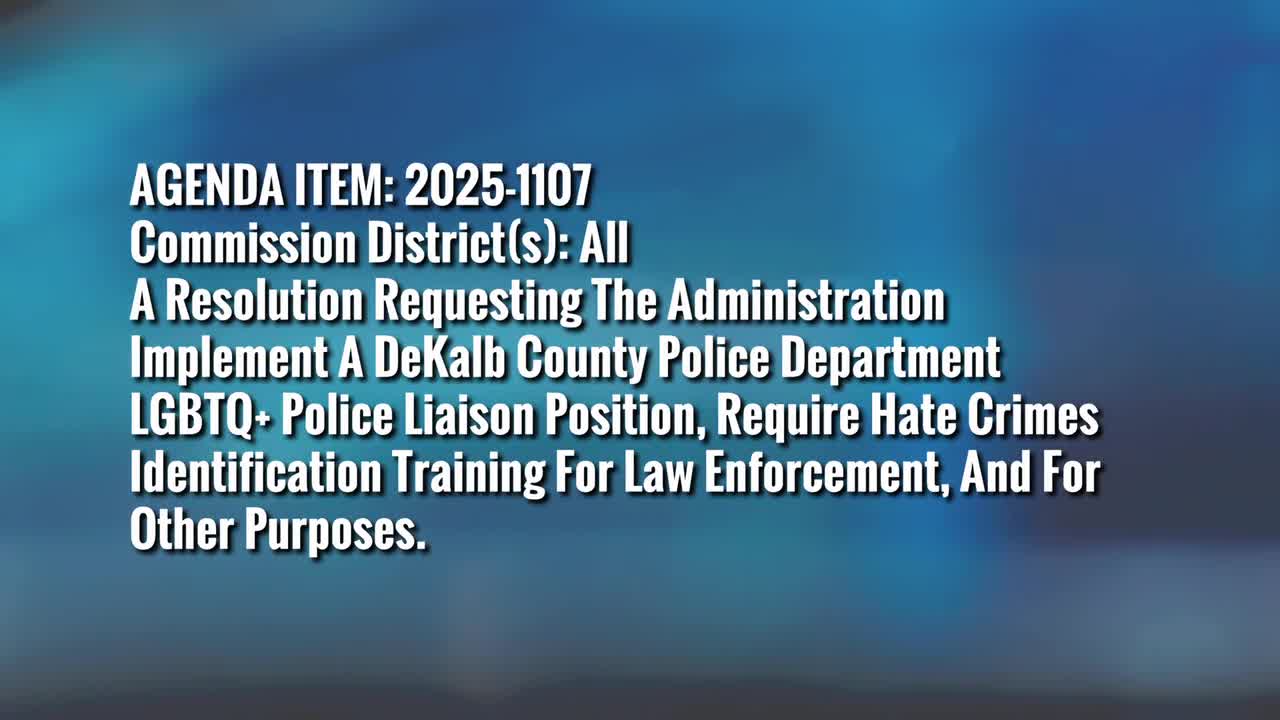
The resolution, filed as item 20251107, asks the administration to implement an LGBTQ+ liaison within the DeKalb County Police Department and to require hate‑crimes identification training for law-enforcement personnel. Commissioner Terry introduced Georgia Equality deputy executive director Chanel Haley to describe how other jurisdictions have implemented liaison roles.
Chanel Haley, deputy executive director, Georgia Equality and the Equality Foundation of Georgia, told commissioners that some implementations are ineffective when they are “created ... and leaving it at that, to where that person has 0 authority,” and that a successful liaison should have clear duties, visibility and the authority to raise internal concerns. Haley pointed to Atlanta as a model where the liaison attends community events, can be requested at incident scenes and helps lead recruit and in‑service training. “They also bring in the public from the community to be able to do run scenarios,” Haley said, citing training on field encounters including name mismatches and intimate-partner incidents.
DeKalb Police leadership said departmentwide training on LGBTQ+ issues is already in place and that a department training supervisor developed a lesson plan that the chief submitted to the Georgia Peace Officer Standards and Training Council (Georgia POST) for statewide use. “This training is continuous,” the chief said, adding that the lesson will be included in in‑service training next year and in the academy curriculum.
Committee members raised questions about scope, overlap with other specialized units and funding. Commissioners discussed whether a liaison should be one position or part of a broader portfolio of liaisons for different communities. One commissioner noted DeKalb already has a nondiscrimination ordinance covering sexual orientation and gender identity. Another asked how a liaison would address hate crimes, trafficking and vulnerabilities among youth and unhoused people; Haley and the chief said liaisons can support identification, community outreach and referrals to victim services.
Commissioners also discussed the mechanics of implementation. Committee members noted the organizational act limits the board’s direct creation of positions; the resolution therefore requests the administration to implement the liaison. Commissioner Terry said the county has vacancies and that funding could be explored by the administration; the committee did not direct specific budget actions.
After discussion, Commissioner Johnson moved to defer the item for two weeks and Commissioner Davis Johnson seconded. The committee voted by voice; the motion carried.
The committee asked staff to invite additional subject-matter speakers for the deferred hearing, including organizations and agencies with experience on hate‑crimes response and human‑trafficking support services. The item will return to committee on the date scheduled after the two‑week deferral.
Ending: The deferral preserves the committee’s request for additional community input and for the administration to outline implementation options; no formal liaison position was created or funded by the committee vote.