Get Full Government Meeting Transcripts, Videos, & Alerts Forever!
Get email alerts on the Education Technology topic
No spam. Unsubscribe anytime.
Talbot County Public Schools presents AI guidance for 2025–26, recommends guidance document over immediate policy
Summary
Talbot County Public Schools staff presented a district AI guidance document developed by a multi‑school committee; the board discussed linking it to existing administrative regulations and monitoring state guidance before adopting a formal policy.
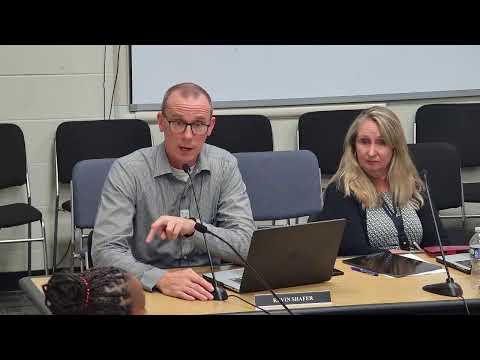
Miss Warner, lead of the TCPS AI committee, presented a draft guidance document on artificial intelligence use in classrooms and for staff during the Talbot County Public Schools Board of Education work session on Aug. 18.
The document — the product of a committee that reviewed sample policies from other states, MSDE materials and local examples such as Calvert County — is framed as a roadmap for “responsible AI integration” for the 2025–26 school year. It proposes a “SMART” framework (support learning, maintain equity, account for privacy, reinforce transparency and train educators), recommends transparency rubrics for classroom assignments, and lists prohibited uses such as plagiarism and harmful actions.
Board members and staff said the guidance is intended to be nimble rather than a fixed policy while state guidance evolves. Miss Warner said the district plans to pilot the rubric in secondary schools first because staff there expressed the most need for direction, and then expand support to elementary grades where some students are already using AI on devices. She noted the committee drew on materials from other states, including a rubric used by North Carolina public schools.
Board discussion focused on where the guidance should live in district governance. Miss Warner and other staff recommended keeping the document as a district guidance item tied to administrative regulations (ARs) and the technology acceptable‑use regulations so it can be updated quickly. A board member urged the policy committee to consider creating a short, general policy that would house more flexible ARs and avoid uneven enforcement; others cautioned that Maryland’s Code of Conduct and MSDE guidance on academic integrity are still being updated, and that the district may want to wait for state updates to avoid multiple revisions.
Staff also flagged operational details discussed during the presentation: recommending free, school‑appropriate AI tools for staff and students when available; clarifying that commercial tools such as ChatGPT have age restrictions (ChatGPT requires users to be 13 and would not be recommended for younger students); and noting that AI “detectors” can generate false positives for non‑native English speakers, a caution against heavy reliance on detection software for discipline.
No formal vote was taken. Several board members asked that the guidance be returned to the policy committee for further work on how it connects to existing ARs and the district technology acceptable‑use regulation.
The presentation materials and committee resources are posted in a shared Google document for staff reference; staff said portions of the guidance have already been piloted and discussed at secondary schools.
Board members said they want the district to continue to collect implementation data during the school year and to revisit whether a formal policy should be adopted after piloting the guidance and following any MSDE or state Code of Conduct updates.