Get Full Government Meeting Transcripts, Videos, & Alerts Forever!
Get email alerts on the Opioid Settlement Funding topic
No spam. Unsubscribe anytime.
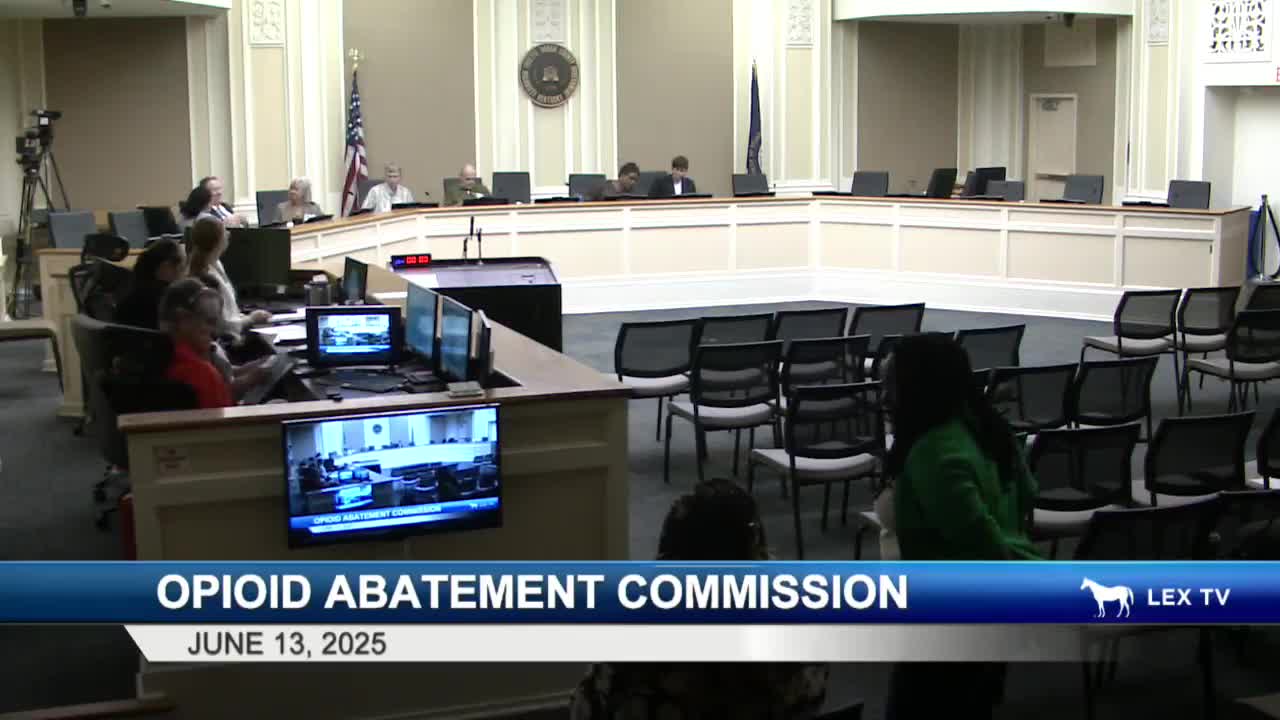
Opioid Abatement Commission approves recommendations 1–7, drops school funding item and defers health-department funding
Summary
The Lexington-Fayette Opioid Abatement Commission approved a package of recommendations on settlement-fund uses but removed a proposed allocation for Fayette County Public Schools and deferred a proposed allocation to the Lexington-Fayette County Health Department pending a fuller commission and conflict-of-interest review.
The Lexington-Fayette Opioid Abatement Commission voted to approve recommendations numbered 1 through 7 from a nine-item packet, removed recommendation No. 9 (funding for Fayette County Public Schools) and deferred recommendation No. 8 (funding for the Lexington-Fayette County Health Department) for consideration at a later meeting when more commissioners are present.
The packet presented by staff member Carmen condensed earlier work-group proposals into nine recommendations for the mayor. Carmen said, "you'll see there's 9 recommendations," then guided the commission through the items and the proposed grant tiers and program ideas. Commissioners debated the items, raised conflict-of-interest and quorum concerns for some allocations, and approved a motion to send the seven-item package to the mayor without No. 9 and with No. 8 left for a later meeting.
Why it matters: The recommendations are intended to guide how opioid-settlement funds will be used locally, including grants to community groups, expanded outreach and treatment supports, corrections-related reentry services and housing assistance. The packet sets priorities that the mayor and city government may use when allocating money from settlement proceeds.
What the commission approved and what remains unresolved
- Approved (items 1–7): The commission approved a suite of measures that include creating an interest-bearing account for funds; hosting a recovery conference; launching a tiered community grant program (macro/mini/micro tiers); expanding the substance use disorder intervention program operated through Lexington-Fayette Urban County Government (LFUCG); allocating support for community corrections reentry services; creating a micro-grant pot targeted to neighborhood associations and faith-based and grassroots groups as a distinct tier within the grant structure; and allocating funds to develop low-barrier housing for people with opioid use disorder and co-occurring conditions. The motion to approve items 1–7 passed; one commissioner indicated an abstention during the voice vote, but specific vote counts were not reported in the record.
- Removed from the packet (item 9): The commission agreed to remove the recommendation to allocate funds specifically to Fayette County Public Schools. Commissioner Kimberly Baird (recorded on the motion) moved to remove No. 9; Margaret Pesciano seconded. The motion passed on a voice vote: "All those in favor? Aye. Anybody opposed? No. Alright. Motion carried. Number 9 is removed from our recommendation."
- Deferred (item 8): Funding specifically earmarked for the Lexington-Fayette County Health Department (item 8) was set aside until a future meeting because staff raised a conflict-of-interest issue: if a commissioner is employed by a potential recipient, that commissioner would need to recuse from discussion and voting, and with a bare quorum a recusal could prevent action. Commission counsel’s statement that a recipient-employment relationship "would require recusal from a vote and participation in the discussion" prompted members to defer final action on item 8 until a meeting with fuller attendance.
Key program details and discussion points
Tiered community grants: The packet sets out a tiered grant structure. Commissioners and staff described three tiers: micro grants (presented in the packet as $2,500–$5,000), mini grants ($5,000–$25,000) and macro grants (starting at $25,000 up to larger awards). The commission decided to keep a discrete pot for neighborhood associations, faith-based groups and grassroots organizations within the tiered framework rather than creating a separate carve-out for faith groups alone. Staff agreed to adjust language so the grant descriptions remain examples rather than prescriptive lists of allowable uses.
Substance use disorder intervention program: Commissioners endorsed expanding LFUCG’s outreach work, including adding outreach staff, vehicles and flexible dollars for field work. Carmen noted an increased need for proper disposal of drug paraphernalia and proposed training community members and establishing reporting tools (examples discussed included QR codes or 311-style reporting) so outreach staff can respond and connect people to services. The expansion discussion also referenced Recovery Supportive Living Assistance (RSLA) funds and the need to fund extended-release medications (RP Meds) where providers identified that as a primary request.
Community corrections/reentry supports: The packet recommends allocating support for county community corrections to fund reentry navigation, medication-assisted treatment access, peer navigation and post-release stabilization. Commissioners discussed that new Medicaid rules enabling payment for incarcerated persons’ services may create a funding stream but likely would not cover all local needs; the commission flagged coordination, staffing and facility logistics as unresolved implementation questions.
Jail-based substance treatment certification: Commissioners agreed that the wording on the packet should be revised: instead of recommending a "court-based diversion or deflection program" (which the jail cannot itself create), the commission recommended that the jail pursue certification as a state-authorized substance-abuse treatment program so incarcerated people housed locally can receive treatment and, when applicable, receive credits or other benefits tied to certified programs.
Low-barrier housing: The packet includes a recommendation to allocate funds for low-barrier housing (housing-first style). Commissioners asked staff to verify that proposed language does not conflict with recent state law (House Bill 5), which contains provisions limiting certain uses of public funds for housing tied to behavioral or sobriety conditions. Commissioners directed staff to check statutory language and report back; the commission retained the housing recommendation but asked for technical legal review before final submission to the mayor.
Conflict-of-interest and process points
Commission counsel advised that commissioners employed by a potential fund recipient must recuse from participation and voting on that recipient. Because the commission was operating with a bare quorum, members said a recusal could prevent action; that procedural constraint was the main reason item 8 (health department funding) was deferred rather than voted on.
Next steps and administrative notes
Staff will revise packet language (grant descriptions, the jail-treatment item title, and examples of allowable uses) and check the low-barrier housing language against House Bill 5. Recommendation No. 8 will be revisited at a future meeting when more commissioners can attend. The commission made several corrections to the special-meeting minutes and adopted the corrected packet for transmission to the mayor with the stated exclusions and conditions.
Ending: The commission adjourned and set its next regular meeting for July; staff will return with language edits and legal review regarding House Bill 5 before the packet is finalized for the mayor.