Get Full Government Meeting Transcripts, Videos, & Alerts Forever!
Get email alerts on the Utility Consumer Notification Energy Incentives topic
No spam. Unsubscribe anytime.
Maryland PSC weighs how utilities must notify customers about federal, state energy incentives
Summary
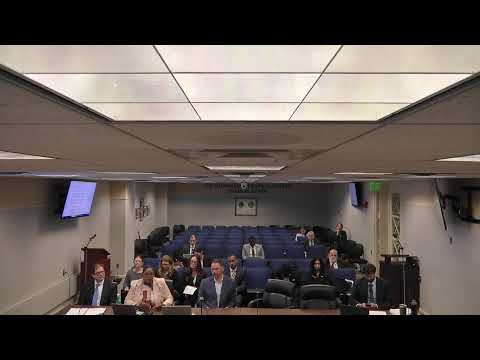
Michael Dean, speaking on behalf of the staff of the Maryland Public Service Commission, told commissioners the agency has filed proposed regulations to implement 2024 legislation directing utilities to provide customers information on federal and state rebates, tax credits and other incentives that support energy-efficiency investments.
Michael Dean, speaking on behalf of the staff of the Maryland Public Service Commission, told commissioners the agency has filed proposed regulations to implement 2024 legislation directing utilities to provide customers information on federal and state rebates, tax credits and other incentives that support energy-efficiency investments.
The legislation, House Bill 864, enacted as Chapter 539 of 2024 and codified in Public Utilities §7-228, directs the commission to require gas and electric companies to post information on incentives for energy-efficient and non–fossil-fuel appliances, breaker-box upgrades and portable heating and cooling equipment — items not normally covered under the EMPOWER program. The commission’s Order No. 91175 directed staff to prepare proposed regulations; staff recorded that filing as rulemaking 88.
Why it matters: commissioners and stakeholders said making customers aware of available incentives could help households reduce consumption and lower bills, but they sharply debated how the information should be delivered so it is timely, usable and cost-effective.
Staff recommendation and rationale
"It could end up that this list could become quite extensive over time and actually add a few dollars to the annual bills," Michael Dean said, explaining staff’s preference to require utilities to post the information on their websites and to refer customers to that online location rather than mandate mass mailings of full lists twice a year.
Dean told the commission staff’s view is the statute requires utilities to assemble the statutory list of incentives and make it available, but that routing customers to a maintained web location reduces direct mailing costs that would be assigned to ratepayers.
MEA and OPC proposals
Babatunde Idrisu, energy policy staff at the Maryland Energy Administration, asked the commission to require utilities to update website material within 30 days of any change and to file written notice to the commission of major changes within the same timeframe. "We want the information to be up to date," Idrisu said.
Portia Oduro of the Office of People’s Counsel recommended more proactive direct customer notification. OPC proposed that utilities notify customers in spring and fall — ahead of heating and cooling seasons — by regular mail and by electronic mail where customers consent, and suggested utilities use bill text, customer portals, emails or clickable PDFs to reach customers. Oduro said direct notification would promote equity by reaching households with limited internet access and help increase participation in energy-efficiency programs.
Cost, format and targeting concerns
Commissioners and utility representatives raised trade-offs. Commissioner Linton said some customers cannot access websites and argued for at least targeted mailed notices so those households receive timely information. "Not everybody is gonna be able to access the website," Linton said.
Staff and several commissioners noted a potential per-customer cost increase. Dean estimated the additional mailing could add "one or two dollars a year to the bill." OPC said that modest cost could be justified given high energy bills and potential customer savings from incentives.
Utility representatives said existing practices vary. Brent Vallea for Baltimore Gas and Electric and Taylor Beckham for the Potomac/Hudson companies said utilities already maintain web pages and submit marketing material semiannually in their EMPOWER filings; PHI and other utilities indicated adding a separate, targeted bill insert specifically focused on federal and state incentives would be an added cost where no such insert currently exists.
Commission debate and next steps
Commissioners discussed several implementation options: (1) require utilities merely to post and maintain the information on their websites, (2) require direct customer notice twice a year by mail or email, or (3) adopt a hybrid approach such as a brief bill blurb or single targeted insert that directs customers to fuller information. Several commissioners suggested a stakeholder work group to develop messaging and formats judged most useful to consumers.
Ben Baker, senior commission advisor, confirmed that utilities already submit semiannual marketing appendices with their EMPOWER reports and said the commission could require utilities to attach copies of any bill inserts to those semiannual filings.
No final regulatory adoption was recorded at the hearing. Commissioners asked staff to solicit additional comments, consider MEA’s 30-day update proposal and convene stakeholder discussions on how to present and distribute the information with minimal cost and maximum consumer value.
Ending
The rulemaking will proceed with comments and likely further stakeholder discussion before the commission adopts a final regulation. The record includes competing proposals: staff’s website-focused approach to limit cost to ratepayers, MEA’s request for prompt updates to reflect changing federal programs, and OPC’s push for direct twice-yearly notice to reach households with limited internet access.