Get Full Government Meeting Transcripts, Videos, & Alerts Forever!
Get email alerts on the Employee Benefits topic
No spam. Unsubscribe anytime.
Board approves new health-plan options and MOU with HEA United after extended discussion; vote 4-1
Summary
After extended discussion about funding levels, tobacco surcharges, HRA carryover and plan design, the Hardee County School Board approved new plan options and an MOU with HEA United that removes the existing $1,200 EBHRA for employees who decline district medical coverage. The measure passed 4-1, with board member Smith voting no.
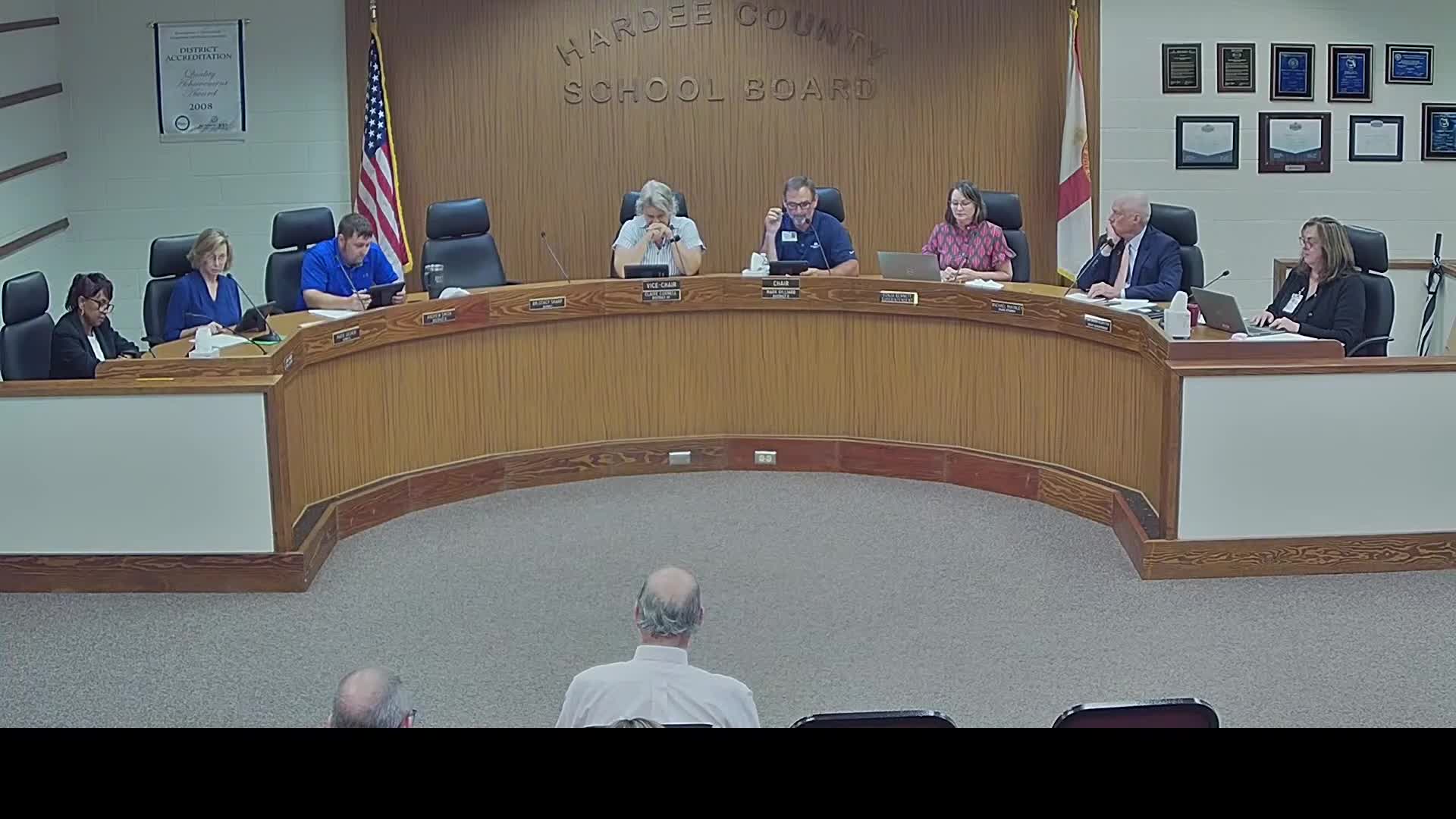
The Hardee County School Board voted 4-1 on June 9, 2025, to approve a package of employee health-plan changes and a memorandum of understanding (MOU) with HEA United covering plan design for plan year 2025–26. The board approved a proposed PY2025-3 plan option that includes an employer HRA seed of $1,200 applied prior to the deductible, an option permitting 50% carryover per year of remaining HRA credit (up to the plan deductible), and increased district funding effective Oct. 1, 2025. The MOU eliminates the current EBHRA offering of a $1,200 HRA to eligible employees who decline district medical coverage.
The motion was made by board member Claire Cornell and seconded by Stacy Dasher. Votes were recorded individually: Dasher, Cornell, Dr. Stacy Sharp and the board chair (unnamed in the transcript) voted yes; Mr. Smith voted no. The board chair announced the measure passed 4–1.
Board discussion focused on plan design details, employee impacts and implementation logistics. Board members and staff discussed three plan options presented by staff and consultants: a higher-premium “buy-up” option; a middle/base plan with a higher deductible; and a lower-premium “buy-down” option with a higher deductible and higher employee cost-sharing. Darren (staff/consultant) and Mr. Bridal (consultant) explained the modeling and funding recommendation. Mr. Bridal said the district is recommending funding at the 90th percentile of expected claims to reduce the risk of midyear supplemental funding, and described implementation mechanics for a tobacco-user surcharge and tobacco-cessation reconciliation: “When you're self funded, you do have the ability to to modify your plans and modify your rates,” he said, adding that the ACA allows up to a 50% surcharge on nicotine users and that the committee could start with an attestation model and offer refunds after completion of a cessation program.
Board members pressed staff on several items: whether a tobacco surcharge would be included (staff and consultants said it could be added and recommended an affidavit/attestation to start), whether the district could allow full carryover of the $1,200 HRA (staff said HRAs are employer-owned and the choice rules can be set by the district; finance follow-up was suggested), and how projected employee contributions would change under the new rate models. Staff and consultants provided sample monthly contribution figures for family coverage discussed in the meeting materials and on the record: figures discussed included a most-expensive family monthly contribution of $1,172.91 and a lowest-option family contribution of $779.68 (presented as projected examples by staff). Board members emphasized the need for substantial employee education on options.
Board members also noted the insurance committee had recommended the package by a 5–0 committee vote after months of work. Several board members said the committee’s unanimous recommendation was influential in their deliberations; others asked for additional employee outreach. Counsel and staff discussed timing constraints related to contract provisions and open-enrollment deadlines; staff warned that tabling the item past an agreed deadline would forfeit an ability to enforce a provider performance guarantee in the vendor contract.
Why it matters: The action adjusts district funding levels and plan design for the 2025–26 benefit year, changes the EBHRA arrangement for employees who decline district medical coverage, and introduces programmatic options (carryover rules, tobacco surcharges, three plan tiers) that affect employee costs and district budgeting. The vote reflects both financial risk management (funding to the 90th percentile) and bargaining/administration choices that will require follow-up communications and potentially committee-level changes for issues raised by members.