Get Full Government Meeting Transcripts, Videos, & Alerts Forever!
Get email alerts on the Air Service Development topic
No spam. Unsubscribe anytime.
Committee backs $150,000 contribution to airport development fund to attract new service
Summary
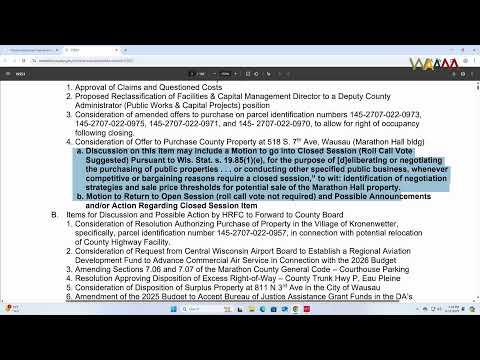
Marathon County committee voted to forward a $150,000 request for the Central Wisconsin Air Service Development Fund to the full board for the 2026 budget. The fund would be part of a roughly $500,000 package to offer minimum revenue guarantees to airlines seeking new routes to Central Wisconsin Airport.
Marathon County’s infrastructure committee on [date not specified] voted to forward a request to include $150,000 in the 2026 county budget to help seed a Central Wisconsin Air Service Development Fund, intended to make the airport more competitive when airlines consider new routes.
The fund would be paired with contributions from Portage County and private and business donors to create about $500,000 in local incentives. The airport’s assistant director for finance, David Droz, told the committee the fund would be used for a minimum revenue guarantee (MRG) program that reimburses airlines if a new route underperforms against a negotiated revenue target.
“The program does work,” Droz said, describing a prior local incentive that helped bring service to the market but ended when the carrier — Avelo Airlines — withdrew for business reasons. “Today we’re asking $150,000 to be budgeted for in 2026 for this fund to basically keep our competitiveness up.”
Why it matters: County leaders said stronger air service supports regional employers and makes the area more attractive to workers and visitors. Airport officials said the region currently “leaks” about 70% of travelers to other airports and lacks the flight frequency employers seek. The airport estimates an initial $500,000 investment could generate roughly $3 million in annual economic impact based on FAA and consultant figures.
How it would work and the risks: The MRG is intended as a temporary, 12–24 month safety net that covers a revenue shortfall versus a target agreed with an airline. Droz said some airlines decline to accept subsidy terms or the required reporting; others accept if community partners offer landing- or rent-fee waivers and marketing support. The Federal Aviation Administration updated guidance in 2023 clarifying how communities can structure such incentives.
County Administrator Leonard and airport board chair Vice Chair Dickinson described plans for governance and oversight: the airport would use landing-fee and rent waivers where allowed, and a third-party accounting firm, Synergy, would handle fund accounting and reporting to ensure transparency.
Committee members pressed on durability and accountability. Supervisor Lemmer said neighborhood feedback raised sustainability concerns: “Is this a one-time ask? And if so... what happens when the fund is depleted?” Droz and Administrator Leonard said there is no fixed long-term commitment; future contributions would require separate county action. Leonard described several options for structuring payouts (per flight, per month, or other measures) to limit payouts and stretch funds.
The motion forwarded a $150,000 allocation to the full County Board; committee members approved the request, and the record shows the motion carried, though the vote was not unanimous.
Dissent and remaining questions: Committee discussion made clear the funding is a risk: there is no guarantee a carrier will commit even with incentives, and if service leaves later the community may not recoup funds. Droz said some airlines have said a much larger amount would be needed in other markets, but he believes $500,000 is a reasonable starting point for Central Wisconsin.
The next step is a County Board vote on the 2026 budget to decide whether the $150,000 will be included. Airport staff said they will continue private fundraising and outreach to Portage County and local business partners.