Get Full Government Meeting Transcripts, Videos, & Alerts Forever!
Get email alerts on the Budget Customs Quarantine Agency topic
No spam. Unsubscribe anytime.
Guam lawmakers hear Customs and Quarantine Agency request for $22.3 million; agency presses staffing, equipment and modernization needs
Summary
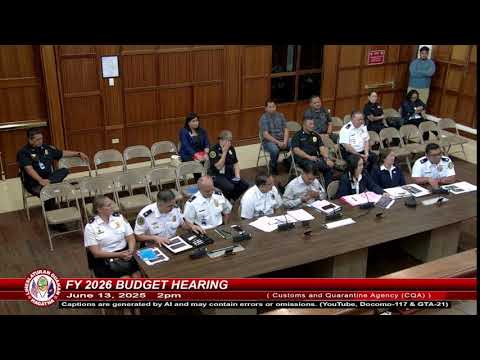
Hearing: The Committee on Finance and Government Operations convened June 13, 2025, at the Guam Congress Building to review Bill 44‑38 COR, an omnibus fiscal‑year 2026 appropriations measure that includes the Customs and Quarantine Agency (CQA).
Hearing: The Committee on Finance and Government Operations convened June 13, 2025, at the Guam Congress Building to review Bill 44‑38 COR, an omnibus fiscal‑year 2026 appropriations measure that includes the Customs and Quarantine Agency (CQA). Director Ike Pareto and senior CQA staff presented the agency’s FY2026 budget request and answered senators’ questions about staffing, seized narcotics and several modernization projects.
The most important takeaway: CQA asked the committee to fund a base FY2026 budget of $22,331,749 (a mix of general and special funds) and submitted supplemental requests of about $2,857,891 for items including a grant match, baggage X‑ray replacements, additional canines and completion of an automation phase. Director Ike Pareto said the agency remains understaffed and requires equipment and facilities funding to meet core border, public‑health and trade‑facilitation duties.
Why it matters: CQA enforces local and federal laws at Guam’s ports of entry, processes passengers and cargo, and operates biosecurity and drug‑detection units. Senators pressed the agency on how budget choices affect public safety (notably drug interdiction), staffing shortfalls, and whether congressional or federal grant dollars identified for projects have actually reached the agency.
Budget totals and supplemental requests: Pareto told the committee the FY2026 base request combines $14,680,116 from the general fund with $7,651,633 from the Customs Inspection Services special fund for a total request of $22,331,749. He identified supplemental items outside that base request totaling about $2,857,891, including: - $170,025: local match for the Port Security Grant (to secure federal grant funding); - $200,000: additional baggage X‑ray machines at Antonio B. Won Pat International Airport; - $150,000: maintenance and veterinary care for additional canines; - $251,253: increased rent caused by a tariff increase at the airport authority; - $1,300,000: completion of Phase 3 of CQA’s automation/modernization project (previous ARP funding was reallocated after a delayed contract); - $150,000: radio equipment to integrate CQA with the island’s SmartNet public safety radio network; - $636,612: funding for 10 additional customs trainee positions (to supplement 10 FTEs already in the budget). Pareto said the agency’s total supplemental ask was approximately $2.86 million.
Staffing, recruitment and retention: Pareto reported CQA currently has 128 sworn customs officers and described an “optimum” target of roughly 300 uniformed officers; at present the agency is approximately 43% of that optimum. Pareto said 45 trainees are in the current academy cycle and that anticipated graduations would bring staffing to “just over 58%” of optimum. He also said the agency has roughly 16 support staff (with an internal optimum of at least 30). Pareto and staff told senators the FY2026 salary and benefits increases shown in the request reflect recruitment, promotions and higher retirement and health‑insurance costs.
Special funds, collections and recent use: Committee members and CQA staff discussed the Customs Inspection Services Fund. Senators were told the agency recorded a special‑fund surplus from FY2024 of about $981,971; that excess was transferred to CQA and used for vehicle purchases, funding for 10 trainees and to pursue procurement of handheld backscatter devices. Senate staff referenced BBMR (Bureau of Budget and Management Research) tracking that projects the Customs Inspection Services Fund collecting roughly $7.9 million in FY2025.
Alleged diversion of special‑fund revenue: Senator Rohan (as identified in the hearing record) asked CQA about a widely reported diversion of roughly $8 million from the customs special fund in 2017. Director Pareto said he understood about $8 million was removed from the customs special fund in 2017, and both he and Chief Vince Parish told the committee CQA lacked documentation on where those funds ultimately were moved. Pareto and other senators said recovery or replenishment would require appropriation action and coordination with the Department of Administration, BBMR and the governor’s office.
Drug interdiction, seizures and prosecutions: Pareto outlined FY2025 interdiction figures the agency reported to the committee: significant methamphetamine seizures (reported as roughly 104,547 grams), fentanyl (reported around 1,278 grams), cocaine (about 1,014 grams) and marijuana (2,777 grams). Pareto said biosecurity and intellectual property seizures were also substantial; the agency reported thousands of counterfeit items seized and large totals of agricultural products intercepted for biosecurity reasons. Senator Barnett thanked CQA for those seizures and said the fentanyl quantities reported “would have killed, three times over our entire population,” language he used in the hearing record.
On prosecutions, the committee was told that many narcotics cases are handled with federal task‑force partners and remain under sealed docketing; Chief Vince Parish and staff said they would provide the committee with prosecution and conviction figures that are releasable.
Canine program and opioid‑settlement funding: CQA described an 18‑dog detector‑dog program funded in part by opioid settlement money secured through the Office of the Attorney General. Pareto and Assistant Chief Franklin Gutierrez said CQA has received an initial nine canines through the settlement funding (with five assigned to CQA, two to the Department of Corrections and two to the Guam Police Department) and expects a second phase of dogs. Gutierrez told the committee, “there’s usually five items that we train on: methamphetamine, cocaine, marijuana, ecstasy, and then heroin.” Committee members asked about long‑term veterinary care and kennel maintenance; staff said ongoing care is funded through a mix of federal subrecipient support and agency budgets, and that CQA will continue to pursue federal grants and AG office support for sustainment costs.
Port facility architecture & engineering (A&E) funding: Senators asked about a $2 million congressional community‑project appropriation that Congressman James Moylan secured for CQA to fund A&E for a proposed customs satellite inspection, holding and secured sterile facility at the Port of Guam (the parcel is identified by statute). CQA staff said the $2 million award had been appropriated by Congress but that the funds must pass through a federal grant process and have not yet been transferred to the government of Guam; CQA said staff are working with the designated federal grant agency to meet the transfer requirements.
Rent at the airport and FAA constraints: Committee members pressed CQA about the agency’s rent obligations at Antonio B. Won Pat International Airport. CQA said rising airport tariffs drove a supplemental rent request of about $251,253. Senators and staff discussed the government’s ability to seek an FAA exemption for CQA rent because CQA is a local agency providing essential port services; officials noted that any exemption would need FAA agreement and could affect airport federal grant eligibility. Senator Lejuan said the Legislature is pursuing FAA conversations and possible congressional assistance to clarify or seek relief from rent charges that apply to non‑federal tenants.
Modernization plans: Pareto outlined multiple modernization items: a Phase‑3 automation project (requested at $1.3 million), replacement and additional baggage X‑ray/backscatter units for the airport, a SmartNet radio integration request ($150,000), port CCTV purchases (CQA indicated an initial phase in the low hundreds of thousands), and the creation of an unmanned aerial vehicle (drone) unit to extend surveillance capability. Pareto said one driver of the automation funding request was the loss of prior ARP funds after a contract was not executed in time.
Process, timelines and next steps: CQA told the committee it expects to graduate and integrate 45 new officers and to pursue reestablishment of an Andersen Air Force Base satellite section within months as base repairs conclude and activity increases. The agency said it is finalizing proposed administrative rules to update customs clearance procedures and the CQISC fee schedule; those rule‑making processes will follow required stakeholder hearings (Administrative Adjudication Act procedures) and may require legislative action if fee or statutory changes are necessary.
Committee action: The committee recessed after questioning and closed the hearing after accepting CQA testimony. Chair Senator Christopher M. Duenas said the committee will continue to accept written testimony on Bill 44‑38 COR for seven calendar days following the hearing.
Ending: CQA’s presentation underscored persistent staffing shortfalls, a multi‑million dollar base request and supplemental needs for equipment, personnel and modernization. Senators repeatedly asked CQA to provide additional written detail on benefit‑cost breakdowns, prosecution figures that can be released, and the status of federal grants and the $2 million A&E appropriation. The committee record shows ongoing follow‑up will be required before final appropriations are determined for FY2026.