Get Full Government Meeting Transcripts, Videos, & Alerts Forever!
Get email alerts on the Energy Gisa topic
No spam. Unsubscribe anytime.
City seeks council OK for Guaranteed Energy Savings project for 14 municipal buildings; prime vendor pledges diverse subcontractor participation
Summary
The administration and the Philadelphia Energy Authority sought council clearance to proceed with a GISA (Guaranteed Energy Savings Act) project for 14 municipal buildings, selecting Johnson Controls after an RFP; the project aims to fund upgrades via energy savings, and PEA/JCI pledged more than 50% participation by diverse business enterprises.
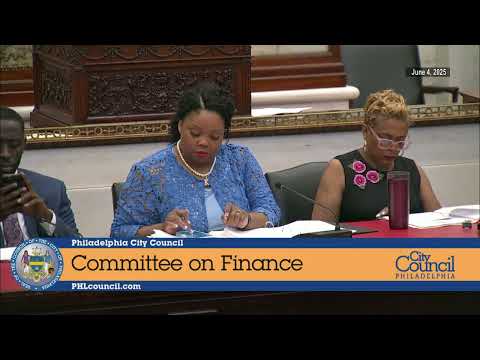
City sustainability officials and the Philadelphia Energy Authority urged the finance committee to advance an ordinance (bill 250103) that would allow PEA to execute a Guaranteed Energy Savings Act (GISA) contract to retrofit 14 municipal buildings — the Quadplex (City Hall, Municipal Services Building, One Parkway and the Criminal Justice Center), seven city health centers and three homeless services facilities — using energy savings to pay for improvements over time.
Project leaders said the energy services company selected through a competitive RFP process is Johnson Controls Inc. (JCI). Dominic McGraw of the Office of Sustainability and Emily Shapiro, president and CEO of the Philadelphia Energy Authority, described the package as a turnkey approach: JCI will perform audits, design and build energy measures and be paid through guaranteed energy savings embodied in the GISA framework. Improvements would include lighting, HVAC, electrical systems and window upgrades with the stated goals of lowering operating costs, improving resilience at critical sites, and creating opportunities for minority- and women-owned businesses.
Shapiro said JCI committed to about 50.5% participation by certified minority- and diverse business enterprises (DBEs) across the project; the Office of Economic Opportunity participated in early procurement planning and set a target range of 30–50% in the RFP. PEA will enforce Economic Opportunity Plan (EOP) provisions and convene a quarterly oversight committee to review subcontracting and workforce participation. Council members asked for procurement dates and the subcontractor bid list; PEA said the investment-grade audit is nearly complete and subcontractor lists are being finalized by the prime contractor and will be shared once contract negotiations conclude.
Committee members asked whether any city capital would be required up front. Shapiro and McGraw said GISA projects typically require no upfront city budget because guaranteed energy savings and operational savings are structured to pay for capital and associated financing over a contract term (maximum 20 years). The administration said some items with weak energy payback may require separate capital contribution decisions by department budgets on a case-by-case basis.
Council members also pressed for details about minority participation timing and the RFP schedule; PEA agreed to provide the RFP date, selection schedule and the timeline for financing authorization, and said construction could run roughly from late 2025 through 2027 once financing is approved.
Committee members did not vote on the ordinance at the hearing. The administration asked the committee to approve the legislation and to suspend rules so financing could be authorized in the fall.