Get Full Government Meeting Transcripts, Videos, & Alerts Forever!
Get email alerts on the Transportation Depot topic
No spam. Unsubscribe anytime.
Springfield Township SD capital assessment recommends replacing bus depot; staff to study propane and other fuels
Summary
A capital assessment rated the district's transportation depot above the renovation threshold and recommended replacement. Staff said electric buses are not feasible now and said propane and alternative fuel options will be investigated; a follow‑up report is planned for fall 2025.
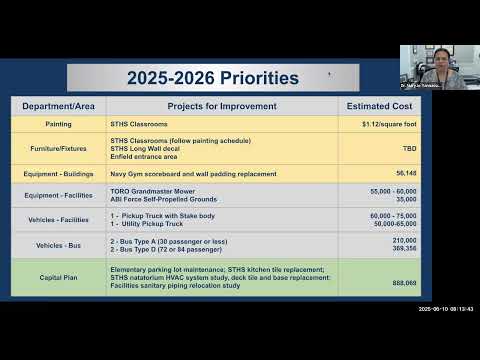
Property Committee members discussed the transportation depot and alternative fuels during the same June 10 meeting where staff presented the five‑year operational plan. The district’s capital assessment rated the depot at 92.4 percent and recommended replacement rather than incremental improvements. The assessment estimated site improvements at about $3,100,000 and a full renovation at about $3,400,000.
Staff described the depot’s existing constraints: a compact footprint composed of multiple adjoined sub‑buildings, limited bus maneuvering space that forces backing during fueling, and aging infrastructure. Possible remedies under study include reconfiguring the building footprint on the current site to allow drive‑through fueling, exploring a two‑story configuration to gain footprint, and redesigning the site to support fueling and maintenance operations more safely and efficiently. Staff said further study is needed before recommending a replacement approach.
On alternative fuels, staff said electric buses are not recommended at this time because of infrastructure limitations, uncertain federal support for grants, and significantly higher upfront costs. Instead, staff described propane as an interim alternative worth investigating: nearby districts have adopted propane for smaller buses, and staff are monitoring industry developments for full‑size propane options. Staff noted that, as of the meeting, manufacturers did not yet offer a rear‑engine, 84‑passenger propane bus that matches the district’s preferred rear‑engine configurations. That constraint could affect whether the district orders propane or maintains diesel for certain vehicle classes.
Transportation staff said they will investigate facility impacts (for example, propane storage and fueling infrastructure), operational costs and safety procedures, and will report back to the property committee in the fall of 2025. Committee members asked staff to continue exploring propane as well as charging and fueling needs for any transition, and to bring a recommendation before the next major vehicle procurement so the district does not purchase diesel buses and then shift fuel platforms prematurely.
No formal action was taken at the meeting; staff sought direction to continue study and to return with a more detailed report on fuel options and depot alternatives.