Get Full Government Meeting Transcripts, Videos, & Alerts Forever!
Get email alerts on the Vision Zero topic
No spam. Unsubscribe anytime.
Committee adopts City of Milwaukee Vision Zero action plan, aims to cut traffic deaths on a 9% high‑injury network
Summary
The Public Safety and Health Committee voted to approve the City of Milwaukee Vision Zero Action Plan, a community‑driven blueprint with 100 actions targeting streets and systems changes to eliminate traffic deaths and serious injuries.
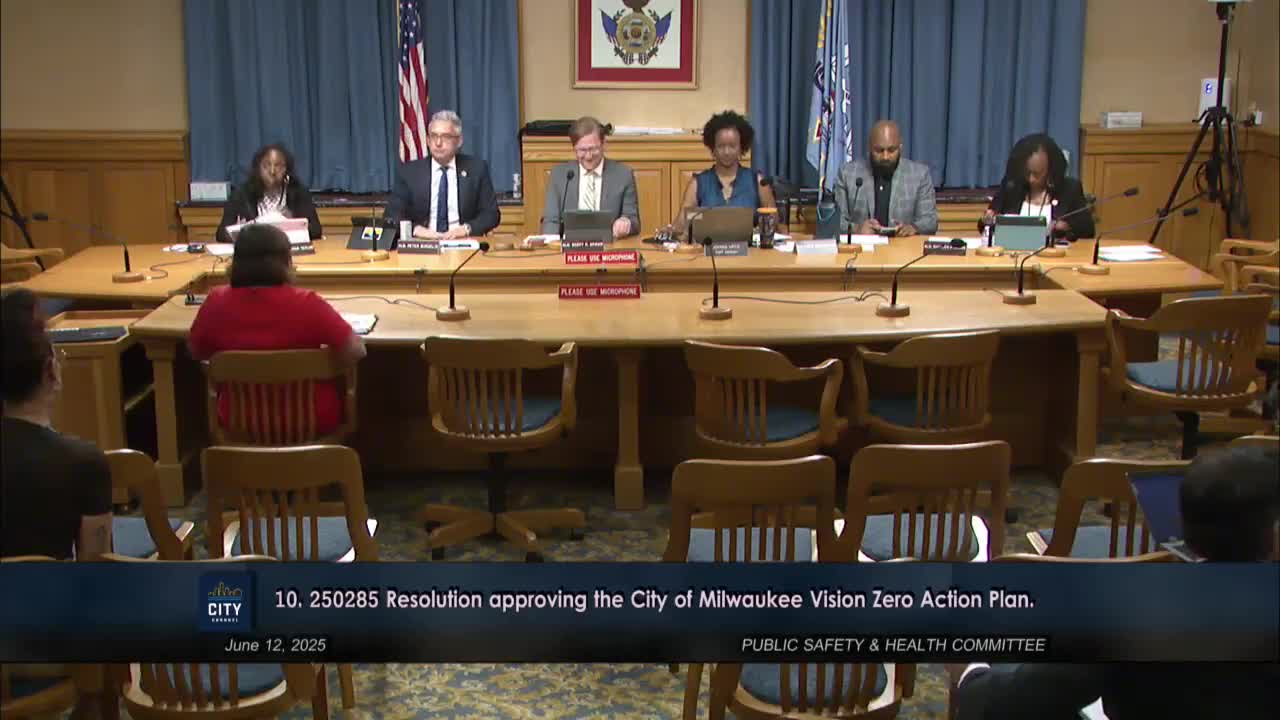
The Public Safety and Health Committee on June 12 approved the City of Milwaukee’s Vision Zero Action Plan, a community‑crafted strategy that sets a goal of eliminating traffic deaths and serious injuries and prioritizes safety improvements on a compact high‑injury network.
Jessica Weinberg, the city’s Vision Zero policy director, told the committee the plan centers on seven goals and roughly 100 recommended actions — from redesigning streets on the high‑injury network to advocating for state authorization of automated traffic‑safety cameras and improving post‑crash medical care. Weinberg said about 9% of Milwaukee’s streets account for roughly 59% of the city’s serious injury and fatal crashes and that targeted interventions can yield outsized benefits.
Why it matters: The plan recommends engineering, enforcement, education and policy changes to reduce vehicle speeds and protect people walking and biking, who face much higher rates of severe injury when involved in crashes.
Key plan elements and next steps The plan’s seven themes are: build safe streets for all with a focus on the high‑injury network; support accountability with prevention‑oriented court options; reimagine streets as people places; expand education and culture change; ensure timely EMS and medical care; advocate for safer vehicles at the federal level; and champion state law changes such as enabling cameras for speed enforcement.
The committee adopted the plan and sent it to the full Common Council for final approval. Weinberg proposed oversight through a community advisory committee and a mayoral Vision Zero work group to shepherd implementation, plus regular data monitoring and public reporting. She described community engagement of nearly 2,000 participants in two rounds of outreach.
Discussion points and committee reaction Members asked how the high‑injury network is updated, how enforcement resources might be targeted to those corridors, and whether reconstruction projects would remove streets from the network. Weinberg said DPW and MPD coordination and clearer data‑sharing would help target deployments and that DPW takes before‑and‑after measurements on major projects.
Aldermen emphasized the potential role of automated enforcement, noting national evidence of substantial crash reductions where cameras are used; Weinberg said state law currently limits local use and that the plan calls for state authorization. The committee approved the resolution to adopt the plan with no recorded objections.
Ending note Weinberg said the plan’s 12‑year target horizon allows staged implementation and urged continued collaboration among departments, community groups and the council to measure progress and pursue the state law changes and federal vehicle safety advocacy called for in the document.