Get Full Government Meeting Transcripts, Videos, & Alerts Forever!
Get email alerts on the Housing Transient Vacation Rentals topic
No spam. Unsubscribe anytime.
Maui Mayor and council hear hours of testimony as Bill 9 — phase-out of short-term rentals in apartment zones — moves through committee
Summary
Maui County leaders and dozens of residents spent more than six hours debating Bill 9 on June 9, a proposed ordinance to phase out transient vacation rentals in apartment‑zoned complexes.
Maui County leaders and dozens of residents spent more than six hours debating Bill 9 on June 9, a proposed ordinance to phase out transient vacation rentals (TVRs) in properties located in apartment‑zoned districts.
Mayor Richard T. Bisson Jr. urged the Housing & Land Use Committee to move the measure forward, saying "the urgency of this moment demands action" and framing the proposal as a way to "preserve our community." The mayor and his team said the administration’s version of Bill 9 (CD1) includes a three‑year amortization period for existing TVR operations in affected apartment zones and that owners who wish to remain in the market could seek re‑zoning to hotel districts.
Why it matters: Administration officials and housing advocates said returning legally used TVR units to longer‑term residential occupancy could add thousands of homes where the housing shortage is most acute — particularly West and South Maui — and thereby lower carrying costs and reduce displacement of workers and families. Opponents — including property owners, managers and representatives of the vacation‑rental industry — warned of large near‑term economic losses, job cuts and litigation risk if the county phases out legal TVRs.
The administration presentation and fiscal numbers Marcy Martin, Director of Finance, told the committee that county property‑assessment data show roughly 6,000 properties on the county’s TVR/minutoria list would be affected and estimated an annual decline in real‑property tax revenue in fiscal 2026 of roughly $40 million to $75 million depending on how units reclassify. "The department currently estimates an overall reduction of about $61,000,000," Martin said, and UHERO’s independent modeling produced a similar mid‑range figure. Martin and other administration speakers said the shortfall could be absorbed or partially offset with targeted tax adjustments and that the county has consistently dedicated more than the charter minimum to the Affordable Housing Fund.
The administration also cited UHERO’s March 2025 report and internal data showing many affected units are one‑ and two‑bedrooms and, in their view, suitable for local households. Executive Assistant Matt Jokowski told the panel that converting TVRs in apartment districts into resident housing could reduce condominium carrying costs in model scenarios — citing UHERO projections that condominium carrying costs might fall for some units.
Planning and enforcement: what the county can and cannot do Deputy Director of Planning Anna Lillis (as introduced in the presentation) discussed enforcement of illegal TVRs and the county’s contracted monitoring tools. She told the committee that the county’s vendor software and zoning inspectors had identified only about 30 enforcement cases for illegal TVRs from their internet‑search contract and that as of January 2025 there was one new illegal‑TVR case noted in that monitoring program. "Continuous monitoring of transit vacation rental advertisements remains a high priority for the department and it is working, but it has not led to a great deal of enforcement cases in actuality," Lillis said.
Public testimony: profound division across the island More than 50 members of the public testified at the hearing. Testimony split sharply. Several speakers who identified themselves as displaced Lahaina residents, housing advocates and representatives of community groups urged the council to pass Bill 9, saying returning units to long‑term use would produce housing quickly and help victims of the August 2023 fires. Jordan Hawker of the Maui Housing Hui said research shows a correlation between short‑term rental saturation and higher rental prices; she told the committee that phasing out TVRs would release units into the long‑term rental pool where demand is highest.
Supporters repeatedly tied the proposal to cultural and community preservation. Testifier Sioné Jacinto, a Napili resident, said the county could "rewrite that history and protect its own greatest asset, its people," and Kiʻinani Kahohanohano noted that families displaced by disaster must be prioritized to keep communities intact.
Opponents included many owners, property managers and workers whose incomes depend on short‑term rentals. Testifiers described dramatic drops in revenue since the fires and warned of layoffs and contractor losses if demand falls further. Erin Kelling, a local property manager who said her company employs 17, told the committee the proposal has already depressed business and that many workers cited threats and intimidation arising from the debate. Several owners said their units carry high mortgages, insurance, HOA fees and special assessments that make conversion to long‑term rents infeasible; some owners said their complexes were marketed and sold as legal short‑term units.
Economic and water impact arguments The administration argued the phase‑out would also improve water availability. In the presentation a comparison of sister properties suggested TVR‑dominated complexes used substantially more water per unit than resident‑occupied complexes; the administration said converting TVRs could free supply for additional domestic housing projects. Opponents questioned how quickly that water could be redeployed for new construction and warned that phase‑out‑related revenue declines could harm the county’s ability to fund infrastructure and housing programs.
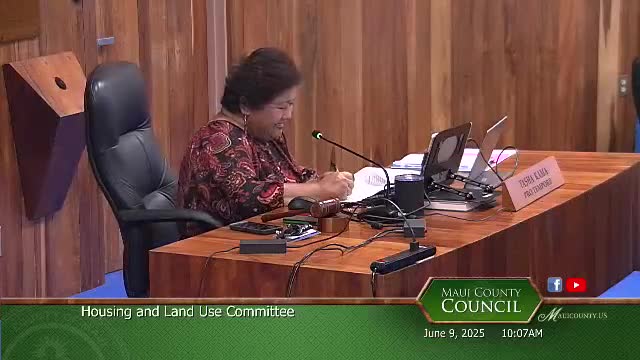
Process and next steps Committee Chair Tasha Kama said the committee will continue to accept testimony and expects extended public comment; she scheduled a recess and a continuation meeting, asking the public to maintain decorum. No vote was taken during the June 9 session. The committee recessed with an announced continuation of testimony and a formal reconvening of the Housing & Land Use Committee on June 18 at 9:00 a.m. in the same chamber and online. The chair also announced planned recesses for lunch and breaks to manage an expected large volume of testimony.
What is unresolved Committee members and staff were pressed repeatedly for additional details: specific implementation mechanics, how many units might realistically become affordable housing vs. be sold or held off‑market, whether deed restrictions or buyouts would be feasible, the county’s exposure to lawsuits, and what offset or transition programs would support small owners and workers. Administration officials said targeted tax policy, mitigation programs and enforcement would be part of a broader strategy but offered no final funding plan at this meeting.
Where this stands: the committee will accept further testimony at follow‑up meetings and has not taken formal action. The public record now includes presentations from the mayor’s office, finance and planning staff, the UHERO report cited by the administration, and dozens of public comments from both homeowners and housing advocates.