
Payson council narrows FY26 personnel increases, seeks to 'bend the curve' on rising payroll costs
Get AI-powered insights, summaries, and transcripts
Sign Up Free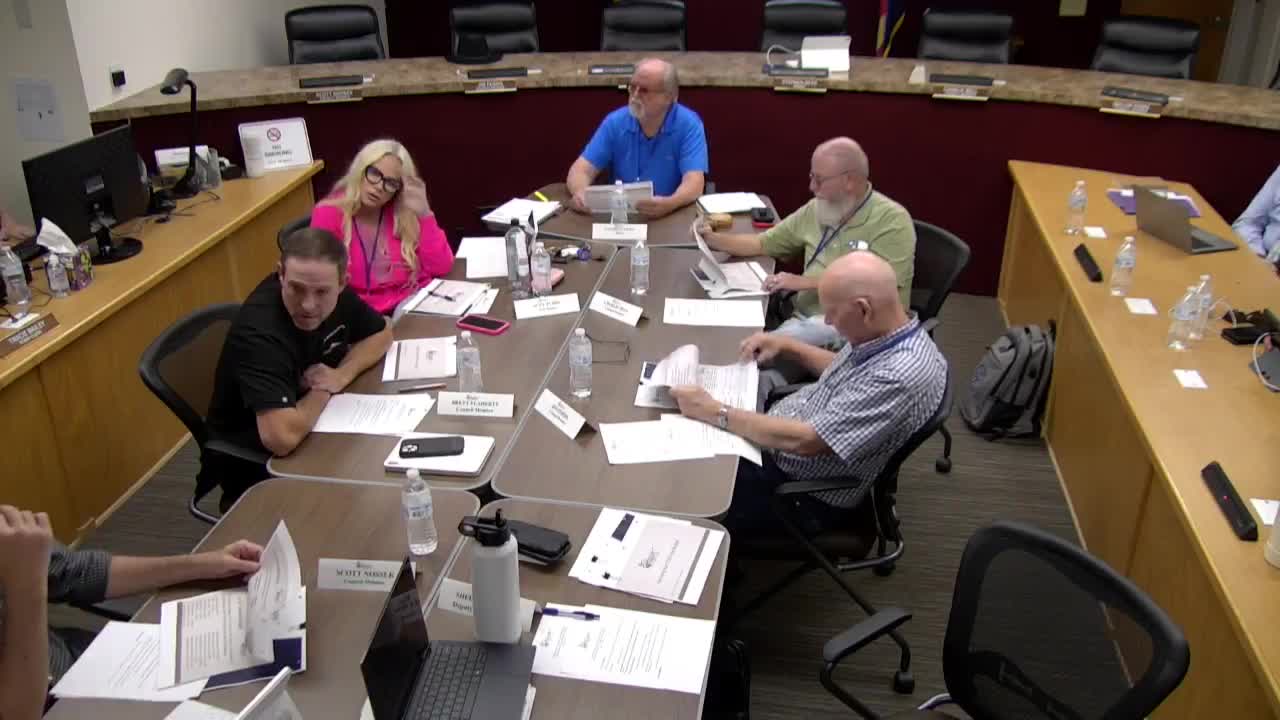
Summary
At a June 3 work study, Payson staff presented options to reduce FY26 personnel cost growth. Council signaled informal consensus for a middle option that trims projected salary range adjustments and merit increases while preserving public-safety pay competitiveness and retaining hiring flexibility for critical roles.
The Payson Common Council on June 3 reviewed staff recommendations to reduce projected personnel-cost growth in the town's proposed fiscal year 2026 budget and signaled informal support for a middle-path plan to reduce the rate of pay growth.
Staff presented three personnel scenarios: the tentative budget baseline (Option 1), a moderated package staff flagged as the staff'preference (Option 2), and a hold-or-freeze package with no market or merit adjustments (Option 3). Each scenario reduces payroll growth to different degrees; staff estimated Option 2 would lower the budgeted increase enough to produce roughly $696,000 in savings compared with the tentative budget, while Option 3 would produce larger savings (about $1.2 million) but risk sharper employee retention impacts.
The discussion emphasized that personnel is the largest recurring cost in the general fund (staff estimated roughly 74% of general fund spending is personnel-related) and that an unresolved structural gap between revenues and expenditures creates risk for FY27. Council members and staff repeatedly framed the question as how much growth to allow this year so the town does not face more severe cuts next year.
Councilmembers repeatedly stressed protecting public safety staffing while trimming elsewhere. Staff said police and fire together account for a large share of personnel dollars and noted that some public-safety step plans produce higher year-over-year increases for lower-paid ranks while capping top-end pay to aid recruitment and retention. Fire and police leadership told the council that a one-year moderation in pay increases would likely affect retention depending on how the change is framed and communicated; the chiefs said recruitment is still competitive but retention could worsen if employees feel undervalued.
Council discussion moved from abstract percentages to operational effects: staff said an administrative hiring freeze (not filling certain vacancies through attrition) could yield about $1 million in one-time savings, but managers warned that leaving some positions unfilled would reduce service levels and, in certain cases, would require relying on external agencies for backup or contract staff. Several council members urged targeted freezes that avoid reducing front-line public-safety hours.
By the end of the session staff reported informal council consensus for Option 2 (moderated range adjustments and a 2% merit band with a smaller employment-cost-index adjustment than the tentative budget). Council also directed staff to return specific line-item analyses and a list of which authorized positions would remain vacant under a temporary hiring freeze. No formal vote was recorded at the work session.
What happens next: staff said the council can still adjust the final budget before adoption; the deadline for adopting the final budget and property-tax levy approaches in late June. Councilmembers asked for at least one additional budget work session to review follow-up numbers before final action.
Ending: Town staff will prepare an apples-to-apples comparison of actual personnel costs (historical actuals) and the three options for FY26, and will return to council with clarifications on operational impacts of targeted freezes and communications steps to mitigate retention risk.