Get Full Government Meeting Transcripts, Videos, & Alerts Forever!
Get email alerts on the Gaza Humanitarian topic
No spam. Unsubscribe anytime.
UN warns Gaza aid deliveries remain a ‘trickle’; calls for immediate restoration of unimpeded humanitarian access
Summary
The UN described catastrophic shortages in Gaza, citing blocked crossings, looting, and displacement orders that have cut services for vulnerable people. The spokesperson called for a ceasefire, release of hostages and restoration of aid entry at scale.
The United Nations described a worsening humanitarian crisis in Gaza and urged immediate restoration of unimpeded, large-scale humanitarian access.
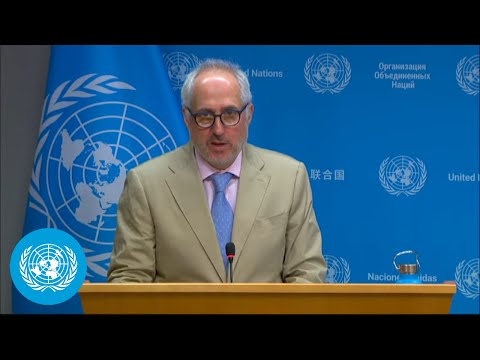
UN spokesperson Steph said civilians in Gaza are “risking and in several instances losing their lives just trying to get food,” and reiterated the secretary-general’s call for an “immediate, permanent, and sustainable ceasefire” and for the unconditional release of all hostages.
Steph and UN humanitarian partners pointed to bottlenecks at the Kerem Shalom (transcribed as Karim Shalom) crossing, which the UN said is the only crossing the Israeli authorities have allowed for aid into Gaza. The UN said it and partners submitted more than 1,200 precleared truckloads for Israeli clearance; roughly 940 truckloads were approved and sent from warehouses in Israel, about 620 reached the Palestinian side, and UN teams managed to collect and forward roughly 370 truckloads inside Gaza. The UN said it did not have visibility over parts of the pipeline because Israeli authorities have not allowed UN monitors at the crossing.
The spokesperson reported a sharp rise in child labor, early marriage and family separation driven by hunger, displacement and economic turmoil. She said about 1,000 women and girls lost access to services after a displacement order affecting four neighborhoods in Khan Yunis put roughly 45,000 people at risk of having to leave those areas.
Steph described the distribution system used in some places as “a death trap,” saying funnels and armed contractors moving food increase the risk to civilians. She called on Israeli authorities to allow the UN and partners to restart distribution under humanitarian principles of impartiality and independence.
The UN also said humanitarian movements requiring coordination with Israeli authorities are frequently denied; the spokesperson said 10 of 13 such coordination attempts were rejected recently, including requests to truck water to North Gaza and move fuel stocks.
In response to questions, the UN declined to tell civilians not to seek food in the absence of safe alternatives, saying it would be wrong to instruct people who are hungry not to try to obtain food. The spokesperson said the UN has “enough supplies lined up and ready to go close to Gaza,” but only limited amounts are reaching people due to conditions on the ground.