Get Full Government Meeting Transcripts, Videos, & Alerts Forever!
Get email alerts on the Downtown Investment Authority Reform topic
No spam. Unsubscribe anytime.
Councilors debate reforms to Downtown Investment Authority ordinance
Summary
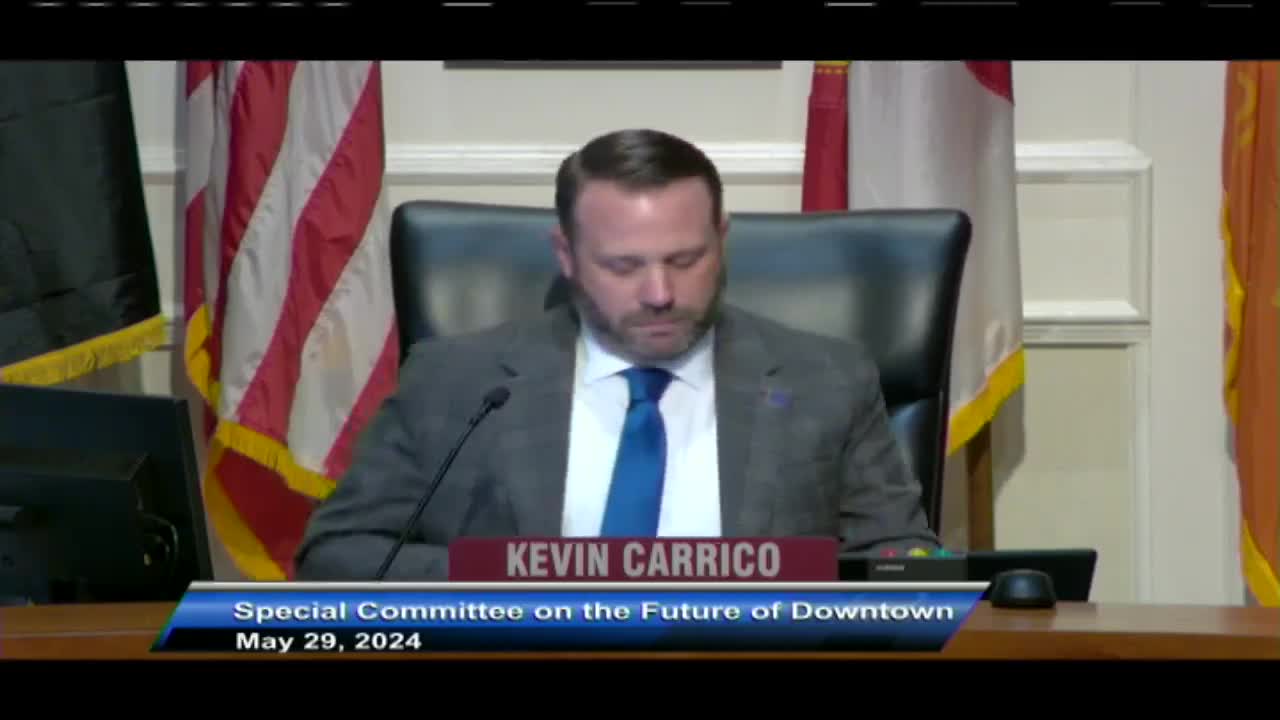
At a May 29 Special Committee on the Future of Downtown meeting, members reviewed ordinance 2025-395, a bill that would change governance and oversight of the Downtown Investment Authority (DIA), including new council confirmation and removal authority for the DIA chief executive officer.
At a May 29 Special Committee on the Future of Downtown meeting, members reviewed ordinance 2025-395, a bill that would change governance and oversight of the Downtown Investment Authority (DIA), including new council confirmation and removal authority for the DIA chief executive officer.
The legislation would allow DIA to request that the council president file legislation on its behalf; require city council confirmation of the DIA chief executive officer and permit removal of the CEO either by a majority vote of the DIA board or by a majority vote of the full city council; reduce the dollar threshold that triggers council approval for certain incentive packages; exclude redevelopment (rev) grants from that dollar threshold; extend the final year of eligibility for rev grants (described in the draft as changing the end year from 2045 to "02/1950"); and require DIA to submit a five‑year capital improvement plan with its annual budget submission. The draft also requests codification instructions and asks for a one‑cycle emergency passage.
"With autonomy comes accountability," Councilmember Joe Carlucci said while introducing the measure and noting the intent to speed deal review by allowing DIA to request legislation directly from the council president. Carlucci and other supporters from the committee argued the change will let DIA operate more nimbly while giving the council a formal check.
Several members expressed concern about adding council removal authority over a CEO. "What problem are we trying to solve with this legislation?" Patrick Kuchowski, chair of the DIA board of directors, asked the committee, saying the board sees itself as the body that manages and evaluates the CEO. Laurie Boyer, DIA chief executive officer, raised a timing concern: the board's planned panel interview for CEO candidates is set for June 9 and a requirement that a council confirmation occur before a contract could be executed might delay the start date and create a gap in leadership.
Councilmembers discussed compromise language. Councilmember Carlucci proposed a step that would require the council to first issue a resolution to the DIA board asking it to act on the CEO; if the board refused, the council could then act. "If the board acts or they don't act, then we would be able to act," Carlucci said, framing the idea as an added layer of review rather than immediate council control. Others suggested a supermajority threshold for council removal if a final decision to allow council removal remains in the ordinance.
The ordinance also would lower the threshold for incentives that must come to council from the previous figure cited by staff to $10 million for non‑rev‑grant packages (the draft peels rev grants out of the metric) and requires a five‑year capital improvement plan when DIA submits its budget. Staff noted the change aims to let DIA negotiate deals funded by CRA/TIF revenues without requiring repeated council approval while preserving council oversight on larger or general‑fund exposures.
Public commenter William Harrell asked the committee to consider DIA accountability and public access concerns tied to waterfront projects, citing the museum group he represents and a phased construction promise he said was not communicated to stakeholders.
No formal vote on ordinance 2025-395 was taken at the meeting. Committee members asked staff and DIA to draft compromise amendment language for the committee meeting next week, including options discussed on confirmation, removal thresholds and timing to avoid gaps in leadership. The committee chair said the measure will proceed to committee where additional amendments and legal review will be considered.