Get Full Government Meeting Transcripts, Videos, & Alerts Forever!
Get email alerts on the Behavioral Health topic
No spam. Unsubscribe anytime.
Claritel Behavioral Health tells DeKalb committee crisis center short staffed, seeks county support and housing pilots
Summary
Claritel Behavioral Health briefed the DeKalb County PECS committee on service volumes, a $2.8 million shortfall that limits its crisis unit to 24 of 36 beds, plans for a smaller new crisis center and a tiny-home pilot on county-owned land, and asked for continued county funding and partnership on homelessness planning.
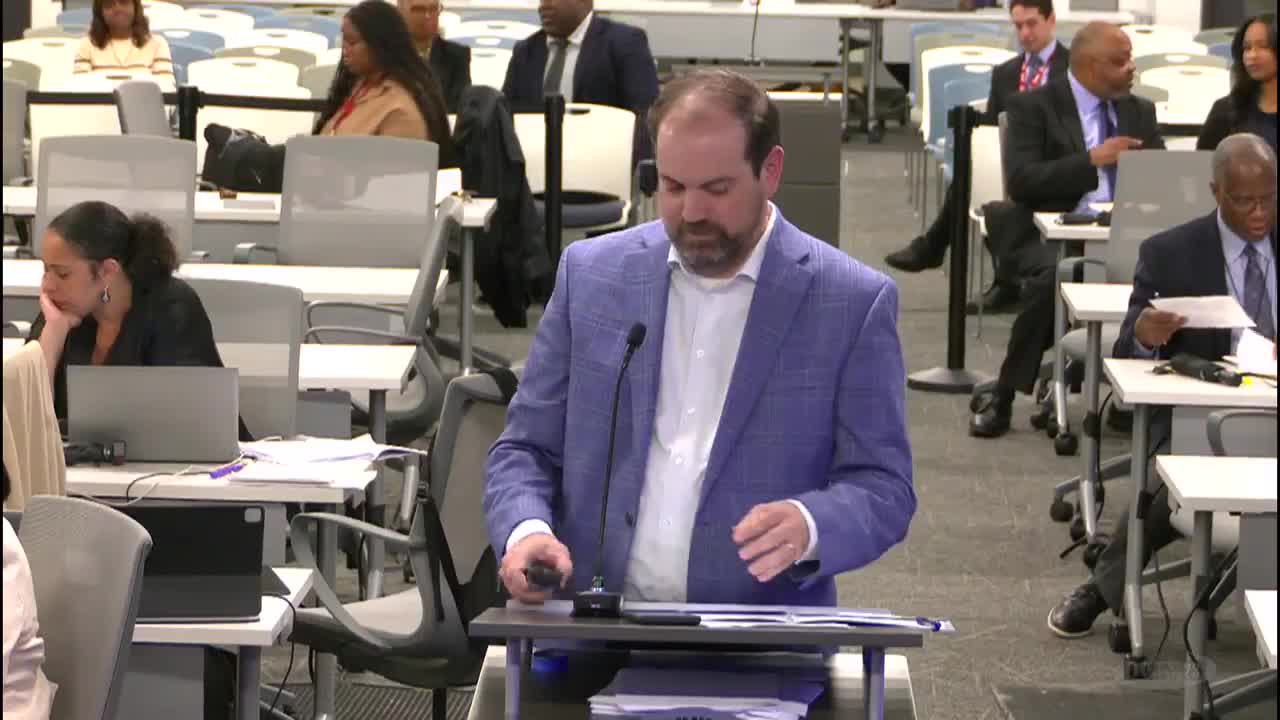
Claritel Behavioral Health updated the DeKalb County PECS committee on operations, capacity and funding shortfalls and described several proposals to expand housing and crisis services.
At the meeting, Claritel reported it is operating 24 of 36 licensed crisis-stabilization beds because of a funding deficit. Fabio, a Claritel representative, said the crisis center “has a deficit of $2,800,000 this year,” and that the organization estimates it would need roughly $4 million more to operate the full 36-bed capacity.
The agency described a two-part proposal for addressing capacity: build a smaller, new crisis center and renovate the existing facility to provide transitional housing. Fabio summarized the approach as a way to “still at least increase some capacity for transitional housing and have a new facility.” He told commissioners that the state did not appear likely to fund a larger expansion, so Claritel hopes to proceed with a smaller new center and repurpose the current building for housing supports.
Claritel also described a proposed tiny-home pilot called Glenfar Cottage on county-owned land on Glenfair Road. The plan would use about 1.5 acres to create 26 small units with on-site case managers and telehealth access as a rapid-rehousing/transitional option for people leaving the street or a crisis placement. Fabio said the project is designed to “keep the barrier of entry as low as possible” and provide 90–180 days of wraparound services before residents transition to longer-term housing.
The presentation included service and financing details. Fabio said Claritel served about 9,975 distinct individuals last year and provided roughly 212,000 services; 60% of clients had no insurance. Claritel’s FY25 budget was reported as about $44 million, with roughly 50.9% from state contracts, 30% from client fees, 7.3% from contracts with other agencies and about 7.2% from DeKalb County. Fabio noted that county support represented roughly 6.4% of Claritel’s funding and that the state contract rates had not materially changed for many years; recent adjustments improved drawdown rates but a funding gap remains.
Commissioners and staff asked for status updates on the East DeKalb facility, which Claritel closed last October because of mold. Fabio said mold remediation is complete and that facilities staff plan roof, window and HVAC repairs; he gave a timeline of roughly four months to reopen the site for some services but acknowledged long-term repairs would require additional funding. County staff confirmed about $450,000 had been approved toward repairs but said the total project estimate could be closer to $2 million and that more funds would be needed for full renovations.
Claritel highlighted other initiatives: expansion of co-responder teams that pair clinicians with police officers (Claritel currently supports three DeKalb County co-responder teams plus teams in Decatur and Doraville); an opioid-residential program for men at the Fox Center (24 beds, supported by a mix of county and state funds); a proposed opioid residential program for women; and a coalition-led unhoused planning process funded in part by $120,000 in one-time county funds. Fabio said Claritel has contracted a consultant to help develop the unhoused plan and is organizing a learning trip to Texas to visit large-scale providers that combine housing and services.
Commissioners expressed support and concern about funding continuity: members noted American Rescue Plan (ARP) funds awarded in prior years are now committed and emphasized the county should consider long-term funding to avoid rolling back services. Several commissioners urged continued partnership and tours of Claritel facilities to better understand operations and the potential savings from out-of-jail crisis care.
Claritel asked that the county continue to partner on funding and planning, and to consider county-owned land and other resources as part of housing solutions. The agency said it will share the unhoused plan, project proposals and periodic updates with commissioners as the work moves forward.